

U.S. Disables Cargo Ship Amid Iran Blockade Dispute
America ı By Michallie K Harrison
0 Comments

Key Takeaways
- U.S. Central Command announced that American forces struck and disabled the Palau-flagged M/V Pacific Archer in the Gulf of Oman on Nov. 26. CENTCOM alleges the civilian cargo ship attempted to violate the Iran blockade despite repeated warnings.
- CENTCOM says the strike disabled the ship's propulsion system without injuring its civilian crew. However, the military has not publicly released the warning communications or sufficient evidence to independently verify the crew's condition.
- A U.S. naval advisory issued Nov. 18 warned commercial vessels that failure to comply with blockade instructions could result in disabling or destructive fire. The Pentagon's law-of-war guidance establishes requirements governing naval blockades and the treatment of merchant vessels.
- The strike follows earlier incidents involving civilian shipping, including a June attack that killed three Indian seafarers. Those deaths underscore the importance of examining how military forces protect commercial crews during maritime operations.
- The Iran blockade remains part of a broader dispute over presidential war powers. The Senate rejected a resolution seeking the withdrawal of U.S. forces from hostilities with Iran on Nov. 19, but that vote did not constitute a separate authorization for the Pacific Archer strike.
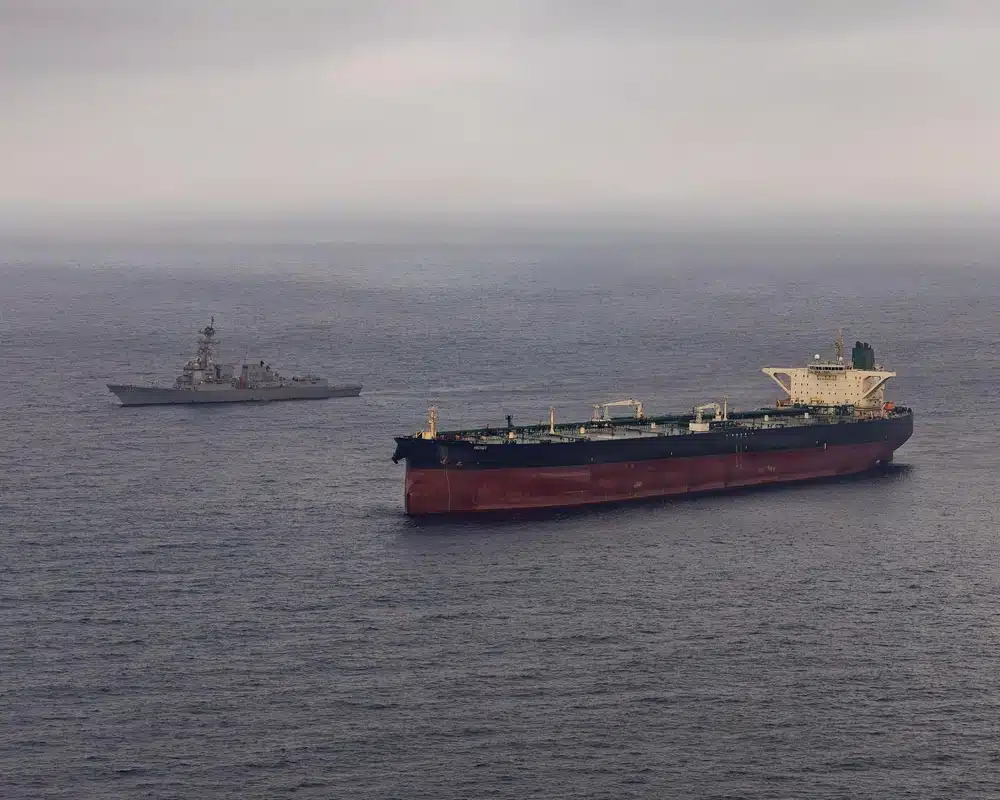
WASHINGTON — U.S. forces struck a civilian cargo ship in the Gulf of Oman while enforcing the Iran blockade, according to U.S. Central Command. The military said an aircraft disabled the Palau-flagged M/V Pacific Archer on Nov. 26 after the vessel allegedly ignored repeated warnings. CENTCOM reported that the strike hit the ship's stern and left its civilian crew unharmed. The incident raises questions about military force against merchant vessels and the safeguards required under international maritime law.
The Nov. 26 strike targeted the M/V Pacific Archer, a Palau-flagged bulk carrier that had departed Bandar Abbas, Iran. The incident follows a U.S. Navy warning issued eight days earlier, threatening commercial vessels with disabling or destructive fire for failing to comply with blockade instructions. It also raises questions about the military's use of force against civilian shipping, the protection of international crews and the constitutional authority behind the continuing conflict.
The United States maintains that its blockade is a lawful wartime measure intended to restrict traffic entering or leaving Iranian ports. However, the military has not publicly released the warnings issued to Pacific Archer or the evidence used to assess the crew's actions. Those omissions limit independent scrutiny of whether the circumstances justified disabling the vessel.
U.S. aircraft strikes Pacific Archer in Gulf of Oman
According to CENTCOM's Nov. 27 announcement, the Pacific Archer attempted to leave the blockaded area after departing Bandar Abbas. Military officials said its crew ignored multiple warnings before a U.S. aircraft launched precision munitions toward the stern. The resulting damage reportedly disabled the ship's propulsion system, leaving it unable to continue its voyage under its own power.
CENTCOM said the civilian crew was unharmed, but its statement supplied few details explaining how officials verified that assessment. The command did not identify the number or nationalities of crew members, describe the vessel's cargo or specify the warning procedures used. It also did not disclose whether personnel were evacuated or whether assistance was provided after the ship lost propulsion.
The command reported that U.S. forces have redirected 158 commercial vessels that complied with blockade instructions and disabled six that refused. Those figures describe enforcement activity since the blockade resumed in July, according to the military. They do not independently establish that every interdiction or use of force satisfied the applicable legal requirements.
CENTCOM releases eight seconds of strike footage
CENTCOM also published an eight-second video of the Pacific Archer operation. The recording provides visual documentation of the strike but does not include the preceding communications described in the military's announcement. It also does not establish the crew's condition following the attack or show a complete inspection of the vessel.
Those limitations matter because the legality of force against commercial shipping depends on the circumstances surrounding an encounter. A recording of the strike alone cannot establish which orders were issued, whether the crew understood them or how the vessel responded. Radio transmissions, navigation records and a fuller operational timeline would provide evidence necessary to assess the military's explanation.
The Defense Department released the footage as public-domain material through the Defense Visual Information Distribution Service. Its accompanying description identifies the vessel and repeats CENTCOM's account of the alleged blockade violation. Those statements should remain attributed to the military rather than presented as findings independently established by the video.
Pacific Archer is a foreign-flagged bulk carrier
The ship's identity provides an important distinction from descriptions of the incident as an attack on an Iranian oil tanker. According to the ClassNK Register of Ships, Pacific Archer is a Palau-flagged bulk carrier with International Maritime Organization identification number 9222510. The register lists Pacific A Shipping Limited as its registered owner and Optimo Marine Limited as its management company. The vessel measures approximately 190 meters long and has a registered gross tonnage of 30,303.
Those records establish the ship's classification, flag and registered management, but they do not identify its cargo during the November voyage. They also do not establish whether the vessel was carrying goods subject to sanctions or whether its operators received authorization to depart Bandar Abbas. Such information would require shipping documents, cargo records or statements from the vessel's management.
A foreign flag does not automatically exempt a vessel from enforcement of the Iran blockade during an armed conflict. However, international law distinguishes between the grounds for stopping a merchant vessel and the circumstances that justify using force against it. Those distinctions are especially important when civilian crews become subject to military enforcement.
Iran Blockade Warning Threatened Destructive Fire
The strike followed an unusually explicit warning published through an international maritime security advisory. On Nov. 18, the Joint Maritime Information Center distributed an updated U.S. naval blockade notice. The document explained that vessels attempting to enter or leave Iranian ports without authorization could face interception, diversion or capture. It also warned shipmasters that failure to comply immediately could result in rapid escalation to "disabling or destructive fire."
The advisory instructed captains to protect their crews while complying with naval directions. It urged vessels to maintain radio monitoring, communicate their intended routes and avoid unnecessary navigation within the blockade area. The document also warned that ships could face enforcement even when carrying cargo transferred from another vessel outside Iranian waters.
Those published rules establish that the United States openly contemplated destructive force against noncompliant commercial shipping. However, issuing a general warning does not eliminate the need to assess the circumstances of a particular encounter. The specific orders, perceived threat and precautions taken during the Pacific Archer operation remain relevant.
What the Iran Blockade Prohibits
The current blockade began July 14, following an announcement by President Donald Trump the previous day. Under the Navy's published instructions, it applies to vessels entering or departing Iranian ports and coastal areas regardless of their national registration. The advisory states that ships suspected of violating the blockade may be stopped, boarded, redirected or captured.
The Iran blockade instructions distinguish traffic involving Iranian ports from passage through the Strait of Hormuz to or from non-Iranian destinations. They state that neutral transit through the strait should remain available, although vessels may still face inspection for prohibited cargo or suspected blockade violations. The distinction matters because military enforcement against an Iranian port is not identical to a general prohibition on commercial navigation throughout the region.
The advisory also establishes procedures for humanitarian shipments carrying food, medicine and other essential civilian supplies. Such shipments may receive permission to cross the blockade after inspection and review. Ship operators seeking approval must provide information identifying the vessel, cargo, owners, crew and intended destination.
These provisions create measurable standards against which enforcement can be evaluated. Officials should be able to explain whether a particular vessel was covered by the blockade, what authorization it lacked and which instructions it allegedly violated. CENTCOM has not publicly supplied those details for Pacific Archer beyond its account of the ship's departure and failure to comply.
International Law and Iran Blockade Enforcement
The Pentagon's own legal guidance provides a framework for examining the strike. The Department of Defense Law of War Manual, updated in July 2023, recognizes that belligerent states may establish naval blockades during armed conflicts. Section 13.10 explains that blockades must satisfy requirements involving legal authority, notification, effectiveness and impartial application. It also addresses restrictions intended to protect neutral shipping and civilian populations.
The manual distinguishes blockade violations from the use of force during enforcement. Section 15.13.4.1 explains that compliant merchant vessels may not be attacked, while ships refusing lawful instructions may be stopped by force. The circumstances of resistance, the applicable rules and the military objective remain important to assessing individual encounters.
A ship's attempted departure from a blockaded port may provide grounds for interception or capture. However, the existence of those grounds does not independently establish that every method of enforcement is appropriate. Determining whether disabling Pacific Archer complied with applicable law requires more information than CENTCOM's short statement and strike footage provide.
The blockade has already involved repeated strikes
Pacific Archer was not the first commercial vessel disabled under the current enforcement campaign. On Nov. 7, CENTCOM announced that U.S. forces disabled the M/V Huda, a St. Kitts-flagged cargo ship in the Gulf of Oman. The command alleged that its crew ignored repeated warnings and attempted to violate the blockade multiple times. Military officials said an aircraft struck the vessel's stern after personnel instructed the crew to leave the targeted spaces.
That earlier statement reported 147 compliant vessels redirected and five disabled since July. By Nov. 27, CENTCOM's cumulative figures had increased to 158 redirected vessels and six disabled. The military's public announcements document continuing Iran blockade enforcement involving both vessel diversions and strikes intended to prevent ships from proceeding.
USA Herald previously reported on U.S. forces disabling the Iranian tanker Hasna in May. That earlier operation involved a different vessel and an earlier phase of the blockade. The recurring use of force makes the methods used to protect civilian crews an important issue for continued scrutiny.
Three sailors died in an earlier ship attack
The potential consequences for merchant crews are not theoretical. On June 11, the International Maritime Organization condemned an attack on the Palau-flagged tanker MT Settebello near the Strait of Hormuz. The organization confirmed that the attack caused a fire and killed three seafarers. Secretary-General Arsenio Dominguez called for the protection of civilian shipping and a transparent investigation into the incident.
India's government separately identified the victims as Indian crew members. In an official June 11 briefing, Indian officials attributed attacks on three commercial vessels carrying Indian sailors to the U.S. Navy. The government said it summoned the American chargé d'affaires to protest the incidents and was assisting the surviving crews.
The Settebello incident involved a separate vessel and occurred months before the Pacific Archer strike. It does not establish that anyone was injured in the November operation or that the circumstances were identical. Nevertheless, it demonstrates why claims of successful civilian protection require scrutiny when military force is directed against commercial ships.
Congress Debates War Powers Amid Iran Blockade
The Nov. 26 strike also occurred one week after Congress debated whether U.S. military operations against Iran should continue. On Nov. 19, the Senate rejected H. Con. Res. 93, which sought the removal of U.S. forces from hostilities with Iran. The measure failed by a vote of 48-51, according to the official Congressional Record. Rejecting a withdrawal resolution did not constitute a separate affirmative authorization for the specific strike against Pacific Archer.
The Trump administration opposed the resolution, arguing that the president possesses constitutional authority to defend American personnel and interests. In its Nov. 19 statement of administration policy, the White House described the conflict with Iran as ongoing and maintained that restrictions on military operations would undermine national security.
Opponents challenged the administration's interpretation of presidential war powers. During the Senate debate, Sen. Tim Kaine, D-Va., argued that sustained hostilities required congressional authorization under the Constitution and the War Powers Resolution. The competing positions demonstrate that the legal foundation for the broader conflict remains politically disputed, separate from questions concerning the conduct of this particular strike.
What CENTCOM has not disclosed
The public account of the Pacific Archer operation leaves important questions unresolved despite the release of military footage. CENTCOM has not published recordings of the warnings allegedly delivered during the Iran blockade operation or a complete chronology of the crew's responses. The statement also does not identify the specific maneuver or action that prompted the decision to fire. Those records would help establish whether the vessel actively resisted enforcement, attempted to escape or failed to comply for another reason.
The command's statement does not describe the ship's condition beyond the loss of propulsion. It also does not identify where the vessel remained afterward, whether it required towing or how the crew obtained assistance. Those details matter because disabling a merchant vessel can create additional risks after the immediate strike ends.
Independent accounts from the captain, crew, registered owner or management company could help clarify the circumstances. Their testimony would not automatically resolve every legal question, but it could provide evidence beyond the military's description. As of publication, the documents reviewed do not include those independent accounts.
Civilian Safety During Iran Blockade Enforcement
The Pacific Archer incident illustrates the tension between wartime enforcement and the protection of commercial shipping. The United States maintains that its blockade restricts supplies and economic activity supporting Iran during an armed conflict. Its published rules allow interception, inspection and other enforcement measures against vessels attempting to violate the restrictions. Those military objectives exist alongside obligations concerning neutral shipping and civilian safety.
The Navy's warning of destructive fire establishes how seriously commanders intend to enforce the blockade. However, the military's own law-of-war guidance recognizes limits on the use of force and the treatment of civilian vessels. Applying those standards requires examining what happened before, during and after each encounter.
For Pacific Archer, the most important unanswered questions concern the warnings, the crew's conduct, the necessity of disabling the vessel and the assistance available afterward. CENTCOM has supplied its account of the operation, but it has not released enough evidence for an independent assessment of those details.
The strike therefore warrants scrutiny beyond whether the aircraft successfully stopped a ship. Accountability also requires establishing that the military objectives, enforcement procedures and protections for civilian life were consistent with the rules governing naval warfare.

Discussion
No comments yet. Be the first to join the discussion!
FOLLOW US
Recent Posts


Don’t Miss It

Thanksgiving Day 2026: Sports to Watch
Thanksgiving Day 2026 offers sports fans a full schedule of…
By – Jackie Allen
Inflation Jumps to 3.8% as Trump…
October PCE inflation rose 3.8% as the administration proposed a…
By – Derek Johnson
Trump’s Second Birthright Citizenship Order Blocked…
Judge Christopher Cooper blocked Trump's second birthright citizenship order on…
By – Derek Johnson
From ‘America’s Mayor’ to Disbarred Election…
Trump gave Rudy Giuliani, 82, the Presidential Medal of Freedom…
By – Derek Johnson
Liberty Mutual faces new robocall lawsuit
The Liberty Mutual new robocall lawsuit begins with a phone…
By – Tyler Brooks
Amica insurance Becomes Title Sponsor of…
The Amica Insurance WCC sponsorship deal puts a fresh brand…
By – Tyler Brooks
Oklahoma Insurance Investigation Leads to $45M…
The State Farm $45M settlement closes a high-stakes examination into…
By – Tyler Brooks
Thanksgiving 2026: Powerful Storm Crawls Up…
Thanksgiving 2026 is shaping up as a weather story. A…
By – Tyler Brooks
Elon Musk Envisions 100,000 Starlink Satellites…
Elon Musk is proposing an ambitious expansion of SpaceX’s satellite…
By – Jackie Allen
Attorneys Seek to Stop Firing Squad…
Nidal Hasan, the former Army psychiatrist convicted of killing 13…
By – Jackie Allen
Noah’s Ark Search Team Reports 4,300-Year-Old …
A research team investigating a boat-shaped geological formation near Mount…
By – Jackie Allen
Iranian Singer Parastoo Ahmadi Receives Beating…
An Iranian singer has reportedly received 74 lashes after performing…
By – Jackie Allen
Applied Systems Acquires Insurtech Tailwind
The news that Applied Systems acquires insurtech Tailwind signals a…
By – Rachel Moore
Turkcell to Sell Digital Insurance Unit:…
The news that Turkcell is set to sell its digital…
By – Rachel Moore
Allstate Tech outage blocks insurance claims,…
The Allstate insurance tech outage is the latest in a…
By – Rachel Moore
Fentanyl Investigation DEA Agents Allow Millions…
The DEA fentanyl investigation in New Mexico is drawing renewed…
By – Jackie Allen
Macy’s Thanksgiving Day Parade 2026: Will…
The Macy’s Thanksgiving Day Parade is still scheduled to take…
By – Jackie Allen
Skywatchers: 2026 Beaver Moon Lights Up…
The November 2026 full moon is giving skywatchers another opportunity…
By – Jackie Allen
Kalshi Suspends Utah Operations As Founders…
By Samuel López | USA Herald | November 24, 2026…
By – Samuel Lopez
Ilhan Omar Search Files Show Judge…
WASHINGTON — Newly unsealed Ilhan Omar search warrant records reveal…
By – Michallie K Harrison
Montgomery Challenges Tuberville’s National Guard Pledge
Gov.-elect Tommy Tuberville’s National Guard pledge has drawn opposition from…
By – Michallie K Harrison
Judge Approves Bayer’s $7.25B Roundup Settlement
Bayer has secured a major legal breakthrough after a Missouri…
By – Rachel Moore
U.S. Army Overrides Federal Court Order…
Middletown, Iowa – The U.S. Army is preparing to detonate…
By – Samuel Lopez
BAAJA Would Make It Harder for…
WASHINGTON — Under BAAJA, a tribe could win a court…
By – Michallie K Harrison
Trump Order Targets Congressional Oversight
WASHINGTON — A Trump executive order requires federal contractors to…
By – Michallie K Harrison
Avengers: Doomsday Thor’s Mighty Hammer Appears…
A massive version of Thor’s legendary hammer, Mjolnir, has…
By – Jackie Allen
Seasonal Affective Disorder: Why Shorter Days…
Seasonal Affective Disorder (SAD), a form of depression associated with…
By – Jackie Allen
Nvidia Stock Jumps 31.5% as Jensen…
Nvidia stock surged 31.5% Monday after directors reinstated co-founder Jensen…
By – Michallie K Harrison
Trump Says He ‘Made the Deal’…
Nvidia’s board unanimously reinstated Jensen Huang as CEO on Nov.…
By – Derek Johnson
Tom Holland New Spider-Man Look Revealed…
Tom Holland is swinging back into the spotlight, and this…
By – Tyler Brooks
Alabama Pipeline Fire Near Ward Forces…
WARD, Ala. — An Alabama pipeline fire forced Ward residents…
By – Michallie K Harrison
Human Skeletons Reveal that Ancient Bones…
Human Skeletons recovered from hundreds of archaeological sites across Europe…
By – Jackie Allen
CoverGirl Hit With Heavy Metals Lawsuit…
Coty Inc., the cosmetics giant behind CoverGirl, is facing a…
By – Samuel Lopez
Iowa Schools Cancel Classes as Army…
MIDDLETOWN, Iowa — Schools in southeast Iowa have canceled Friday…
By – Michallie K Harrison
13 U.S. Babies Born With Measles…
U.S. officials documented 13 babies born with measles and 112…
By – Michallie K Harrison
Katie Couric Reveals Memory-Loss Episode That…
Katie Couric is opening up about a recent frightening medical…
By – Jackie Allen
What the GTA 6 ‘Simp’ Backlash…
OPINION When a parent on Threads asked what their son…
By – Michallie K Harrison
Liz Cambage Reveals Battle With Alcohol…
Key Takeaways Former WNBA star Liz Cambage revealed that she…
By – Jackie Allen
Ohio State Football vs University of…
The Ohio State vs Nebraska showdown arrives Saturday with the…
By – Rachel Moore
43 Soldiers Unlock a GTA 6…
FORT STEWART, Ga. — The 9th Brigade Engineer Battalion offered…
By – Michallie K Harrison
Content Creator Chrisean Rock Faces Looming…
By Samuel Lopez – USA Herald INGLEWOOD, Calif. – What…
By – Samuel Lopez
Tower Hill Investment in Gator Athletics:…
The Tower Hill investment in Gator Athletics just rewrote the…
By – Tyler BrooksNo posts found.
No posts found.


Join the Discussion
Share your thoughts, ask questions, and engage with
other readers. Sign in or create a free account to
comment.