

Texas Trans Texts Spark Election Propaganda Allegations
America ı By Michallie Harrison
0 Comments

Key Takeaways
- The Republican policy record is explicit. The Texas GOP platform calls for restrictions on transgender people’s care and participation in schools, while state officials have pursued related laws and investigations.
- TENT denies authorizing the texts and mailers. The organization says the texts triggered hate and threats.
- A Republican lawmaker asked Paxton to investigate TENT. The sender’s identity and the source of recipients’ information remain unresolved.
- TENT fears the outreach could manufacture grounds for legal action. That concern is an allegation requiring investigation.
- No verified evidence identifies the sponsor. The political context is documented; responsibility for producing and financing these particular materials has not been established.
News Analysis | Texas voters began casting early ballots Monday, Oct. 19, with a controversy over alleged impersonation of a transgender advocacy group already unfolding.
In the days before voting opened, unsolicited messages promoting transgender resources reached self-identified Republicans. Physical mailers also appeared. The Transgender Education Network of Texas says it authorized neither, while a Republican lawmaker asked the attorney general to investigate the organization.
As Texas enters its second day of early voting, the reported recipients, disputed authorship and election timing give substantial reason to suspect propaganda aimed at provoking Republican voters’ fears about transgender children.
The Texas Tribune reported that public accounts of the texts included self-identified Republican recipients and their friends. Rep. Jeff Leach, R-Plano, also said he received a message.


Meanwhile, the Transgender Education Network of Texas, known as TENT, expanded its denial to include physical mailers. Its Oct. 17 statement says the materials were “not authored, authorized, approved, or distributed by TENT.”
Texas early voting began Oct. 19. The texts surfaced in the preceding days, and the mailer controversy continued as voters began casting ballots.
The sponsor remains unidentified. A verified recipient list has not established how the audience was selected, and the available evidence does not prove that the texts and brochures shared an operator. My assessment of their apparent political purpose rests on the disclosed circumstances: reported Republican recipients, disputed authorship, election timing and the political response that followed.
Those circumstances deserve serious scrutiny.
Why this looks like an election scare campaign
The messages linked to real resources on TENT’s website. Screenshots reviewed for this article show one offering information about gender-affirming care and another promoting a school guide addressing bathrooms and other concerns affecting transgender students.
A familiar organization’s web address can make an unsolicited message appear legitimate. It cannot establish who sent it.
That distinction is central to the suspected propaganda mechanism. If recipients believe a transgender advocacy group has contacted their household without permission, their anger can fall on that group before anyone verifies the sender.

LGBTQ Nation’s Oct. 15 coverage described the texts as an apparent attempt to provoke anti-trans hostility before the midterms. Its report included examples of recipients reacting angrily to messages promoting transgender resources.
The material does not need an explicit instruction to vote Republican to carry an apparent political purpose. Presenting an advocacy organization as intruding into families’ lives can reinforce an existing campaign message about transgender people and children.
Whether the sender intended that result remains a question for records and investigation. The reported reaction shows why the question matters.
TENT told KXAN in its Oct. 14 reporting that the texts had produced “an onslaught of hate and threats.” That is the organization’s reported account; this article has not independently authenticated those threats.
The Republican political context is explicit
The party’s own documents explain why this controversy cannot be detached from Republican politics.
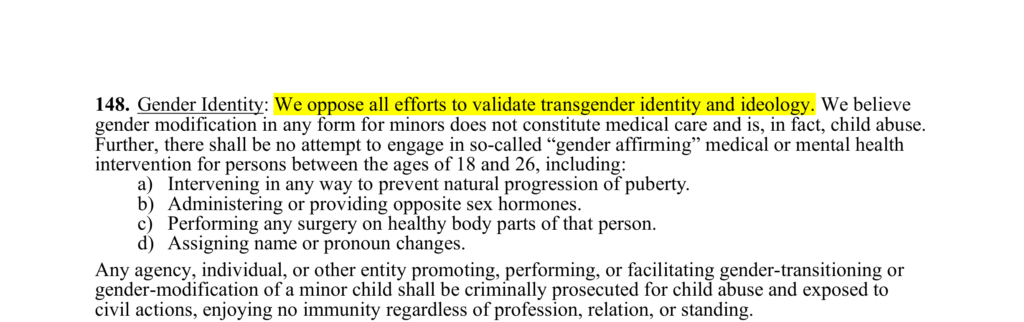
The Republican Party of Texas’ 2026 platform states: “We oppose all efforts to validate transgender identity and ideology.”
Plank 116 supports excluding transgender people from school district positions, including volunteer roles. Plank 148 calls for criminal prosecution and civil liability for entities or individuals promoting, performing or facilitating a minor’s gender transition. It also opposes specified gender-affirming interventions for adults ages 18 through 26.
These are official party proposals, distinct from current legal requirements. They establish that the party’s opposition extends beyond pediatric medical procedures to transgender adults’ participation in schools and access to care.
State policy already imposes restrictions. The enrolled text of Senate Bill 12 prohibits school districts and open-enrollment charter schools from authorizing or sponsoring clubs based on sexual orientation or gender identity. It also requires districts to prohibit employees from assisting students with what the law defines as social transitioning.
The Texas State Law Library’s guide documents additional restrictions involving transition-related medical treatment for minors, restrooms and other facilities in government buildings, and changes to sex markers on identification documents.
This is the political environment in which the messages arrived. Republican leaders have made transgender identity, care and support subjects of legislation and enforcement. Unsolicited material appearing to show an advocacy group contacting students enters that environment with an obvious capacity to inflame it.
That context strengthens the case for examining a possible electoral motive. It does not identify who paid for this particular outreach.
The messages became a demand to investigate TENT
On Oct. 13, Leach asked Attorney General Ken Paxton to investigate TENT’s back-to-school toolkit and how recipients’ personal information had been obtained.
According to FOX 4’s account of the request, Leach acted as chairman of the House Judiciary and Civil Jurisprudence Committee and lead House sponsor of SB 12. He questioned whether the toolkit encouraged violations of the law and whether recipients’ information had been obtained or shared unlawfully.
The toolkit is authentic TENT material, according to KXAN. Its authenticity does not establish that TENT distributed the unsolicited messages.
That creates a basic evidentiary problem for the request to investigate the organization’s use of personal information: The available record has not established that TENT possessed or used the recipient list.
Asked about the organization’s denial, Leach told the Tribune that he wanted “a diligent search for the truth, no matter where that search may lead.”
That commitment should include determining whether someone created a misleading impression about TENT’s involvement.
The request for an investigation is documented. The material reviewed for this article does not establish that Paxton’s office opened one or reached findings. Nor does it establish that Leach or Paxton participated in producing or financing the outreach.
Their documented actions can still be scrutinized. A public official’s demand for investigation carries consequences, particularly when the organization being questioned says someone else used its identity.
TENT fears a manufactured pretext
On Oct. 14, TENT sent cease-and-desist demands to Peerless Network and Infobip, seeking to stop an unnamed client’s alleged impersonation and obtain that client’s identity, the Tribune reported.
The organization warned that the messages could “manufacture a pretext for legal action” against it. The Tribune reported that the companies had not responded to its requests for comment before publication. TENT also did not explain to the outlet how it identified them.
TENT’s warning is an allegation about possible intent. The sequence makes it consequential: Unsolicited messages circulated, and a lawmaker sought government scrutiny of the organization whose resources they promoted.
The records that could test that allegation include account information, instructions to vendors, recipient lists and payment documentation.
Naming a communications provider does not identify the sponsor. Peerless’ published records policy explains that it generally serves wholesale customers rather than end users. Appropriate legal process may identify a carrier or reseller, with further requests needed to obtain subscriber information.
There may be a traceable chain of responsibility. Identifying it should be central to any inquiry into these messages.
Government scrutiny already has a history
For transgender Texans, a demand for investigation arrives against years of state action affecting families and medical providers.
In 2022, Gov. Greg Abbott directed the Department of Family and Protective Services to investigate reported instances of certain gender-transition treatments for children as abuse. A Texas Supreme Court opinion addressing the resulting litigation documents investigations of families whose children received puberty blockers or hormone therapy.
The court’s later account also records the disposition of those investigations. Three families’ investigations closed without further action. The remaining family’s child reached adulthood, leaving the agency without authority to continue investigating that family. The court dismissed the interlocutory appeals as moot and vacated the temporary injunctions.
That ruling did not establish that the families had abused their children. It addressed whether the requests for injunctive relief still presented a live controversy.
Medical providers have faced separate lawsuits. In September 2025, The Associated Press reported that Paxton’s office dropped its case against El Paso pediatric endocrinologist Dr. Hector Granados. The office said “no legal violations were found” after reviewing evidence and his complete medical records.
The withdrawal came nearly a year after the state sued him over allegations that he illegally provided gender-affirming care to minors.
That history is relevant to the stakes. Public allegations and investigations can impose burdens long before a court determines whether anyone broke the law.
What the mailers actually contain
The physical mailers intensified the controversy. The Dallas Express reported Oct. 19 on households receiving student resource guides, including photographs shared by recipients. Its reporting did not identify who produced or distributed them.
Photographs supplied for this article show a brochure titled “Texas Trans & LGBTQ+ Student Resource Guide.” Its return-address panel uses the name “Texas Transgender Student Union.” Other panels prominently describe TENT and direct readers to its resources.
The brochure uses transgender pride colors, photographs and language offering support to students. It also names several established organizations.
That presentation can create an apparent association with those groups. TENT expressly denies authorizing the mailing, and the photographs do not establish authorization by the other organizations listed.
The contents deserve accurate treatment, particularly when they circulate alongside angry commentary.
The brochure discusses supportive adults, unsupportive parents, emancipation and gender-affirming care. Its medical-care section advises approaching an organization rather than obtaining medication independently. Its section on out-of-state care cautions readers younger than 18 that parental consent, custody and the laws of both states can matter.
The emancipation section describes conditions involving age, financial independence and court review. The closing panel tells readers they do not need to decide immediately about hormones or surgery.
These are descriptions of the photographed material, not independent verification of its legal or medical guidance. They show why the brochure’s qualifications should remain visible when its contents are discussed.
The central concern is who packaged and distributed this information, under whose identity and for what purpose.
The sender’s identity remains unresolved
The photographed return address differs from TENT’s published mailing address. The brochure lists 1611 W. Airport Blvd., Suite 123, in Meadows Place. A TENT-operated website lists 11611 W. Airport Blvd., No. 180, in the same city and ZIP code. Both the street number and unit designation differ.

That discrepancy is a reason to examine the mailing’s origin. It cannot identify the person responsible.
The same care applies to the recipient information. A mailing addressed to students in a household does not establish that a child requested it, that a school shared records or that the sender knew anything about a particular child’s identity.
Distribution totals, production costs and the source of the contact information remain unverified. The possibility of a coordinated political operation should be investigated through records that can establish those facts.
The election timing belongs at the center
The reported Republican recipients, the proximity to early voting and TENT’s denial are central to the propaganda concern. Treating each as an unrelated detail would obscure the very pattern that requires examination.
My assessment is that the outreach bears the hallmarks of an attempt to turn transgender advocacy into an election-season scare story for Republican households. Establishing deliberate targeting and sponsorship will require evidence beyond the public material now available.
The documented political response already warrants accountability. A Republican lawmaker sought scrutiny of TENT while the identity of the people behind the unsolicited messages remained unresolved.
Leach says he wants the truth wherever it leads. That requires serious attention to the possibility that recipients were misled about who contacted them.
Texas officials should establish who sent these materials, who selected the recipients and who paid for their distribution. TENT’s allegation of impersonation deserves examination with the same urgency directed at the organization itself.
Frequently Asked Questions
The evidence reviewed does not establish who commissioned or financed them. Republican officials’ actions restricting transgender rights, the Texas GOP’s platform and Rep. Jeff Leach’s request to investigate TENT are documented. Those facts provide relevant political context, but identifying the sender requires additional evidence.
The materials reviewed establish neither. A mailing addressed to students in a household does not reveal how the sender obtained the address or whether anyone in the family requested information. The recipient list’s source remains unknown.

Discussion
No comments yet. Be the first to join the discussion!
FOLLOW US

Recent Posts






Don’t Miss It

Skywatchers: Meteor Season Brings Orionid and Taurid…
The Autumn Meteor Season is underway,. Skywatchers will have two…
By – Jackie Allen
Patriot Missiles Delayed Despite Payment, Zelenskyy…
WASHINGTON — The United States is delaying deliveries of Patriot…
By – Michallie Harrison
Trump’s Russia Policy: Cornyn Shares Investigation…
WASHINGTON — Republican Sen. John Cornyn has amplified a call…
By – Michallie Harrison
Human Genome Project Legacy Advances Research…
The Human Genome Project transformed scientists’ understanding of human DNA.…
By – Jackie Allen
An Airman Died After a Pregame…
By Michallie K. Harrison | Opinion Tech. Sgt. Ian Patterson’s…
By – Michallie Harrison
Hunter’s Moon Illuminates October Skies
The Hunter’s Moon will light up the autumn sky in…
By – Jackie Allen
Alleged Chinese Agent Has Ties to…
A Federal investigation into California realtor Wanying “Heather” Zhang reveals…
By – Jackie Allen
Protests in Paris: Macron to Address…
PARIS, France — October 18, 2026 — Protests in Paris…
By – Jackie Allen
KJ Biermann Faces Felony Charges as…
ATLANTA — KJ Biermann, the 15-year-old son of reality television…
By – Jackie Allen
America in 2035: A Nation Unraveled…
By Michallie K. Harrison | Opinion The future I warned…
By – Michallie Harrison
School Shooter Killed After Father Crawls…
A father whose two daughters attended Silver Rail Elementary School…
By – Jackie Allen
Flying Car:Elon Musk’s SpaceX-Inspired Tesla Takes…
The Flying Car concept took a dramatic step into the…
By – Jackie Allen
Russian Winter Blueprint: Ukraine’s Heat and…
KYIV, Ukraine — A reported Russian winter blueprint outlines attacks…
By – Michallie Harrison
Recently Obtained FOIA Records Reveal AARO…
What the Pentagon Records Now Show AARO arranged a private…
By – Samuel Lopez
Daylight Saving Time Returns Nov. 1…
Americans will turn their clocks back one hour on Nov.…
By – Jackie Allen
Russian Drone Strikes Hit American Businesses…
Russian drone strikes against American-linked businesses in Ukraine are raising…
By – Jackie Allen
Ilhan Omar MIA as Husband Flips…
What Readers Need to Know Federal agents seized Rep. Ilhan…
By – Samuel Lopez
Trump May Replace Susie Wiles as…
Susie Wiles, President Donald Trump’s longtime chief of staff and…
By – Jackie Allen
Chubb And GKN Race To Opposite…
What’s Driving the Insurance Battle ACE American, a Chubb unit,…
By – Samuel Lopez
Trump Fires Katie Zacharia After Five…
What You Need to Know Zacharia was dismissed after only…
By – Samuel Lopez
Katie Zacharia Says She Is A…
WASHINGTON – President Donald Trump’s new White House press secretary,…
By – Samuel Lopez
California’s New Mojave Steel Mill Brings…
What Matters in Mojave 1. Pacific Steel Group’s Mojave Micro Mill…
By – Samuel Lopez
California Identifies New York Life, Aetna,…
Key Takeaways California’s Department of Insurance maintains an official…
By – Samuel Lopez
Starship Launches: SpaceX Seeks 456 Flights…
WASHINGTON — SpaceX wants permission for up to 456 Starship…
By – Michallie Harrison
NJ Severe Thunderstorm Watch Covers All…
New Jersey residents are preparing for potentially powerful thunderstorms Friday,…
By – Rachel Moore
Katie Zacharia Fired After Less Than…
White House press secretary Katie Zacharia has been fired after…
By – Rachel Moore
International Seaways To Buy Euronext Oslo-Listed…
International Seaways Inc., a major player in global oil transportation,…
By – Rachel Moore
Order To Limit Ukraine’s Use of…
What Readers Need to Know Zelenskyy answered a question about…
By – Samuel Lopez
Tesla Flying Car Roadster Leaps, Flips…
Most car launches involve a spinning platform and some dry…
By – Tyler Brooks
California Ballots: Trump DOJ Targets 20,000…
WASHINGTON — The Trump administration sued California on Thursday, seeking…
By – Michallie Harrison
HealthSplash VP 18 Months Sentencing Rewards…
Cooperation can shave years off a prison term, but it…
By – Tyler Brooks
Three Children, Teacher Killed in Oregon…
BEND, Ore. — An Oregon school shooting killed three children…
By – Michallie Harrison
Trump Scraps Hegseth’s Execution Livestream After…
WASHINGTON — President Donald Trump canceled the planned execution livestream…
By – Michallie Harrison
Pope Leo XIV’s Surgery Exposes Gap…
By Samuel López | USA Herald VATICAN CITY — As…
By – Samuel Lopez
Selma Blair Faces Issues After Alleged…
Selma Blair, the actress known for her roles in Cruel…
By – Jackie Allen
Medicare Insurer Sues CMS After Star…
What’s at Stake Alignment’s largest California Medicare Advantage contract fell…
By – Samuel Lopez
NFL Player $300M Hip Surgery Lawsuit…
Athletes bet their bodies on surgeons the way pilots bet…
By – Tyler Brooks
AP Poll Top 25: Georgia Claims…
Georgia has reclaimed the top spot in the AP Poll…
By – Rachel Moore
A.J. Armstrong: Former NFL Player’s Son…
HOUSTON — Antonio “A.J.” Armstrong Jr., the son of former…
By – Jackie Allen
NFL Pro Tyreek Hill Takes the…
What the Jury Is Hearing Lakeeta “Keeta” Vaccaro Hill testified…
By – Samuel Lopez
Terrell Owens Sued By Nolan Wells’…
What Readers Need to Know Three young men who were…
By – Samuel Lopez
California Sends Cease and Desist Letter…
What Matters in This Fight California regulators have reportedly ordered…
By – Samuel LopezNo posts found.
No posts found.


Join the Discussion
Share your thoughts, ask questions, and engage with
other readers. Sign in or create a free account to
comment.