

Earth Awaits the Night Sky’s Verdict As 3I/ATLAS Enters Its Final Observation Window – December 19
America ı By Samuel Lopez
0 Comments
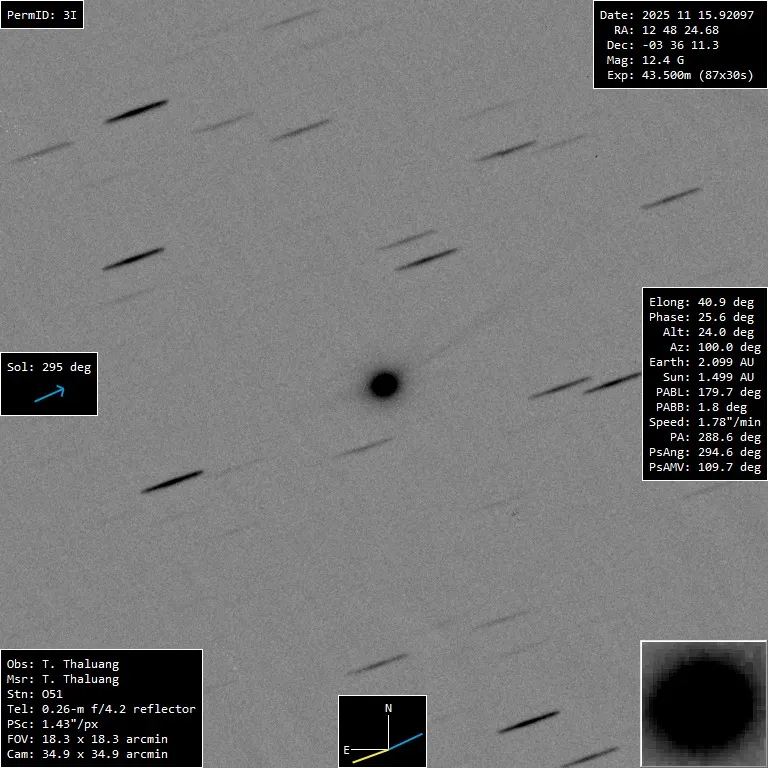
A strange interstellar object brightens, accelerates, and defies physics as Earth prepares for a historic December 19 encounter.
A sky full of eyes. A moment science can no longer postpone. Tonight begins the test that will tell us what 3I/ATLAS really is.
By Samuel Lopez
USA HERALD - The night sky is about to turn into a global laboratory. Beginning tonight, ground telescopes from every corner of the world—from Italy’s Virtual Telescope Project to backyard rigs across the Americas and Asia—will swing toward the rapidly brightening interstellar object known as 3I/ATLAS.
Their new observation window opens just 33 days before the object makes its closest approach to Earth on December 19, a moment many in the scientific community describe as the final, conclusive test of whether this is a natural comet or something far more provocative.
I’ve followed 3I/ATLAS since the earliest JPL tracking estimates, and what is unfolding now is unlike anything I’ve seen in two decades of covering space science. Tonight’s observations are not routine—they are a direct response to a series of anomalies that have worsened, multiplied, and intensified since perihelion.
Experts expected things to calm down as the object swung away from the Sun, but instead the opposite has happened. Its jets have sharpened, its brightness has steepened, and its behavior has become so irregular that even seasoned astronomers admit they have no natural template to compare it to.
The European Space Agency, NASA’s planetary-defense monitors, university observatories, and amateur networks are now aligned on a single goal: gather fresh, unfiltered imaging while the object is still close enough and bright enough to reveal its true nature.
The Virtual Telescope Project will lead tonight’s effort with a livestream beginning at 11:15 p.m. ET from Manciano, Italy, giving the public a rare instant-access view of an interstellar visitor under active scrutiny.
The object continues to exhibit confirmed non-gravitational acceleration—an unmistakable sign that something besides gravity is pushing it. Harvard astrophysicist Avi Loeb has identified two components to this acceleration: a radial push outward from the Sun and a transverse slide across its orbital track, forming a pattern that classical cometary physics fails to reproduce.
Natural outgassing is the standard fallback explanation, but that theory now carries a major burden of proof. If this were simply gas venting from volatile ices, we should be witnessing a massive plume—roughly ten percent of the object’s mass—streaming off in a visible arc. But the window for that evidence is closing fast, and so far nothing like that has been confirmed.
In fact, the opposite seems to be happening. Rather than fading after perihelion, 3I/ATLAS has brightened again—sharply—following a curve that scales inversely with the seventh power of its distance from the Sun.
Nothing in the historical record of comets shows this behavior. Its color has remained distinctly blue, not the typical dusty red scattered by comet grains. Ionized carbon monoxide is one proposed explanation, yet it does not fully account for the jet structure patterns now appearing in high-contrast images from the Nordic Optical Telescope and other facilities.
Some jets point sunward—so-called anti-tails—the kind of geometry Loeb has publicly suggested could arise from controlled thrust or engineered emission rather than chaotic natural venting.
As of tonight, more than a hundred observatories will begin coordinated monitoring runs. Webb, Hubble, and ESA’s Juice spacecraft are expected to join the global campaign over the coming weeks.
Their combined data will give the world its most detailed look yet at the object’s thermal properties, rotation, jet behavior, plasma environment, and any signatures that resemble internal illumination or artificial propulsion. And in the background of this rapidly accelerating story remains a pressure point that has not eased: NASA has still failed to release the HiRISE images captured in early October during the government shutdown. Those images—now more than forty days old—could already offer clarity, yet the silence continues from both NASA Associate Administrator Sean Duffy and the White House.
What we learn between now and December 19 will decide whether 3I/ATLAS becomes the third known interstellar comet—or the first interstellar artifact. The observations beginning tonight will either validate natural explanations or push the conversation into territory rarely breached in mainstream astronomy.
Either way, the truth will come from data, not speculation. And because of the sheer number of instruments now converging on this object, we may finally get the clarity that has eluded scientists since the day 3I/ATLAS was first detected streaking in from deep space.
What happens next depends on what we observe tonight, tomorrow, and across the next month. Unusual acceleration patterns, missing gas plumes, inconsistent jet orientation, and the possibility of engineered reflectivity are no longer fringe topics—they are central scientific questions now being pursued by respected researchers.
As the closest-approach countdown continues, the stakes extend beyond astronomy. They touch public trust, government transparency, planetary-defense readiness, and humanity’s willingness to confront an answer it may not be prepared for.
December 19 is coming. Until then, we watch the skies.
OFFICIAL STATEMENT: “If the object does not show a natural plume during this monitoring window, then nature is not the explanation.” — Avi Loeb

Discussion
No comments yet. Be the first to join the discussion!
FOLLOW US

Recent Posts

Tony Buzbee Must Face $25 Million Defamation Lawsuit as Jay-Z…

Judge Refuses to Dismiss Labor Union’s Trademark Case Against Starbucks…

Pentagon’s Project Meridian Gives Musk, Luckey and Gingrich 120 Days…

Every Pentagon UAP File Drop Has Landed on Friday and…

Molestation Allegations Rock Kern County Political Dynasty as SCRIVNER Act…

Rioters in France: School Protests Escalate as Teacher Is Doused…

SNAP Cost Shift Sends a Bigger Bill to States and…
Don’t Miss It
Cornell University Rape Case Escalates as New York Appoints Special Prosecutor
By – Rachel MooreAtlantic Coast Insurance Suspension Follows Growing Financial Concerns
By – Rachel MooreKaiser Permanente Layoffs Eliminate 147 Jobs Across California
By – Rachel MooreICC Ends Contract With French Insurer Axa Amid U.S. Sanctions Pressure
By – Rachel MooreMinnesota Health Insurance Rates Rise as 2027 Premiums Jump Up to 21.4%
By – Rachel MooreNexfibre’s $2.7B Deal Faces U.K. Competition Roadblock
By – Tyler BrooksNFL Concussion Claims Count as Separate Insurance Occurrences in Major New York Ruling
By – Samuel LopezVisa Mastercard Antitrust Suit Targets Card Giants Over Billions in Merchant Fees
By – Tyler Brooks
Operation Epic Fury: Trump Warns Iran…
Operation Epic Fury remains central to the Trump administration’s account…
By – Jackie Allen
Capitol Police Plaque Lawsuit Dismissal Ends…
Sometimes a legal fight isn’t about the money or the…
By – Tyler Brooks
G7’s Release of 100M Barrels of…
What Truckers and Consumers Need to Know The G7’s 100-million-barrel…
By – Samuel Lopez
Halle Berry Hit with Temporary Restraining…
What the Court Order Signals A Los Angeles judge granted…
By – Samuel Lopez
Killed by in-laws: New York Times…
Jonathan McKinsey, 40, was killed by his elderly in-laws. They…
By – Jackie Allen
Government Spending: Trump Administration Moves to…
The Trump administration is moving to cancel nearly $1 billion…
By – Jackie Allen
Government Spending: Trump Administration Moves to…
The Trump administration is moving to cancel nearly $1 billion…
By – Jackie Allen
Lyft $272.5M Settlement Marks California’s Largest…
Some settlements fade quietly into legal history. This one is…
By – Tyler Brooks
Google Launches Project Suncatcher, Betting on…
Sometimes the boldest ideas start small — in this case,…
By – Tyler Brooks
TJ Maxx Closing Three More Stores…
Empty storefronts have become almost a recurring chapter in retail’s…
By – Rachel Moore
$500 Obamacare Refund Checks Land in…
Not every government payment lands evenly across the map —…
By – Rachel Moore
Zurich Beazley Takeover Officially Closes, Creating…
Months of regulatory hurdles, court hearings and shareholder maneuvering have…
By – Rachel Moore
JPMorgan Executive Renews Countersuit After Ex-Banker’s…
The “sex slave” allegations involving JPMorgan Chase executive Lorna Hajdini…
By – Jackie Allen
Diesel Crisis: Louisiana Relief Meets New…
Louisiana’s diesel crisis has entered October with emergency relief still…
By – Michallie Harrison
Chad Lowe’s Daughter Fiona Dies at…
Actor Chad Lowe and his wife, producer Kim Painter, are mourning the…
By – Jackie Allen
Clone Saga could replace Spider-Noir as…
The Clone Saga could be coming to television as Sony…
By – Jackie Allen
Unabomber: Russell Crowe true-crime thriller surges…
“Unabomber,” Netflix’s new true-crime drama starring Russell Crowe and Jacob…
By – Jackie Allen
Cornell University case draws renewed scrutiny…
ITHACA, N.Y. — A key piece of evidence in the…
By – Jackie Allen
Newsom Signs AI Laws Barring California…
What California Workers and Lawyers Need to Know AI cannot…
By – Samuel Lopez
Senate Sponsor Says Mercedes-Benz Won’t Be…
The Fight Over Who Gets Shut Out Sponsor Bernie Moreno…
By – Samuel Lopez
“NHI vs. NHI” David Grusch Tells…
Key Takeaways Former U.S. intelligence officer David Grusch told Joe…
By – Samuel Lopez
Two-Time NBA Champion J.R. Smith Arrested…
What We Know About the Smith Arrest Smith, 41, is…
By – Samuel Lopez
Former NASCAR Driver Jennifer Jo Cobb…
What This Verdict Means A North Carolina jury found former…
By – Samuel Lopez
Arnold Schwarzenegger Heads to Jury Trial…
What the Jury Will Decide Schwarzenegger has conceded negligence in…
By – Samuel Lopez
Arnold Schwarzenegger Heads to Jury Trial…
What the Jury Will Decide Schwarzenegger has conceded negligence in…
By – Samuel Lopez
Oklahoma Judge Strips Secrecy From 11…
Inside the Hursh Courtroom Showdown A judge removed the confidential…
By – Samuel Lopez
AI Is Creating New Losses Faster…
What Policyholders Need to Know Deepfakes and misinformation dominate reported…
By – Samuel Lopez
California ‘Kelvin Wave’ Phenomena Could Supercharge…
What Coastal Homeowners Need to Know A massive El Niño-linked…
By – Samuel Lopez
Queen and David Bowie’s Copyright Dispute…
What the Copyright Record Actually Shows Queen and David Bowie…
By – Samuel Lopez
Wladimir Klitschko Moves to Protect Daughter…
What the Court Filing Reveals Klitschko wants immediate legal authority…
By – Samuel Lopez
Trump Launches America.gov AI Portal That…
What Americans Need to Know gov is now an AI-powered…
By – Samuel Lopez
Pope Leo XIV Condemns France’s New…
What Readers Should Know Pope Leo XIV used his visit…
By – Samuel Lopez
Strangers Collected $30 Million In ‘Illegal…
What You Need to Know 1. George A. Neukom Jr.’s estate…
By – Samuel Lopez
Princess Diaries Star Heather Matarazzo Says…
WHY THIS MATTERS Heather Matarazzo just admitted something most working…
By – Samuel Lopez
California’s $11 Billion Undocumented Immigrant Benefits…
By Samuel López | USA Herald SACRAMENTO – California is…
By – Samuel Lopez
Hayden Panettiere’s Cause of Death Confirms…
What the Toxicology Findings Tell Us Hayden Panettiere’s death has…
By – Samuel Lopez
JJ McCarthy Trade Sends Former First-Rounder…
Two years ago, a franchise spent a top-10 pick on…
By – Tyler Brooks
New York Sues Polymarket Claiming Prediction…
What This Fight Is Really About New York says Polymarket…
By – Samuel Lopez
New York Sues Polymarket Over Alleged…
What’s Riding on the Bet New York says Polymarket’s sports…
By – Samuel Lopez
Roblox widow alleges $6 million scam,…
The Roblox widow says a former companion took $6 million…
By – Jackie Allen
Network Traffic Challenges May be Reshaped…
Network traffic has traditionally moved in one dominant direction: from…
By – Jackie Allen
Gilbert Goons Defendant Arrested Again for…
A Gilbert Goons defendant awaiting trial in the 2023 death…
By – Jackie AllenNo posts found.
No posts found.


Join the Discussion
Share your thoughts, ask questions, and engage with
other readers. Sign in or create a free account to
comment.