


Did 3I/ATLAS Begin Its Journey Inside Our Solar System
America ı By Samuel Lopez
1,014 0 Comments
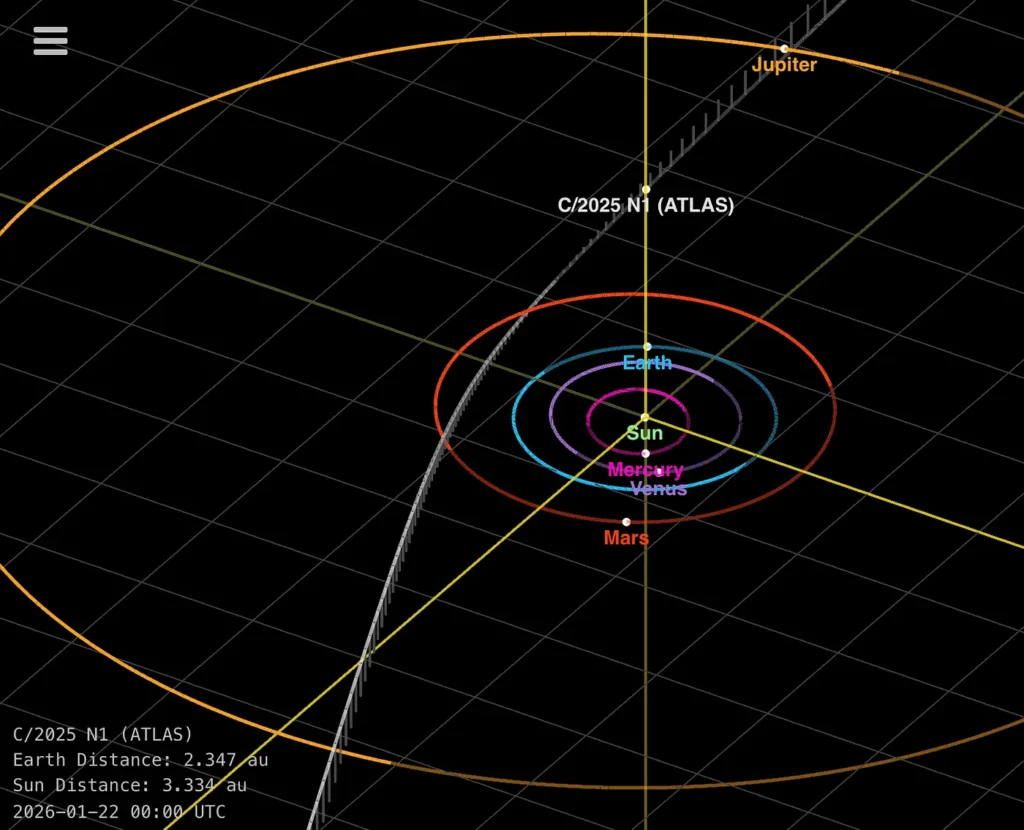
THREE KEY FINDINGS
- The question of whether 3I/ATLAS originated within the Solar System reframes one of the most perplexing space mysteries of the past decade and directly challenges long-standing assumptions about interstellar objects.
- New analysis suggests that the object’s unusual mass, trajectory, and recurring appearance rate may be easier to explain if it was launched locally rather than traveling for millions of years between stars.
- If correct, this scenario carries implications not only for astronomy, but for planetary defense, detection limits, and what governments may quietly know about deep-space activity beyond public observation.
[USA HERALD] - On the morning of January 23, 2026, Harvard astrophysicist Avi Loeb posed a deliberately unsettling question in a newly published essay: Did 3I/ATLAS originate in the Solar System? The question alone signals a shift. Rather than treating 3I/ATLAS strictly as a visitor from another star system, Loeb explores whether its journey may have begun much closer to home.
At the center of his argument is a statistical and physical tension that has quietly troubled astronomers since 3I/ATLAS was first detected. Objects of this size—estimated to exceed a billion tons—should be extraordinarily rare if they come from the diffuse reservoir of material between stars. Yet detections like 3I/ATLAS appear to be occurring at a pace that exceeds those expectations. According to Loeb’s prior modeling, the appearance rate implied by current surveys is difficult to reconcile with the known mass density of interstellar debris.
If 3I/ATLAS were instead launched from within the Solar System, that discrepancy largely disappears. A local origin would allow for both a large mass and a relatively frequent detection rate without requiring an implausibly crowded interstellar environment.
Loeb further notes that 3I/ATLAS exhibits a collection of geometric and compositional anomalies that strain conventional explanations. Publicly released observational data show unusual alignments between the object’s trajectory and the ecliptic plane, a rotation axis that appears correlated with the Sun, and a symmetric pattern of mini-jets, including an apparent anti-tail. Spectroscopic observations have also pointed to an unexpectedly high nickel-to-iron ratio. Each of these features can be explained individually through natural processes, but taken together they form a pattern that remains unresolved.
A critical limitation underpinning Loeb’s hypothesis is observational blindness. Modern survey telescopes detect distant objects primarily by reflected sunlight, which means they are effectively blind beyond roughly 20 astronomical units. Neptune orbits at about 30 AU. Anything operating beyond that range—no matter how numerous—would escape detection unless it deliberately or accidentally entered the inner Solar System. In Loeb’s words, the Sun acts like a lamppost, and humanity can only find objects that wander into its light.
This detection bias opens the door to a more radical but still physically plausible idea: that a technologically advanced civilization could operate a base or network of devices far beyond Neptune, hidden among the Kuiper Belt or Oort Cloud. Such a civilization could, in theory, “hitchhike” on natural icy bodies and propel them inward under the camouflage of fast-moving natural objects, making them appear indistinguishable from comets or asteroids.
Insights shared with Loeb by his collaborator Mauro Barbieri sharpen this idea. Barbieri argues that interstellar travel spanning millions of years presents serious biological and logistical challenges, while launches from the inner Oort Cloud—roughly 1,000 AU away—could reach the inner Solar System in decades. These timescales are compatible with biological life, multigenerational missions, or autonomous systems that rely on updated targeting data rather than ancient trajectories.
From a strategic standpoint, such a forward operating base would make sense. The Oort Cloud offers concealment among trillions of similar objects, access to raw materials, and a stable vantage point for observing planetary systems without revealing one’s presence. Crucially, humanity would have no practical way of knowing whether such objects exist. As Barbieri notes, most interstellar objects pass through the outer Solar System at distances we cannot see. We only detect the rare few that venture close to the Sun, meaning our sample is inherently biased.
This framing weakens the traditional Fermi Paradox—the question of why we see no evidence of extraterrestrial intelligence. If technological objects are deliberately positioned beyond our detection range, their apparent absence tells us very little. In this context, the fact that 3I/ATLAS approached within roughly 1.36 AU of the Sun becomes notable. Visibility itself becomes part of the anomaly.
Loeb also outlines testable ways to distinguish artificial objects from natural ones. In prior peer-reviewed work, he showed that artificial light sources would dim with distance differently than reflected sunlight. A self-luminous object would fade with the square of its distance, while a reflective rock fades with the fourth power. Deep observations from instruments like the Hubble Space Telescope could, in principle, detect artificial illumination comparable to a large city at distances as far as Pluto. Spectral analysis could further distinguish artificial light from sunlight.
Analysis
From an investigative standpoint, Loeb’s hypothesis remains speculative, but it is not unmoored from physics. Every mechanism he describes—propulsion, detection bias, forward bases, and artificial illumination—falls within known or theoretically possible science. The key issue is not whether the idea is extraordinary, but whether it is testable. Monitoring 3I/ATLAS for non-gravitational acceleration, unusual light signatures, or long-term deviations remains a legitimate scientific objective.
There is also a quieter implication that deserves attention. Governments, particularly those with advanced space-surveillance capabilities, operate detection systems that are not fully disclosed. If certain anomalous objects carry strategic or intelligence significance, history suggests such information would be compartmentalized rather than publicly debated. This does not require assuming secret treaties or active contact—only that classified data may exist beyond what civilian astronomers can access.
In that light, 3I/ATLAS may represent not proof of technology, but a stress test for our assumptions. It exposes how much of near-space remains unobserved, how detection bias shapes scientific consensus, and how easily anomalies are dismissed when they challenge established frameworks.
What comes next is clarity through observation. Continued tracking, improved deep-space surveys, and openness to unconventional but testable hypotheses will determine whether 3I/ATLAS is an unusual natural object—or something that forces a re-evaluation of humanity’s place in a much busier Solar System.

FOLLOW US

Recent Posts

Sora Shutdown Marks Sudden End to OpenAI’s AI Video Ambitions

EPA Gasoline Sales Expansion Targets Summer Price Surge

KKR to Acquire Nothing Bundt Cakes in $2 Billion Deal

7 Year-Old Girl Dies in Modesto Duplex Fire, Family Devastated

Massachusetts Teacher Indicted on Rape Charges After Years of Allegations

Mom Accused on Boy Kidnapping Faces Felony Charges in Utah…

Meta YouTube Teen Addiction Case Ends in Landmark Jury Verdict
Don’t Miss It
Supreme Court Music Industry Ruling Reshapes Internet Liability Debate
By – Rihem AkkoucheMeta $375M Verdict Shakes Tech Giant After Landmark Jury Decision
By – Rihem AkkoucheIran Rejects U.S. Ceasefire Blueprint as War Demands Escalate
By – Rihem AkkoucheEveryday life across Asia is being heavily disrupted by a fuel crisis triggered by the war involving Iran.
By – Tyler BrooksRobotics companies struggle to perfect the robotic hand
By – Tyler BrooksOahu Island Residents Ordered to Evacuate As Severe Flooding Could Cause Dam Failure
By – Tyler BrooksNASA to Spend $20 Billion on Building a Moon Base, Shifts Away from Lunar Space Station Plans
By – Tyler BrooksBlackRock chief warns global recession could follow if oil prices reach $150 per barrel.
By – Tyler Brooks
Kelly Warner Law Firm Blames USA Herald for Arizona Bar Investigation
In what appears as a desperate attempt to defend multiple allegations of fraud on the courts, the Kelly Warner Law…
By – USA Herald
Aaron Kelly Law Firm Resorts To Attacking Former Client Again On KellyWarnerLaw.com – Pattern Recognized
Attorney Aaron Kelly and his law partner Daniel Warner are currently under investigation by the Arizona Bar for legal misconduct.…
By – Jeff Watterson
Arizona Bar Opens Investigation on Attorney Aaron Kelly
USA Herald recently reported on a developing story involving Attorneys Daniel Warner and Aaron Kelly. Both Warner and Kelly have…
By – Paul O'Neal
Parents Think They Understand How Kids Use AI — But They Don’t
Recent surveys reveal a major disconnect between how parents think their children use artificial intelligence and what teenagers are actually…
By – Tyler Brooks
Ground Truth: When the Earth Moves, AI Can Detect It
Sudden and unpredictable, landslides and avalanches kill thousands of people each year and cause billions of dollars in damage. But…
By – Tyler Brooks
The Philippines Declares a National Energy Emergency Following War on Iran, Becoming the First Country To Do So
President Ferdinand Marcos Jr. announced that he signed an executive order to protect the country’s energy security, warning of an…
By – Tyler Brooks
OpenAI has Shut Down its Artificial Intelligence Video-Generation App, Sora, Less than Two Years After Its Launch
At the same time, OpenAI is ending its content partnership with Disney. The company said it decided to discontinue Sora…
By – Tyler Brooks
Meta Ordered to Pay $375 million For Misleading Users About Children Safety on Platform
A court in New Mexico has ordered Meta to pay $375 million (£279 million) after finding that the company misled…
By – Tyler BrooksSANTA MONICA, CA — A California civil jury on Tuesday found 88-year-old Bill Cosby liable for drugging and sexually assaulting…
By – Derek JohnsonSANTA MONICA, CA — A California civil jury on Tuesday found 88-year-old Bill Cosby liable for drugging and sexually assaulting…
By – Derek Johnson
Iran-Israel War Rages Into Day 25: Trump Claims Peace Talks While Tehran Flatly Denies Any Negotiations
WASHINGTON, D.C. — As the U.S.-Israel military campaign against Iran enters its 25th day, a deepening rift has emerged between…
By – Derek Johnson
Oil rebounds above $100 amid mixed signals over US–Iran talks
Brent crude prices climbed back above $100 per barrel after a sharp drop earlier in the week, as uncertainty grew…
By – Tyler Brooks
Delta Congress VIP Membership Removal Amid DHS Shutdown
Delta Air Lines has suspended airport escorts and red coat services for members of Congress and their staff due to…
By – Rachel Moore
Pentagon to Send 3,000 Soldiers to Middle East Amid Iran Tensions
The Pentagon confirmed plans to deploy roughly 3,000 soldiers from the Army’s 82nd Airborne Division to the Middle East, intensifying…
By – Rachel Moore
Namibia Blocks Elon Musk’s Starlink in Licensing Setback
In a move that underscores the collision between global ambition and local policy, Namibia blocks Elon Musk’s Starlink, denying the…
By – Rachel Moore
Namibia Blocks Elon Musk’s Starlink in Licensing Setback
In a move that underscores the collision between global ambition and local policy, Namibia blocks Elon Musk’s Starlink, denying the…
By – Rachel Moore
NASA Plan for Moon Base Shifts Course in $20 Billion Lunar Pivot
In a dramatic strategic overhaul, the NASA plan for moon base is taking center stage as the agency abandons its…
By – Rachel Moore
Dayton Webber Charged With Murder After Deadly Car Shooting
A story once defined by resilience and triumph has taken a dark and shocking turn, as Dayton Webber charged with…
By – Rihem Akkouche
US Park Police Officer Shot in DC Sparks Intense Manhunt
A violent ambush in the nation’s capital has triggered alarm after a US Park Police officer shot in DC during…
By – Rihem Akkouche
Explosion at Valero Refinery Sends Smoke Towering Over Texas Coast
A thunderous blast at a Gulf Coast facility has ignited concern after an Explosion at Valero refinery sent massive plumes…
By – Rihem Akkouche
UCI Health Layoffs Impact 150 Workers Amid Financial Pressures
A wave of restructuring has swept through Southern California’s healthcare sector as UCI Health layoffs affect approximately 150 employees, signaling…
By – Rihem Akkouche
Arizona Man Accused of Crucifying Pastor Pushes Judge For A Quick Death Sentence
By Samuel A. Lopez | USA Herald – An Arizona courtroom is now the center of a deeply disturbing case…
By – Samuel Lopez
Trump’s Laser Talk Sparks New Questions About America’s Secret Arsenal
President Donald Trump has once again done what he often does best in moments of war and tension: he dropped…
By – Samuel Lopez
The Northern Lights Return
The Northern Lights have a chance to be visible from several northern U.S. states on Tuesday night, forecasters at the…
By – Jackie Allen
February Unemployment Up as Job Losses Surprise Economists
February Unemployment Up as the latest labor market data revealed weaker-than-expected job growth and a slight increase in the national…
By – Jackie Allen
Late-Night Attack by Venezuelan National at Florida Beach
A Late-night attack by a Venezuelan National has left a Florida community shaken after authorities say a 26-year-old man ambushed…
By – Jackie Allen
Trump’s War in Iran: Congress Confronts Escalation After U.S. Strikes
Trump’s War in Iran was triggered open conflict, casualties, and renewed constitutional debate in Washington. The crisis intensified following reports…
By – Jackie Allen
Apollo to Acquire Nippon Sheet in Landmark $3.7B Deal
In a move that underscores shifting tides in global finance, Apollo to acquire Nippon Sheet has emerged as one of…
By – Rachel Moore
UCI Health Layoffs Impact 150 Workers Amid Financial Pressures
A wave of restructuring has swept through Southern California’s healthcare sector as UCI Health layoffs affect approximately 150 employees, signaling…
By – Rihem Akkouche
Estée Lauder to Merge With Puig in Talks to Form $40bn Beauty Powerhouse
A potential seismic shift is underway in the global beauty industry as Estée Lauder to merge with Puig discussions gather…
By – Rachel Moore
US French Energy $1bn Investment Sparks Offshore Wind Controversy
In a move that could reshape America’s clean energy future, the Trump administration announced Monday it will pay French energy…
By – Rachel Moore
Alphabet San Francisco Drone Delivery Set to Take Flight
A new chapter in urban logistics is unfolding as Alphabet San Francisco drone delivery moves from concept to reality, with…
By – Rachel Moore
Fentanyl Inside Barbie Doll Packaging Triggers Urgent Investigation in Missouri
A startling discovery has rattled a Missouri community after fentanyl inside Barbie doll packaging was uncovered at a local discount…
By – Rachel Moore
War Insurance Reality Americans Face Even When the Battlefield Is Overseas
By Samuel A. Lopez | USA Herald – When Americans hear news of airstrikes in the Persian Gulf, naval confrontations…
By – Samuel Lopez
Supreme Court Asked To Step In As 98-Year-Old Federal Judge Pauline Newman Fights Suspension From The Bench
[USA HERALD] – For more than four decades, one of the most influential judges in American patent law helped shape…
By – Samuel Lopez
Iran Appears To Have Conducted Its First Major Cyberattack Against A U.S. Company, Since The War Began – New Front Opens Against American Healthcare
An alleged Iran-linked cyberattack on Stryker appears to mark a dangerous turn in the conflict, pushing digital retaliation from nuisance-level…
By – Samuel Lopez
Beyond Gas Prices The Strait of Hormuz Crisis Could Hit Fertilizer, Plastics, Aluminum And Global Supply Chains
By Samuel Lopez | USA Herald – Right now, most Americans hearing about the Strait of Hormuz are thinking about…
By – Samuel Lopez
When The Files Are Finally Unsealed The Most Mind-Bending Truth May Not Be What We Expect
[USA HERALD] – There is a widespread assumption that if governments release their most highly classified files related to unidentified…
By – Samuel Lopez
Civil Rights Icon Rev. Jesse Jackson Dies at 84 As President Trump Issues Personal Tribute
[USA HERALD] — The Rev. Jesse Jackson, a towering figure of the American civil rights movement whose career spanned more than…
By – Samuel Lopez
The World Cup Security Reckoning: Trump Warns Iran Soccer Team About Safety As War Tensions Spill Into Global Sports
By Samuel A. Lopez | USA Herald – A short Truth-Social post from President Donald Trump on Thursday morning is now…
By – Samuel Lopez
Trump’s War in Iran: Congress Confronts Escalation After U.S. Strikes
Trump’s War in Iran was triggered open conflict, casualties, and renewed constitutional debate in Washington. The crisis intensified following reports…
By – Jackie Allen
Cadillac Names Inaugural Formula 1 Car MAC-26 in Tribute to Mario Andretti Ahead of 2026 Australian Grand Prix Debut
Cadillac has officially revealed the name of its first Formula 1 challenger, confirming that its 2026 car will be called…
By – Ahmed Boughalleb
Norway Tops Medal Table After Day 13 at 2026 Winter Olympics as Team USA Surges Into Second Place
With 13 days complete at the 2026 Milan Cortina Winter Olympics, Norway sits atop the overall medal standings, collecting 34…
By – Ahmed Boughalleb
Olympic Science Explained: How Figure Skaters Spin at Blinding Speeds Without Getting Dizzy
When Amber Glenn finishes her routine, the arena usually rises with her. The music builds, her blades carve a tight…
By – Tyler Brooks
Olympic Villages Run Out of Condoms at 2026 Milan-Cortina Games
Condom supplies in the Olympic Villages at the 2026 Winter Games have been temporarily depleted, the Milan-Cortina organizing committee confirmed,…
By – Tyler BrooksNo posts found.
No posts found.
 No comments yet. Be the first to comment!