


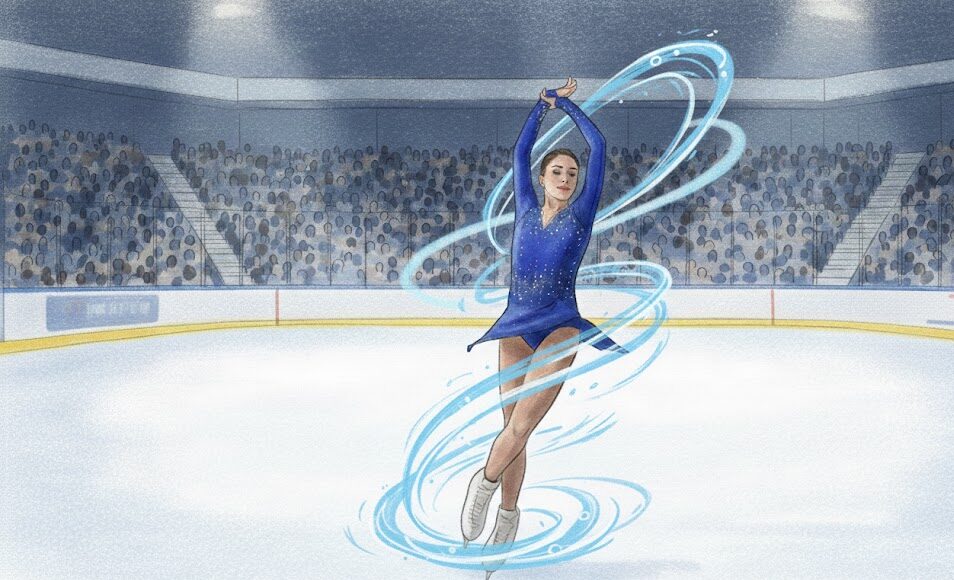
When Amber Glenn finishes her routine, the arena usually rises with her. The music builds, her blades carve a tight circle into the ice, and then come the spins — fast, centered and seemingly endless.
For many watching at home, one thought immediately follows: how is she not dizzy?
The short answer is training. The longer answer involves science, repetition and a body that has adapted over years to handle extreme motion.
Inside each ear is a small but powerful system responsible for balance. It detects movement and rotation and sends signals to the brain. When you spin quickly, that system becomes overstimulated. The brain struggles to process the signals, and you feel lightheaded or nauseous.
Most people experience this after just a few turns.
Figure skaters are different because they train their bodies to tolerate it.
When young skaters begin learning to spin, they often feel dizzy. That reaction is normal. But through repetition, the brain slowly adapts. The balance system becomes less sensitive to rapid rotation. Over time, what once caused nausea becomes manageable.
There is also technique involved. Dancers use a method called “spotting,” where they focus on one fixed point while turning. Skaters sometimes apply similar principles during certain elements. However, at elite levels — when athletes rotate five or more times per second — adaptation becomes far more important than visual focus.
Studies suggest that experienced figure skaters show reduced vestibular responses compared to non-athletes. In simple terms, their brains do not react as strongly to spinning motion. Years of practice condition both mind and body.
Mental strength also plays a role. Early training requires pushing through discomfort. As the body adapts, the dizziness fades faster and eventually becomes minimal during performance.
By the time a skater reaches Olympic competition, those spins are no longer a battle against nausea. They are controlled, practiced movements repeated thousands of times in training rinks long before the spotlight ever turns on.
What appears effortless on television is the result of science, discipline and persistence.
So the next time a skater finishes a rapid spin sequence without even a wobble, remember: it is not magic. It is the human body adapting — one rotation at a time.



















































 No comments yet. Be the first to comment!