


Green Comet Wierzchoś Surges Toward Earth With Massive Carbon Dioxide Signature And One Way Exit From Solar System – Feb. 17th Close Encounter With Earth
America ı By Samuel Lopez
802 0 Comments
INSIDE THIS REPORT
- A rare green glow is rising in the night sky.
- A massive comet packed with carbon dioxide is sweeping through the inner solar system for what scientists believe may be the first and last time.
- And within days, it will reach its closest point to Earth before beginning a long, irreversible departure that could send it into interstellar space — much like 3I/ATLAS.
A newly brightening city-size comet rich in carbon dioxide makes its closest Earth approach February 17 as scientists say it may be permanently ejected into interstellar space.
[USA HERALD] - Comet C/2024 E1, widely known as Comet Wierzchoś, is rapidly brightening as it approaches its February 17, 2026 closest approach to Earth. Discovered in March 2024 by Polish astronomer Kacper Wierzchoś using a 1.5-meter telescope at Arizona’s Mount Lemmon Observatory, the comet has since drawn the attention of major observatories — including the James Webb Space Telescope.
According to observational data released from Webb, the comet’s surrounding coma contains significant quantities of carbon dioxide. In plain terms, the icy nucleus is actively releasing CO₂ gas as it warms near the Sun. That matters because carbon dioxide is one of the more volatile compounds trapped inside primordial comets — material that has remained frozen since the early formation of the solar system.
Initial analysis of telescope measurements suggests the comet’s nucleus spans approximately 13.7 kilometers (8.5 miles) in diameter. That makes it roughly two-thirds the length of Manhattan — large enough to qualify as a substantial Oort Cloud body, not a minor fragment.
Astronomers classify Comet Wierzchoś as hyperbolic, meaning its orbit is open rather than closed. Unlike periodic comets such as Halley’s Comet, which repeatedly loop around the Sun, a hyperbolic comet follows a trajectory that does not bring it back. According to publicly available orbital models, its path suggests it originated in the distant Oort Cloud — a vast spherical reservoir of icy bodies at the outer edge of our solar system — and is now receiving a gravitational slingshot that may permanently expel it.
The comet reached perihelion — its closest point to the Sun — on January 20, 2026, at a distance of roughly 84 million kilometers from the solar surface. On February 17, it will pass approximately 151 million kilometers from Earth, a distance comparable to Earth’s average separation from the Sun. There is no impact threat.
But its trajectory is what captures scientific interest.
Orbital solutions reported through public tracking databases show the comet’s eccentricity exceeds 1.0 — the mathematical threshold for escape velocity from the solar system. While it may take decades or centuries to fully exit the Sun’s gravitational sphere of influence, current modeling suggests it will not return.
In that respect, it mirrors the fate of 3I/ATLAS, the interstellar visitor that dominated astronomical headlines last year after being identified as an object not gravitationally bound to our Sun. While 3I/ATLAS entered our system from interstellar space, Comet Wierzchoś appears poised to do the opposite — becoming an outbound wanderer.
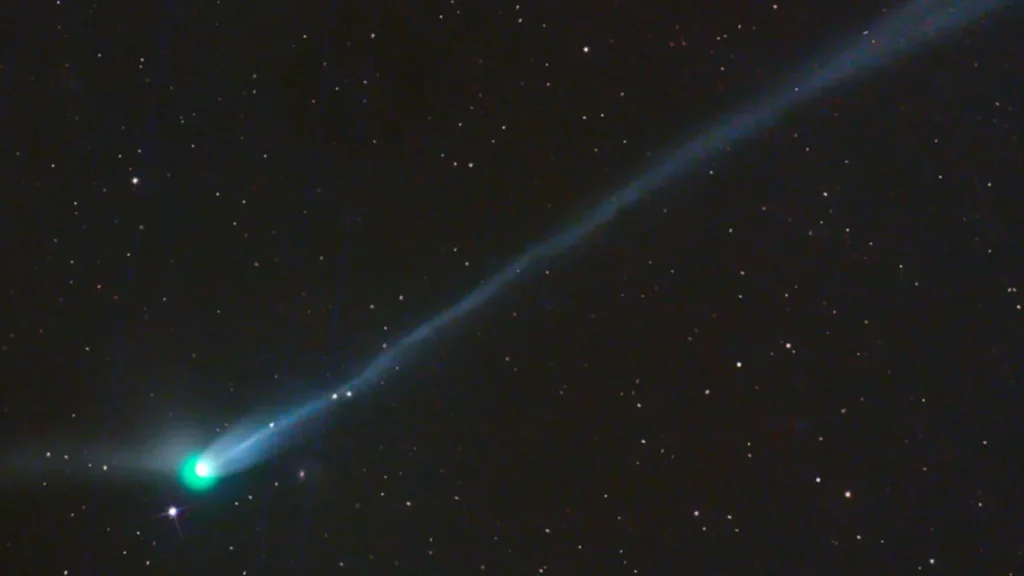
What makes this object visually striking is its emerald coma. Astrophotographers have captured images showing a vivid green glow surrounding the nucleus.
Comet C/2024 E1 (Wierzchoś) captured during its brightening phase as it approaches Earth in early 2026. The green coma is likely linked to carbon-bearing compounds excited by solar radiation.
Scientists generally attribute the green coloration in comets to diatomic carbon (C₂) molecules that fluoresce under ultraviolet sunlight. While carbon dioxide itself is colorless, CO₂ sublimation may contribute to releasing carbon-bearing compounds that generate the distinctive hue. Researchers have not yet published a definitive breakdown of the emission mechanisms in this specific case.
Importantly, the comet will not become visible to the naked eye under most conditions. Observers in the Northern Hemisphere can locate it above the southwestern horizon after sunset, particularly as it passes through the constellation Sculptor. Stargazing binoculars or moderate telescopes significantly improve visibility. Southern Hemisphere observers may have better viewing geometry in the coming weeks.
Beyond the spectacle, there is scientific value.
Oort Cloud comets are considered deep-freeze archives from the early solar system. Carbon dioxide abundance offers clues about the temperature and chemical conditions that existed when the solar nebula formed over 4.5 billion years ago. If confirmed in large quantities, the CO₂ signature could help refine models of volatile distribution in the outer protoplanetary disk.
There is also broader context.
Astronomers are increasingly identifying dynamic, high-energy cometary pathways that either inject objects inward or eject them outward. The forthcoming observational power of the Vera C. Rubin Observatory is expected to accelerate such discoveries, potentially identifying more outbound bodies — and perhaps the next inbound interstellar visitor.
2026 is already shaping up as a notable year for comet tracking. Additional objects, including C/2026 A1 (MAPS) and C/2025 R3 (PanSTARRS), are under observation, with some projections suggesting they could reach binocular or even naked-eye visibility if conditions align.
From a planetary defense standpoint, hyperbolic comets are not inherently dangerous, but they are dynamically complex. Their velocities and unpredictable outgassing can slightly alter trajectories. Continued tracking ensures that orbital solutions remain precise.
In my assessment, the larger takeaway is this: our observational network is improving, but these objects remind us that the solar system remains far from static. Massive bodies still arrive from the outermost fringes — and sometimes leave entirely.
Comet Wierzchoś is not a threat. It is, however, a reminder that gravitational boundaries are permeable — and that interstellar space is not an abstract concept, but a destination some objects inevitably reach.
By late 2026 and beyond, the green glow will fade, the tail will dissipate, and the comet will dim into darkness. What remains will be orbital data, chemical signatures, and a growing understanding of how material moves between star systems.
That knowledge may prove far more enduring than the spectacle itself.
***
USA Herald continues to provide independent, in-depth reporting and analysis you won’t find anywhere else. Readers who want access to exclusive insights, developing investigations, and original reporting are encouraged to join our exclusive USA Herald newsletter. Signing up takes just a moment and helps support ethical, transparent journalism.

FOLLOW US

Recent Posts

Chilling Pattern Emerges As Scientists with Nuclear, Exoplanet & UFO…
America’s Eyes On The Sky – Citizen Astronomers Step Up…
Texas Home Pierced by Meteorite As Fireball Surge Sparks Nationwide…

Taylor Frankie Paul Video Exposes Uncomfortable Truth About Female-Perpetrated Domestic…

White House Unveils National AI Policy to Guide Congress

Counting Calories Isn’t Enough, Experts Say: Focus on How and…

Pentagon Supply Chain Risk Label Likely to Have Limited Effect,…
Don’t Miss It
First Lady Melania Trump Showcases Humanoid Robot at Tech Summit
By – Tyler BrooksHouston Airport Lines Top Four Hours as Shutdown Strains Security Staffing
By – Tyler BrooksPhilippine Transport Workers Strike as Fuel Prices Surge
By – Tyler BrooksMusk Unveils ‘Terafab’ Plan to Boost Chip Production for Tesla, SpaceX
By – Tyler BrooksJury Finds Meta, YouTube Liable in Landmark Social Media Addiction Case
By – Tyler BrooksRocket Stocks Jump on Report SpaceX May Move Ahead With Share Sale
By – Tyler BrooksMiddle East Conflict Threatens to Upend Global Air Travel Model
By – Tyler BrooksSora Shutdown Marks Sudden End to OpenAI’s AI Video Ambitions
By – Rachel Moore
Kelly Warner Law Firm Blames USA Herald for Arizona Bar Investigation
In what appears as a desperate attempt to defend multiple allegations of fraud on the courts, the Kelly Warner Law…
By – USA Herald
Aaron Kelly Law Firm Resorts To Attacking Former Client Again On KellyWarnerLaw.com – Pattern Recognized
Attorney Aaron Kelly and his law partner Daniel Warner are currently under investigation by the Arizona Bar for legal misconduct.…
By – Jeff Watterson
Arizona Bar Opens Investigation on Attorney Aaron Kelly
USA Herald recently reported on a developing story involving Attorneys Daniel Warner and Aaron Kelly. Both Warner and Kelly have…
By – Paul O'Neal
EPA Gasoline Sales Expansion Targets Summer Price Surge
The EPA gasoline sales expansion is poised to reshape the fuel landscape this summer, as federal officials move to loosen…
By – Rachel Moore
KKR to Acquire Nothing Bundt Cakes in $2 Billion Deal
The KKR to acquire Nothing Bundt Cakes deal is rising like a perfectly baked confection in the private equity world,…
By – Rachel Moore
7 Year-Old Girl Dies in Modesto Duplex Fire, Family Devastated
The 7 year-old girl dies in Modesto duplex fire tragedy has left a California community reeling after flames tore through…
By – Rachel Moore
Massachusetts Teacher Indicted on Rape Charges After Years of Allegations
The Massachusetts teacher Indicted on Rape Charges case has reached a pivotal moment, as a longtime educator at an elite…
By – Rachel Moore
Mom Accused on Boy Kidnapping Faces Felony Charges in Utah Case
The mom accused on boy kidnapping case has stunned a Utah community, as prosecutors allege a mother took justice into…
By – Rihem Akkouche
Meta YouTube Teen Addiction Case Ends in Landmark Jury Verdict
The meta youtube teen addiction case reached a dramatic turning point in Los Angeles, where a jury delivered a sweeping…
By – Rihem Akkouche
Meta YouTube Teen Addiction Case Ends in Landmark Jury Verdict
The meta youtube teen addiction case reached a dramatic turning point in Los Angeles, where a jury delivered a sweeping…
By – Rihem Akkouche
Supreme Court Music Industry Ruling Reshapes Internet Liability Debate
The supreme court music industry ruling delivered a decisive blow Tuesday to efforts by major record labels to hold internet…
By – Rihem Akkouche
Meta $375M Verdict Shakes Tech Giant After Landmark Jury Decision
Meta $375M verdict sent shockwaves through Silicon Valley Tuesday as a New Mexico jury ordered Meta Platforms to pay $375…
By – Rihem Akkouche
Iran Rejects U.S. Ceasefire Blueprint as War Demands Escalate
Iran rejects US ceasefire plan, setting the stage for a deepening geopolitical standoff as competing visions for peace collide like…
By – Rihem Akkouche
Everyday life across Asia is being heavily disrupted by a fuel crisis triggered by the war involving Iran.
The effective closure of the Strait of Hormuz after the United States and Israel launched military action against Iran in…
By – Tyler Brooks
Robotics companies struggle to perfect the robotic hand
In the late 1990s, engineer Rich Walker recalls building one of Shadow Robot’s earliest robotic hands using simple materials like…
By – Tyler Brooks
Namibia Blocks Elon Musk’s Starlink in Licensing Setback
In a move that underscores the collision between global ambition and local policy, Namibia blocks Elon Musk’s Starlink, denying the…
By – Rachel Moore
NASA Plan for Moon Base Shifts Course in $20 Billion Lunar Pivot
In a dramatic strategic overhaul, the NASA plan for moon base is taking center stage as the agency abandons its…
By – Rachel Moore
Dayton Webber Charged With Murder After Deadly Car Shooting
A story once defined by resilience and triumph has taken a dark and shocking turn, as Dayton Webber charged with…
By – Rihem Akkouche
US Park Police Officer Shot in DC Sparks Intense Manhunt
A violent ambush in the nation’s capital has triggered alarm after a US Park Police officer shot in DC during…
By – Rihem Akkouche
Explosion at Valero Refinery Sends Smoke Towering Over Texas Coast
A thunderous blast at a Gulf Coast facility has ignited concern after an Explosion at Valero refinery sent massive plumes…
By – Rihem Akkouche
UCI Health Layoffs Impact 150 Workers Amid Financial Pressures
A wave of restructuring has swept through Southern California’s healthcare sector as UCI Health layoffs affect approximately 150 employees, signaling…
By – Rihem Akkouche
Arizona Man Accused of Crucifying Pastor Pushes Judge For A Quick Death Sentence
By Samuel A. Lopez | USA Herald – An Arizona courtroom is now the center of a deeply disturbing case…
By – Samuel Lopez
Trump’s Laser Talk Sparks New Questions About America’s Secret Arsenal
President Donald Trump has once again done what he often does best in moments of war and tension: he dropped…
By – Samuel Lopez
The Northern Lights Return
The Northern Lights have a chance to be visible from several northern U.S. states on Tuesday night, forecasters at the…
By – Jackie Allen
February Unemployment Up as Job Losses Surprise Economists
February Unemployment Up as the latest labor market data revealed weaker-than-expected job growth and a slight increase in the national…
By – Jackie Allen
Late-Night Attack by Venezuelan National at Florida Beach
A Late-night attack by a Venezuelan National has left a Florida community shaken after authorities say a 26-year-old man ambushed…
By – Jackie Allen
Trump’s War in Iran: Congress Confronts Escalation After U.S. Strikes
Trump’s War in Iran was triggered open conflict, casualties, and renewed constitutional debate in Washington. The crisis intensified following reports…
By – Jackie Allen
BlackRock chief warns global recession could follow if oil prices reach $150 per barrel.
Larry Fink, the chief executive of Larry Fink and leader of the global asset management firm BlackRock, has warned that…
By – Tyler Brooks
OpenAI has Shut Down its Artificial Intelligence Video-Generation App, Sora, Less than Two Years After Its Launch
At the same time, OpenAI is ending its content partnership with Disney. The company said it decided to discontinue Sora…
By – Tyler Brooks
Oil rebounds above $100 amid mixed signals over US–Iran talks
Brent crude prices climbed back above $100 per barrel after a sharp drop earlier in the week, as uncertainty grew…
By – Tyler Brooks
Apollo to Acquire Nippon Sheet in Landmark $3.7B Deal
In a move that underscores shifting tides in global finance, Apollo to acquire Nippon Sheet has emerged as one of…
By – Rachel Moore
UCI Health Layoffs Impact 150 Workers Amid Financial Pressures
A wave of restructuring has swept through Southern California’s healthcare sector as UCI Health layoffs affect approximately 150 employees, signaling…
By – Rihem Akkouche
Estée Lauder to Merge With Puig in Talks to Form $40bn Beauty Powerhouse
A potential seismic shift is underway in the global beauty industry as Estée Lauder to merge with Puig discussions gather…
By – Rachel Moore
War Insurance Reality Americans Face Even When the Battlefield Is Overseas
By Samuel A. Lopez | USA Herald – When Americans hear news of airstrikes in the Persian Gulf, naval confrontations…
By – Samuel Lopez
Supreme Court Asked To Step In As 98-Year-Old Federal Judge Pauline Newman Fights Suspension From The Bench
[USA HERALD] – For more than four decades, one of the most influential judges in American patent law helped shape…
By – Samuel Lopez
Iran Appears To Have Conducted Its First Major Cyberattack Against A U.S. Company, Since The War Began – New Front Opens Against American Healthcare
An alleged Iran-linked cyberattack on Stryker appears to mark a dangerous turn in the conflict, pushing digital retaliation from nuisance-level…
By – Samuel Lopez
Beyond Gas Prices The Strait of Hormuz Crisis Could Hit Fertilizer, Plastics, Aluminum And Global Supply Chains
By Samuel Lopez | USA Herald – Right now, most Americans hearing about the Strait of Hormuz are thinking about…
By – Samuel Lopez
When The Files Are Finally Unsealed The Most Mind-Bending Truth May Not Be What We Expect
[USA HERALD] – There is a widespread assumption that if governments release their most highly classified files related to unidentified…
By – Samuel Lopez
Civil Rights Icon Rev. Jesse Jackson Dies at 84 As President Trump Issues Personal Tribute
[USA HERALD] — The Rev. Jesse Jackson, a towering figure of the American civil rights movement whose career spanned more than…
By – Samuel Lopez
The World Cup Security Reckoning: Trump Warns Iran Soccer Team About Safety As War Tensions Spill Into Global Sports
By Samuel A. Lopez | USA Herald – A short Truth-Social post from President Donald Trump on Thursday morning is now…
By – Samuel Lopez
Trump’s War in Iran: Congress Confronts Escalation After U.S. Strikes
Trump’s War in Iran was triggered open conflict, casualties, and renewed constitutional debate in Washington. The crisis intensified following reports…
By – Jackie Allen
Cadillac Names Inaugural Formula 1 Car MAC-26 in Tribute to Mario Andretti Ahead of 2026 Australian Grand Prix Debut
Cadillac has officially revealed the name of its first Formula 1 challenger, confirming that its 2026 car will be called…
By – Ahmed Boughalleb
Norway Tops Medal Table After Day 13 at 2026 Winter Olympics as Team USA Surges Into Second Place
With 13 days complete at the 2026 Milan Cortina Winter Olympics, Norway sits atop the overall medal standings, collecting 34…
By – Ahmed Boughalleb
Olympic Science Explained: How Figure Skaters Spin at Blinding Speeds Without Getting Dizzy
When Amber Glenn finishes her routine, the arena usually rises with her. The music builds, her blades carve a tight…
By – Tyler Brooks
Olympic Villages Run Out of Condoms at 2026 Milan-Cortina Games
Condom supplies in the Olympic Villages at the 2026 Winter Games have been temporarily depleted, the Milan-Cortina organizing committee confirmed,…
By – Tyler BrooksNo posts found.
No posts found.
 No comments yet. Be the first to comment!