

‘Golden Age’ Playbook Fails Its Own Test
America ı By Michallie K Harrison
0 Comments

Key Takeaways
- Tuberville’s overhaul would freeze most state hiring and pursue estimated annual savings of $150 million to $200 million. Those savings are projections, not money already recovered, and the article argues that reducing staffing cannot substitute for demonstrating better services.
- The playbook promises no rural hospital closures while rejecting Medicaid expansion. The essay challenges whether its alternatives adequately address both hospital finances and uninsured patients’ ability to afford care.
- Income taxes are among the largest revenue sources supporting Alabama’s Education Trust Fund. The article argues that income tax cuts require a credible explanation of how education funding would be protected.
- Tuberville proposes felony penalties for mailing or delivering abortion pills. The essay challenges the contradiction between his small-government message and proposals that expand state control over reproductive decisions.
- Alabama already has a Department of Examiners of Public Accounts responsible for audits, investigations and oversight. The article argues that any new efficiency initiative must demonstrate what it adds and measure success through public outcomes, not spending reductions alone.
AUBURN – Tommy Tuberville wants Alabama to believe that smaller government, lower taxes and better public services can arrive together. His October announcement of the “Golden Age Playbook” promises jobs, affordability and accountability, starting with the governor himself. Those are attractive promises. They are also claims that deserve scrutiny before anyone starts celebrating.
As an Alabama resident, I am less interested in what an administration calls its agenda than what families will experience under it. Will people receive medical care they can afford? Do public schools have the resources they need? Will government offices still have enough qualified people to perform the work we expect?
My objection is not to reviewing government spending. It is to treating a smaller government as proof of a better one. A reduced payroll is an accounting result, not evidence that a child is safer, a hospital is stronger or a family is better off.
The playbook deserves the same examination Tuberville wants to impose on state agencies. Show the costs, identify the risks and explain who pays when the promises do not cover the bills.
The Golden Age Playbook Starts Freezing Before Reviewing
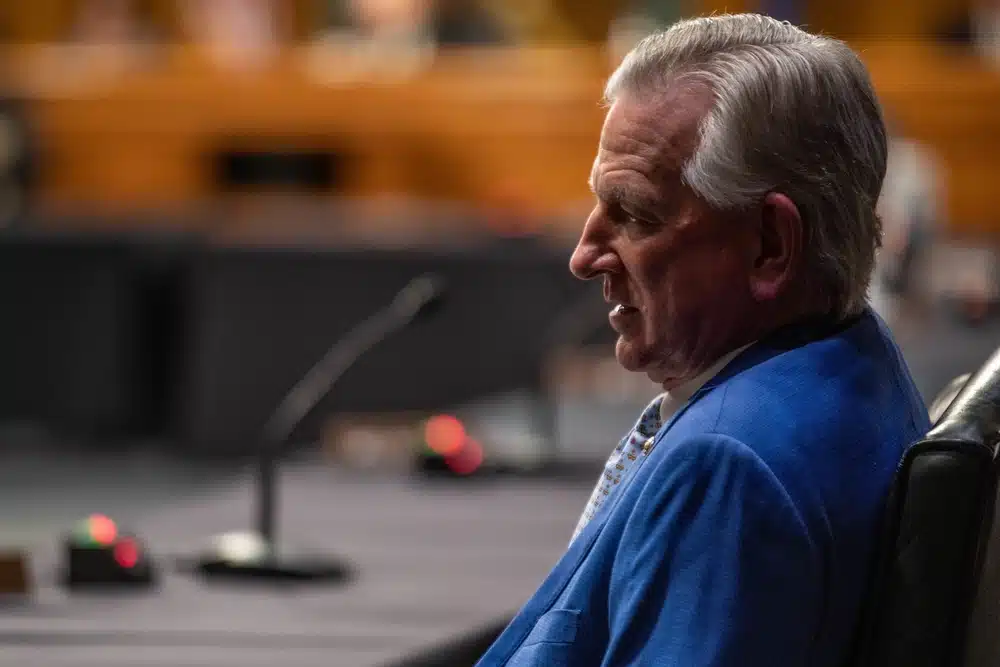
Photo credit:
U.S. Air Force photo by Tech. Sgt. Jack Sanders, via DVIDS. Public domain.
Tuberville’s proposed first executive order would begin agency audits and impose a hiring freeze outside public safety and direct care. A deeper efficiency review would follow within one year, according to the published description of the order. In other words, the restriction on hiring would begin before the broader review established what each agency needs.
That sequence deserves scrutiny. A serious review should distinguish unnecessary positions from vacancies that prevent an agency from functioning. Starting with a broad freeze risks treating both categories alike until someone obtains an exception.
The proposal protects troopers, correctional officers and direct-care personnel. It says local schoolteachers fall outside the state-agency workforce plan, and it describes layoffs as a last resort. Those qualifications matter, but they do not prove that every other position is expendable.
Consider the practical risk. An administration could protect frontline workers while weakening the administrative support that allows them to work effectively. Before eliminating positions through attrition, it should establish which duties can disappear, which can be automated and which will simply fall on fewer people.
A vacancy is not proof of waste. Sometimes it is evidence that work already needs doing.
Alabama Already Has People Who Audit Government
Tuberville did not discover government accountability. Alabama’s Department of Examiners of Public Accounts already conducts financial and compliance audits, investigates misuse of public money and evaluates government operations. Its responsibilities include examining efficiency, not merely checking whether receipts exist.
The state’s Budget Management Act also requires continuing review of programs, performance reporting and consideration of more effective alternatives. It assigns responsibilities to both the governor and Legislature. The legal framework for asking whether public money produces results already exists.
That does not mean the existing system works perfectly. It means a new administration should identify its failures before selling a new label as a solution. Which audit recommendations went ignored? What agencies conceal costs? Which oversight bodies lack staff or authority?
Those questions could produce useful reform. Announcing that Montgomery needs accountability, without explaining what existing accountability has missed, produces a campaign message.
If another management structure is necessary, it should face the same test as every other government office. What does it add, what does it cost and how will we know whether it works?
Golden Age Playbook: The Savings Need Their Own Audit
The campaign projects eventual annual savings of $150 million to $200 million from its overhaul. AL.com’s examination of the proposal describes workforce reductions, agency consolidation and limits on executive authority. The savings figure is a target, not money already recovered and available to spend.
Before taxpayers accept that number, they deserve a year-by-year calculation. How much comes from eliminating positions? How much comes from contracts, purchasing or administrative changes? What will new technology, reorganizations and outside assistance cost?
The calculation must distinguish recurring savings from one-time reductions. Selling an asset or delaying a purchase does not produce an annual stream of money. Neither does moving a responsibility to a county make its cost disappear for the people who live there.
An honest estimate should also account for service performance. If fewer employees produce longer waits, greater backlogs or more expensive contracting, those consequences belong in the calculation. They cannot be left outside the frame because the payroll column looks better.
I am not asserting that no savings are possible. I am saying that promised savings cannot carry the authority of an audit before the audit happens. A forecast deserves testing, not applause.
An Income Tax Cut Is Also a School-Funding Question
Alabama’s Executive Budget Office identifies individual and corporate income taxes among the largest revenue sources for the Education Trust Fund. That fund supports schools, colleges and other educational functions. Cutting income taxes therefore raises a school-funding question, whether the campaign chooses to emphasize it or not.
This does not mean every tax reduction automatically produces a classroom cut. Revenue growth or a carefully designed replacement could preserve funding. But those possibilities need credible estimates, not assurances that growth will somehow handle the difference.
The administration should publish the expected revenue loss, the replacement funding and the assumptions behind both. It should also show how the benefits would reach households at different income levels.
A tax cut should be evaluated alongside the services those taxes support. A family has not necessarily come out ahead if its tax bill falls while other costs rise. Alabama deserves the complete calculation, not just the part that fits on a campaign sign.
Golden Age Playbook: Hospital Promises Without Expansion
The health care section exposes a particularly serious tension. As Alabama Political Reporter’s account of the playbook explains, Tuberville promises no rural hospital closures while rejecting Medicaid expansion. His alternatives include telehealth, rural physician recruitment, changes to facility approval rules and additional federal support.
Some of those measures could help. Recruiting a physician addresses a real need. But increasing the availability of a service and giving patients coverage to pay for it are different tasks. A doctor’s arrival does not automatically make an uninsured patient’s treatment affordable.
Under federal Medicaid law, Washington generally pays 90% of qualifying medical costs for newly eligible expansion adults. The state’s share is real and deserves a financing plan. So does the decision to reject the federal contribution.
The hospital connection is not merely a campaign argument. A 2018 study in Health Affairs associated Medicaid expansion with stronger hospital finances and lower likelihoods of closure, particularly in rural markets. That finding does not guarantee that expansion would save every hospital. It does make categorical rejection harder to defend alongside a promise of zero closures.
Tuberville is entitled to propose another approach. He should have to demonstrate how it will cover patients, support providers and meet his own hospital commitment. Refusing one funding mechanism does not relieve him of explaining the replacement.
A Rural Health Grant Is Not an Insurance Card
There is federal rural health funding to pursue. The Centers for Medicare & Medicaid Services describes a $50 billion Rural Health Transformation Program, distributed over fiscal years 2026 through 2030. Its purposes include improving access, strengthening the workforce and modernizing health care delivery.
Those investments should not be dismissed. Nor should they be confused with expanding individual eligibility for health insurance. A grant supporting equipment, technology or workforce development answers a different question from who pays for a patient’s ongoing treatment.
That distinction belongs at the center of Tuberville’s health care agenda. How many additional residents would gain affordable coverage under his alternative? Which hospitals would receive sustained support, and what happens when time-limited funding ends?
A promise to keep facilities open must account for both sides of the examination room. Providers need resources, and patients need access they can afford. A hospital commitment without a convincing answer for uninsured patients remains unfinished.
School Choice Still Spends Public Money
Tuberville’s support for expanding school choice also deserves examination alongside his insistence on smaller government. The CHOOSE Act provides publicly financed education savings accounts, including up to $7,000 for eligible students attending participating schools. Calling the arrangement a tax credit does not remove the public’s stake in how the money performs.
In July, Gov. Kay Ivey announced more than $174 million in approved accounts for the 2026-27 academic year. Her office also confirmed that applications for 2027-28 would open to families regardless of household income. Funding limits and allocation priorities still apply; universal eligibility does not guarantee every applicant an award.
The question is not whether participating families value the assistance. Many clearly do. The question is why a government-efficiency agenda should demand less scrutiny of this spending than of a public agency’s payroll.
Publish participation by income and county. Show what families must still pay and whether the program improves educational outcomes. Explain what meaningful choice exists for families without transportation or an accessible participating school.
Public money does not become inherently efficient because it follows a child into a private institution. It deserves the same evidence-based evaluation Tuberville promises everywhere else.
Small Government Until Reproductive Freedom Enters
The playbook’s approach to reproductive rights makes the limits of its small-government philosophy difficult to ignore. AL.com reports that Tuberville proposes legislation making it a felony to mail or deliver abortion pills. The proposal targets people and companies involved in supplying the medication. It is a legislative objective, not a criminal law he has already created.
Here, government is not being told to step aside. It is being invited to intervene more aggressively, with criminal penalties attached. The contradiction is not subtle: Regulatory restraint becomes less attractive when the subject is someone else’s reproductive decisions.
People can hold sincere moral objections to abortion. Those beliefs do not make the use of state punishment something other than government power. A politician cannot invoke personal freedom as a governing principle and then avoid explaining why it stops where his preferred moral judgment begins.
This is the same question of selective freedom examined in our earlier reproductive-autonomy commentary. Who gets trusted to make a decision, and who gets a government official standing between them and it?
Tuberville’s position is not simply that government should be smaller. It is that government should be smaller for some purposes and more intrusive for others. Alabamians should judge those choices directly.
A DEI Crackdown Is Not an Efficiency Finding
The playbook also promises enforcement against diversity, equity and inclusion programs, alongside restrictions framed around other cultural issues. 1819 News’s account of the agenda places those commitments within its statement of Alabama values. That is an ideological position, not a demonstrated finding about program performance.
Alabama already enacted SB 129’s restrictions on specified DEI programs and practices. The law also contains exceptions involving research, historically accurate teaching and certain support services. Enforcing it does not establish that every activity associated with diversity is wasteful.
A genuine efficiency review should examine what a program does, what it costs and whether it achieves useful outcomes. Identifying an unpopular acronym is not a substitute for that work. Neither is counting how many offices change their names.
My concern is that a promised financial review can become a vehicle for predetermined political priorities. If the outcome is decided before the evidence is examined, call it a policy choice. Do not dress it up as an audit.
The National Guard Is Not a Campaign Prop
A separate campaign promise makes the question of government power even sharper. In a Sept. 30 advertisement discussing Alabama cities, Tuberville declared, “don’t think I won’t send in the National Guard on day one.” That statement was not an operational order and should not be confused with the proposed agency-audit directive.
As a veteran, I want considerably more than that before troops become part of a governor’s public-safety pitch. What would their mission be? Who would command them, what authority would govern their actions and what conditions would end the deployment?
Those are not arguments against every possible Guard mission. They are the basic questions responsible civilian leadership should answer before presenting military personnel as a demonstration of political toughness.
People living in Birmingham, Montgomery and Mobile deserve safety. They also deserve a plan that defines the problem and explains how the proposed response would solve it. A uniform does not make a vague policy precise.
Service members should never have to discover the limits of a politician’s planning after becoming the most visible part of it.
The Data Center Promise Should Become Enforceable
One part of the agenda deserves support, followed by close scrutiny. Tuberville says data centers should lose tax breaks, cover the infrastructure costs they create and respect communities that reject them. Those commitments appear in Yellowhammer News’s detailed account of the playbook.
Requiring developers to account for their costs is a reasonable principle. But residents need enforceable protections, not merely a governor’s promise that their bills will remain unaffected. The distinction matters when decisions involve long-term infrastructure commitments.
What costs must developers cover? Who independently verifies the calculation? Which public body can refuse a project, and what happens if the developer fails to meet its obligations?
The same standard applies to his proposals for grocery-tax relief, child care assistance and industrial development. A worthwhile objective does not validate every other item packaged beside it. Each proposal must stand on its evidence, financing and enforceable terms.
A credible critique should recognize useful ideas. It should also refuse to let those ideas provide cover for the parts of the agenda that weaken access, restrict freedom or leave their costs unresolved.
The Golden Age Playbook Must Answer to Alabama
Tuberville’s plan is an agenda for an incoming administration, not a collection of accomplished results. That distinction should remain visible throughout the transition. Promising a tax cut is not delivering one, and promising a functioning hospital is not keeping its doors open.
The most revealing question is what his administration will count as success. Will it celebrate fewer employees even if residents wait longer? Is it possible to announce savings without disclosing the costs transferred elsewhere? Will it measure reproductive restrictions and DEI enforcement as achievements while treating affordable care as an unresolved financial problem?
Alabamians should insist on a broader standard. Measure access to care, classroom outcomes, processing times, household costs and the condition of essential services. Publish the assumptions behind every claimed saving and give independent reviewers access to the records.
I do not need Tommy Tuberville to sell me a golden age. I need him to show that the government he wants to shrink will still serve the people who depend on it. An Alabama that costs less to administer but becomes harder to live in is not a golden age. It is a budget cut with better advertising.

Discussion
No comments yet. Be the first to join the discussion!
FOLLOW US

Recent Posts






Don’t Miss It

WNBA: DeWanna Bonner Makes Emotional Admission…
ATLANTA — The WNBA Finals ended in heartbreak for the…
By – Jackie Allen
3M $7.35 Billion PFAS Settlement Targets…
3M Co. is committing $7.35 billion over nine years to…
By – Rachel Moore
PAI Buys Elemis, Betting on U.S.…
Private equity firm PAI Partners said Wednesday it will acquire…
By – Rachel Moore
Dronamics’ $500M SPAC Deal Sets Autonomous…
Autonomous aviation company Dronamics unveiled plans Wednesday to enter the…
By – Rachel Moore
The Midterms Gave This Veteran Faith…
OPINION | I need to be real with y’all again. More…
By – Michallie K Harrison
Amy Totenberg $16M Deal: Judge Approves…
A decade-long dispute over retirement benefits at NCR Corp. has…
By – Tyler Brooks
CVS To Split In 2, Unwinding…
CVS Health announced Wednesday that it plans to divide into…
By – Tyler Brooks
Inés Gómez Mont Arrested by ICE…
MIAMI — Inés Gómez Mont, a former television personality who…
By – Jackie Allen
El-Sayed Wins Michigan Senate Race in…
Progressive favorite Abdul El-Sayed has defeated Republican Mike Rogers in…
By – Tyler Brooks
Democrats’ Senate Takeover Sends Shockwaves Through…
President Donald Trump urged voters to imagine he was on…
By – Tyler Brooks
California Landlord Agrees to $28M Settlement…
What California Renters Need to Know Essex Property Trust agrees…
By – Samuel Lopez
Mississippi Senate Race on a Knife’s…
The mississippi senate race remained locked in a razor-thin contest…
By – Tyler Brooks
Hakeem Jeffries and the Power of…
WASHINGTON — Hakeem Jeffries is poised to become the first…
By – Michallie K Harrison
Freedom for Whom? El-Sayed, Hinojosa and…
El-Sayed and Hinojosa have given America two victories that belong…
By – Michallie K Harrison
America’s 60-Day Danger Zone After the…
WASHINGTON — Americans voted to change the balance of power…
By – Michallie K Harrison
Nuremberg Trials Part 2: The 2026…
WASHINGTON — The 2026 midterms have delivered a political earthquake.…
By – Michallie K Harrison
Keisha Lance Bottoms Just Broke a…
For 250 years, the United States has called itself a…
By – Michallie K Harrison
Erika Eleniak Turns OnlyFans Success Into…
LOS ANGELES — Erika Eleniak is proving that life after…
By – Jackie Allen
Toyota Insurance Sues Farmers Over Alleged…
Key Revelations Behind the Lawsuit Toyota alleges Farmers is violating…
By – Samuel Lopez
Chinese Biotech Giant Novogene Sues Pentagon…
Key Takeaways Chinese biotechnology company Novogene filed a federal lawsuit…
By – Samuel Lopez
Convicted Killer Captured After Nine-Day Manhunt…
Behind the Prison Break Two Tennessee inmates escaped state custody…
By – Samuel Lopez
Reflect Orbital Wants to Sell Sunlight…
Beyond the Beam — Three Things to Know 1. Reflect Orbital…
By – Samuel Lopez
Supreme Court Takes Up Colorado Preschool…
What the Justices Must Decide Colorado says every publicly funded…
By – Samuel Lopez
California Supreme Court Could Reshape Police…
SAN JOSE, Calif. – A federal appeals court has ruled…
By – Samuel Lopez
Soft War? Trump Orders Limited U.S.…
WASHINGTON — November 3, 2026 — President Donald Trump described…
By – Jackie Allen
Trump Weighs Iran Strikes as Carlson…
WASHINGTON — U.S. officials have warned regional allies to prepare…
By – Michallie K Harrison
China May Be Making Weapons-Grade Uranium…
China has likely resumed producing weapons-grade uranium after a pause…
By – Michallie K Harrison
California Bar Exam Pass Rate Falls…
What the Numbers Reveal California’s July 2026 bar exam pass…
By – Samuel Lopez
Federal Judge Tosses DOJ Lawsuit Seeking…
What the Ruling Actually Means The judge did not rule…
By – Samuel Lopez
Adam Robinson Among Nine Killed in…
A Texas technology entrepreneur, his wife, their two young children…
By – Tyler Brooks
California Botox Doctor Gets 15 Years…
What the Medicare Records Revealed A California doctor billed more…
By – Samuel Lopez
A New 2026 Twin Study Revives…
Three Takeaways Identical twins and triplets were separated through adoption…
By – Samuel Lopez
Michigan Double-Digit Health Insurance Hikes Set…
Michigan residents are facing another costly year for health coverage,…
By – Tyler Brooks
Miyoko Plant Butter Recall Sparks Food…
A plant-based butter product distributed across 10 states is being…
By – Rachel Moore
Pentagon Ketamine Contract: $41M Deal Under…
WASHINGTON — The Pentagon has awarded a Singapore-based pharmaceutical company…
By – Michallie K Harrison
CDC Warns Drug-Resistant Germs Threaten Modern…
WASHINGTON — Drug-resistant germs are causing millions of infections and…
By – Michallie K Harrison
Bill Belichick and Jordon Hudson Reportedly End…
Bill Belichick and Jordon Hudson reportedly ended their romantic relationship…
By – Jackie Allen
Brewers Beat Rays to Win First…
ST. PETERSBURG, Fla. — The Milwaukee Brewers won their first…
By – Michallie K Harrison
Connor Hellebuyck Traded to New Jersey…
The New Jersey Devils have made a major move to…
By – Tyler Brooks
Information Ecosystem: Five Tools to Detect…
The information ecosystem is increasingly vulnerable to misinformation. There are…
By – Jackie Allen
An Airman Died After a Pregame…
By Michallie K. Harrison | Opinion Tech. Sgt. Ian Patterson’s…
By – Michallie K Harrison
NFL Player $300M Hip Surgery Lawsuit…
Athletes bet their bodies on surgeons the way pilots bet…
By – Tyler BrooksNo posts found.
No posts found.


Join the Discussion
Share your thoughts, ask questions, and engage with
other readers. Sign in or create a free account to
comment.