

The Hidden Numbers Behind Ocean Reef Islands: Why Panama’s Most Exclusive Address May Be Quieter Than It Looks
Business ı By Rochdi Rais
0 Comments
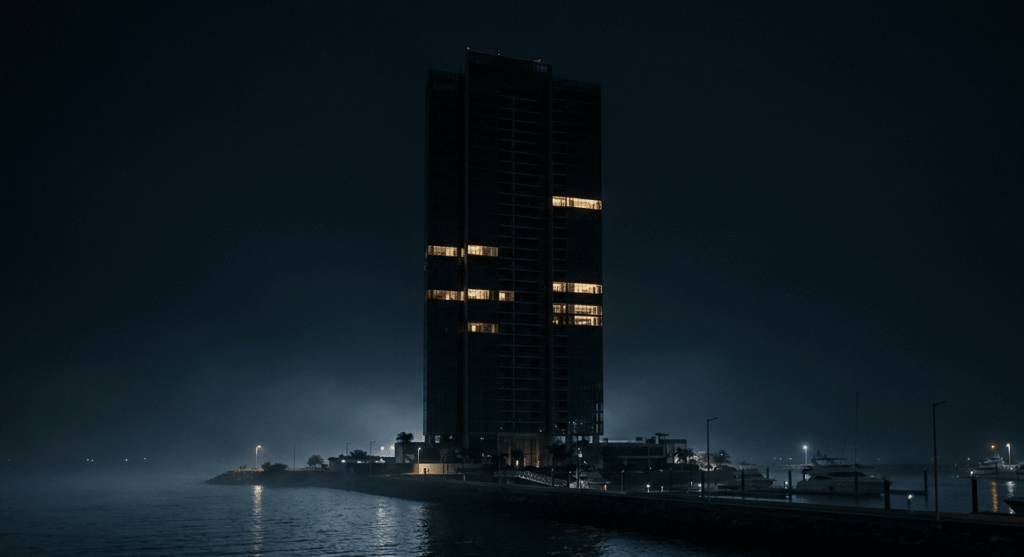
The luxury developments off Punta Pacifica are sold on scarcity. But Panama’s notoriously opaque transaction data means the real picture of who actually lives there — and what units actually trade for — is anyone’s guess. And the visible signals are not flattering.
Drive across the private causeway from Panama City to Ocean Reef Islands at dusk, and you will see what brochures promise: glass towers and white villas glowing above the Pacific, yacht slips lined up in formation, the skyline of Punta Pacifica behind you. What you may not see is light in many of the windows.
Ocean Reef Islands — the only private residential islands in Latin America, perched off the Punta Pacifica neighborhood that has become Panama City’s flagship luxury address — has spent the last decade selling itself on exclusivity.
The pitch is consistent across the broker community: 137 lots, 24/7 controlled bridge, an “Aman-like” lifestyle, scarcity as the engine of long-term appreciation. The Agency Panama, one of the development’s brokerages, recently described the inventory as “tightening — currently down 7% year-over-year,” citing it as evidence of “stable pricing and long-term value growth.”
But step back from the marketing copy and look at what’s actually known about the wider segment, and a very different picture comes into focus. The Punta Pacifica luxury condo market is softening visibly in the data that exists. And — more importantly for buyers, sellers, and the integrity of the asking prices being floated across the islands — the data that doesn’t exist may be telling a worse story still.
The Data That Exists Already Paints a Soft Picture
Start with what the industry itself is willing to say on the record.
Kent Davis, the founder of Panama Equity Real Estate and one of the most-quoted voices in the Panama City brokerage community, told Global Property Guide earlier this year that “premium areas like Punta Pacifica and Santa Maria… are seeing slower rental absorption and declining yields.”
The MLS Acobir analyst team, citing RIAL Di Tella–Zonaprop transaction data, characterized the broader Panama market as emerging from “several years of discounts, aggressive promotions, and depressed prices due to excess inventory.”
The scale of the inventory overhang is hard to overstate. Wilson Ruiz, head of Panama’s national real estate association ACOBIR, has put the number of unsold luxury apartments in Panama City at 6,000 to 8,000 units.
Some industry estimates run higher — to 8,000–15,000 vacant luxury units concentrated in Punta Pacifica and Costa del Este. As of the first quarter of 2025, Panama City had 16,519 preconstruction condos sitting in 412 projects.
The independent property analyst TheLatinvestor, tracking Panama City listings against transaction signals, found that Punta Pacifica luxury prices declined roughly 2% over the trailing twelve months, while the upscale Santa Maria community fell 6%.
Their conclusion is unsparing: “Older high-rise condos in oversupplied pockets like parts of Punta Pacifica often require 10% to 15% discounts to sell, even while newer units nearby appreciate.”
Time-on-market numbers tell the same story. Well-priced, move-in-ready condos in Costa del Este or San Francisco can clear in 30 to 60 days. Properties in oversupplied luxury towers — or with the ambitious asking prices common to the segment — routinely sit 120 to 180 days, with some listings active for over a year.
Ocean Reef Islands sits squarely in that second bucket. On the international luxury platform JamesEdition alone, there are currently 86 active listings for sale in the development — 41 apartments and 21 houses, with an average asking price of $2.07 million and a range from $1.04 million to $11.7 million.
For a community whose full build-out is capped at roughly 450 homes, having that many units publicly on offer in a single channel — let alone the additional inventory listed via local brokerages and the Acobir MLS — is a striking ratio. It is not, on its face, the inventory profile of a scarce asset.
The Data That Doesn’t Exist May Matter More
Here is where the analysis gets uncomfortable, and where any honest assessment of Ocean Reef Islands pricing has to slow down.
Panama does not have a functioning multiple listing service in the sense that a buyer in Miami, Houston, or Toronto would recognize. There is technically an MLS, operated by ACOBIR since the early 2010s. But by the industry’s own admission, it covers a sliver of actual activity.
“The MLS in Panama currently represents less than 10% of the properties for sale at any one time,” Panama Equity wrote in its public guide to finding comparable sales — adding that even among the agents who do use the system, “some… do not report their sales.”
The country lacks an official nationwide house price index. Most published benchmarks, including the widely cited RIAL series, rely on asking prices rather than actual transaction prices. By TheLatinvestor’s analysis, the asking-price benchmarks “can overstate actual transaction values by 5% to 10%.”
The deeper structural problem is the way high-end Panamanian real estate is held and transferred. A significant portion of luxury units in towers like those across Punta Pacifica — and especially across Ocean Reef Islands, where international ownership is the norm — are owned not in individuals’ names, but inside Panamanian sociedad anónima (S.A.) corporations. When the property changes hands, what actually changes hands is the stock of the company that owns the unit.
The Public Registry, which records titled property transfers, sees nothing. No price filed. No comparable created. No data point added to any database that any analyst will ever see.
What this means in practice: a meaningful share of Ocean Reef Islands closings — perhaps a majority, given the international, asset-protection-oriented buyer profile — leaves no public trace at all.
The number of units actually sold last year at Ocean Reef Islands is not a number anyone outside the closing rooms can produce. Neither is the price at which they cleared.
That ambiguity cuts in one direction. When the visible data already shows softening prices, double-digit discounts in oversupplied luxury pockets, and listing periods stretching past six months, the invisible data is unlikely to be more flattering. Distressed transactions, family workouts, and quiet share transfers between offshore holding companies are precisely the kinds of trades that don’t get advertised, and precisely the kinds of trades likely to clear well below published asking levels.
In a healthy, transparent market, the absence of bad data is reassuring. In Panama’s luxury segment, where the structural incentive is to hide weak prints, the absence of data is itself a signal.
A Cautionary Tale Four Hundred Meters Away
Anyone trying to read Ocean Reef Islands pricing should look at the building directly across the water. The JW Marriott Panama — known until 2018 as Trump International Hotel & Tower Panama, and before that as Trump Ocean Club — opened in 2011 as the most expensive residential tower ever built in Central America. Sales had launched at the 2006 market peak. When the 2008 downturn arrived, the project became, in the words of Punta Pacifica Realty’s managing director Jeff Barton, “the poster child for the downtown.”
It took until December 2016 — eight years after the crisis hit — for the developer-controlled units to clear, and the final units traded at $75,000 to $100,000 below list, with prices that had returned to “2006 pre-construction levels.” Hotel occupancy across Panama’s luxury segment fell from 57.5% in 2012 to 40.3% by 2017, according to STR data; Trump-branded unit owners reported their personal performance was worse.
By the time the building’s condo association ousted the Trump management team in 2018, 58 individual condo owners had stopped paying their building fees entirely, having lost so much on rentals. A 153-square-meter, 2-bedroom unit in the same tower is listed today at $440,000 — roughly $2,876 per square meter. Ocean Reef Islands asking prices currently average roughly $7,000 per square meter, more than double.
The Trump-to-Marriott story is not a perfect parallel. Ocean Reef Islands is a different product — lower-density, marina-anchored, marketed to a different buyer. But it is the cleanest available example of what happens to luxury Punta Pacifica pricing when supply outruns occupancy, and the cleanest illustration of how long the gap between asking and clearing can persist in a market without functioning transaction transparency.
Who Actually Lives on Ocean Reef Islands?
For a community marketed as a residential paradise, Ocean Reef Islands has a surprisingly small on-island life. The development supports one coffee shop and kitchen (Blu), a small convenience store, a butcher, a deli, a wine store — and that is essentially the list. There are no schools on the islands, no medical facilities, no banks, no full-service restaurants beyond the yacht club, no meaningful retail. Residents are explicitly expected to drive across the causeway into Punta Pacifica for everything from groceries to dining to healthcare.
That commercial footprint is consistent with the buyer profile the development itself promotes: “snowbirds,” “second-home buyers,” international high-net-worth individuals drawn from Canada, the United States, Brazil, Colombia, Europe, and the Middle East, and what Ocean Reef’s own marketing calls “a niche of entrepreneurs… looking to improve their quality of life… [who can] blur permanently the lines between leisure and business travel.” What this profile describes — and what the islands appear in practice to be — is a community of part-time residents.
Many units serve as occasional retreats for owners who spend most of the year elsewhere. Some are held by offshore entities for asset protection and accessed rarely. Some have been purchased pre-construction and never meaningfully occupied. Without a public occupancy survey, the precise full-time population of the islands is not knowable. But the absence of the commercial infrastructure that would support a dense, full-time community speaks for itself.
For a buyer evaluating an Ocean Reef Islands asking price, this matters in two ways. First, thin full-time occupancy means thin demand for the kind of long-term rental income that anchors valuation in healthy luxury markets. Second, units owned by absentee international holders are the most likely to be quietly listed, quietly discounted, and quietly transferred at prices that never see the light of day.
A complete picture requires the other side. Panama’s overall residential market is forecast to appreciate 1% to 3% in 2026, with prime luxury neighborhoods running slightly ahead. Foreign buyer share of Panama City apartment purchases has climbed to 25% to 40%, helping absorb new inventory. Panama’s dollarized economy, its proximity to U.S. retiree flows, the expanded Tocumen International Airport, and the country’s relative political stability remain genuine tailwinds. Ocean Reef Islands itself has reportedly added new buyers from across the Americas and Europe over the last year, and its land inventory is genuinely finite.
A patient holder of a well-located unit on the islands, willing to ride out the current softness, is not making an obviously bad bet. The argument here is not that Ocean Reef Islands will collapse.
The argument is much narrower: that today’s asking prices on Ocean Reef Islands — and on the small condo units in particular, where the broadest pool of comparable listings sits in the $1.05M to $2.06M range — are unlikely to be supported by today’s clearing prices, and that the structural opacity of Panamanian transaction data makes it unusually easy for sellers to maintain asks that the market is no longer paying.
What Buyers — and Sellers — Should Take Away
For buyers, the implication is straightforward. The combination of (a) asking-price benchmarks that overstate reality by 5–10%, (b) oversupply discounts of 10–15% for older luxury Punta Pacifica units, and (c) S.A.-share-transfer closings that hide weak prints from any public database, means the realistic clearing-price gap below published asks could plausibly run 15–25% in this segment.
A small condo on the islands carrying a $2.4 million ask is best evaluated against the 2-bedroom Azure unit listed at $2.055 million, the 183-square-meter Beach Club unit at $1.06 million, and the broader $1.45 million range for The Palms — not against the seller’s own number.
For sellers, the implication is harder but more important. In a market where listings sit for six months, where the data sources brokers cite are themselves admittedly incomplete, and where the historical precedent four hundred meters away spent eight years working off a luxury glut, the cost of holding an unrealistic asking price is not measured in pride. It is measured in years.
The marketing pitch on Ocean Reef Islands is scarcity. The arithmetic is something quieter, and considerably less flattering.
Sources
- Panama Equity Real Estate (Kent Davis)
- ACOBIR (Wilson Ruiz)
- Global Property Guide
- RIAL Di Tella–Zonaprop / MLS Acobir
- INEC Panama
- STR
- TheLatinvestor
- JamesEdition
- Panama Equity guide to comparable sales
- Punta Pacifica Realty (Jeff Barton)
- The Agency Panama
- Associated Press / PBS reporting on Trump Ocean Club
- PR Newswire historical Trump Ocean Club closeout sales data

Discussion
No comments yet. Be the first to join the discussion!
FOLLOW US

Recent Posts







Don’t Miss It

Character.AI Collapses Into Bankruptcy As Disney…
What Readers Need to Know AI filed Chapter 11 after…
By – Samuel Lopez
Ilhan Omar Faces Federal Search as…
Ilhan Omar, is a current Minnesota Democratic congresswoman known for…
By – Jackie Allen
Microsoft Cut Off From Green Card…
What American Workers Need to Know Microsoft has been suspended…
By – Samuel Lopez
Supreme Court Opens Explosive New Term…
WASHINGTON, D.C. — The Supreme Court opened its new term…
By – Derek Johnson
Trump Insists Russia-Ukraine “Energy Ceasefire” Is…
WASHINGTON, D.C. — President Donald Trump insisted Tuesday that an…
By – Derek Johnson
Man Dies at Six Flags Over…
AUSTELL, Ga. — A man died Monday afternoon after an…
By – Derek Johnson
David Grusch Takes Pentagon FOIA Fight…
Key Takeaways Former U.S. intelligence officerDavid Grusch is fighting the…
By – Samuel Lopez
Corcept Moves to Bar Retired Federal…
What’s at Stake in the Korlym Fight Corcept Therapeutics wants…
By – Samuel Lopez
Selma Blair Faces Issues After Alleged…
Selma Blair, the actress known for her roles in Cruel…
By – Jackie Allen
Medicare Insurer Sues CMS After Star…
What’s at Stake Alignment’s largest California Medicare Advantage contract fell…
By – Samuel Lopez
Popular True Crime Podcasts to Explore
True crime podcasts allow listeners to follow investigations, revisit historical…
By – Jackie Allen
California Sues 3D Printing Giant Polymaker…
What California Is Alleging San Diego County alleges Polymaker deliberately…
By – Samuel Lopez
True Crime: Why Real-Life Mysteries Fascinate…
True crime has become one of the most popular genres…
By – Jackie Allen
Police Can Collect Your Phone’s Data…
AUSTIN, Texas — Texas ordered nearly $4.5 million in police…
By – Michallie Harrison
State Farm $5B Payout Sends Cash…
Insurance usually works in one direction: you pay premiums, and…
By – Rachel Moore
Ilhan Omar: Urgent Federal Raid Sparks…
WASHINGTON — Federal agents raided Rep. Ilhan Omar’s Washington-area home…
By – Michallie Harrison
Are Russian Bots Behind Quieter Feeds?…
Ukrainian strikes on Russian data centers have fueled claims that…
By – Michallie Harrison
Televangelist Jim Bakker Dies At 86…
Key Takeaways Televangelist Jim Bakker died October 5 at 86,…
By – Samuel Lopez
MIT Files Major Lawsuit Against Amazon…
What the Lawsuit Says MIT says Amazon Web Services…
By – Samuel Lopez
DOJ Charges 16 People In Election…
By Samuel López | USA Herald WASHINGTON — The Justice…
By – Samuel Lopez
Federal Agents Obtained Cellphone Surveillance Warrants…
USA Herald’s Key Takeaways Federal investigators obtained warrants authorizing the…
By – Samuel Lopez
Alignment Health 2027 Star Ratings lawsuit…
Straight-A students still bristle at the one grade they believe…
By – Rachel Moore
Lawyer’s AI Hallucinations Cost His Client…
SIDEBAR A federal judge entered default judgment against Affable Avenue…
By – Samuel Lopez
Pre-Dawn Raid at Rep. Ilhan Omar’s…
What the Federal Search Means Federal agents searched Rep. Ilhan…
By – Samuel Lopez
Selma Blair Arrest Follows Midair Incident…
A cross-country flight is supposed to end with a quiet…
By – Tyler Brooks
RJ Mitte Death at 34 Leaves…
Some actors play a role. A rare few turn that…
By – Tyler Brooks
Charter Space $5M Seed Funding Fuels…
Rockets get the headlines, but none of them leave the…
By – Rachel Moore
Sean Combs Medical Emergency Sends Fort…
Few places are as tightly sealed as a federal prison,…
By – Rachel Moore
Ilhan Omar Raid Sparks Political Firestorm…
Most political storms announce themselves with speeches and press releases.…
By – Rachel Moore
Brad Pitt Lawyer Raises Sexism Concern…
By Samuel López | USA Herald LOS ANGELES — Brad…
By – Samuel Lopez
Mother of Dead Russian Plague Lab…
What Readers Need to Know Darya Shipilova’s mother says the…
By – Samuel Lopez
Cornell Rape Case Raises a Difficult…
SIDEBAR Major research generally places demonstrably false sexual-assault reports at…
By – Samuel Lopez
Kevin Hart’s 2017 Sex Tape Could…
SIDEBAR Kevin Hart’s former assistant Miesha Shakes has identified both…
By – Samuel Lopez
Hegseth’s Execution Livestream Is a Disgrace
The Pentagon plans to livestream the firing-squad execution of Nidal…
By – Michallie Harrison
Christa Pike Survived. Can Tennessee Execute…
NASHVILLE, Tenn. — Christa Pike is conscious and speaking after…
By – Michallie Harrison
Judge Newman Wins Independent Review As…
What Changed for Judge Newman Judge Pauline Newman has finally…
By – Samuel Lopez
AP Poll Top 25: Georgia Claims…
Georgia has reclaimed the top spot in the AP Poll…
By – Rachel Moore
A.J. Armstrong: Former NFL Player’s Son…
HOUSTON — Antonio “A.J.” Armstrong Jr., the son of former…
By – Jackie Allen
NFL Pro Tyreek Hill Takes the…
What the Jury Is Hearing Lakeeta “Keeta” Vaccaro Hill testified…
By – Samuel Lopez
Terrell Owens Sued By Nolan Wells’…
What Readers Need to Know Three young men who were…
By – Samuel Lopez
California Sends Cease and Desist Letter…
What Matters in This Fight California regulators have reportedly ordered…
By – Samuel Lopez
Costco Faces $5 Million Sugar-Free Lawsuit…
By Samuel López | USA Herald Costco Wholesale Corporation is…
By – Samuel LopezNo posts found.
No posts found.


Join the Discussion
Share your thoughts, ask questions, and engage with
other readers. Sign in or create a free account to
comment.