

The Tate Hearing Is Tomorrow. Here Is What the Law Actually Decides.
High Profile Court Cases ı By Rochdi Rais
0 Comments
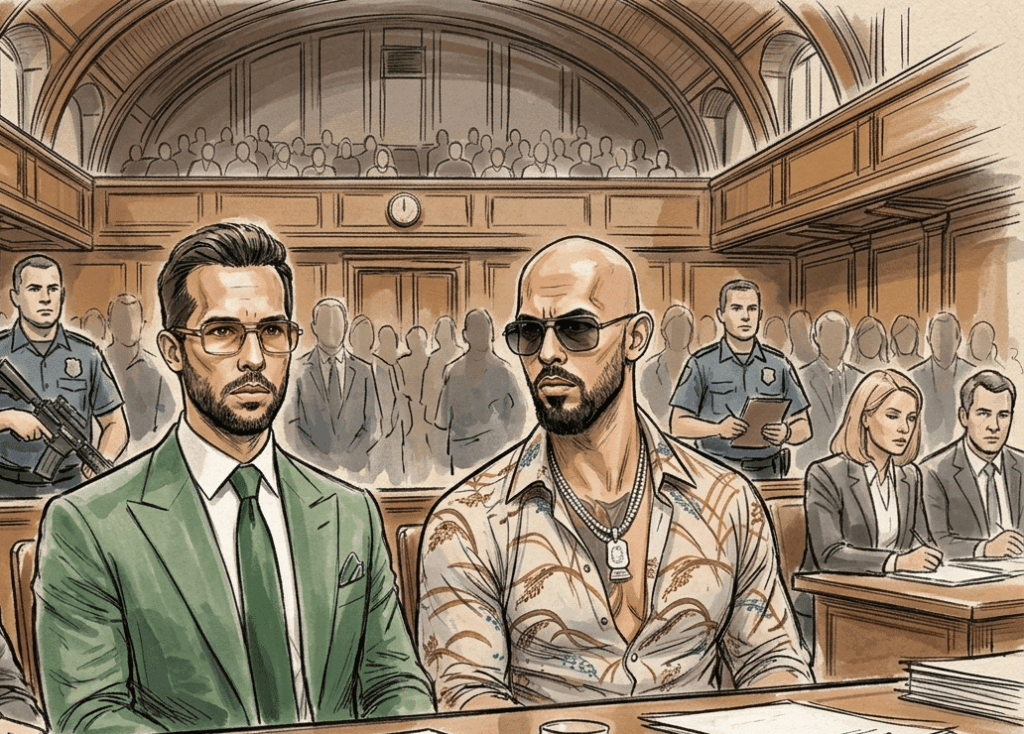
On Thursday 13 August, a federal magistrate in Miami will decide whether Andrew and Tristan Tate spend the next year in a cell. The law is stacked against release. The optics are not stacked the same way. A reader's guide to what will and will not be decided in that courtroom — and to everything that has happened in the twenty-six days since the arrests.
1. Tomorrow is not a trial — and what happens there is not what you think
On Thursday morning, Andrew and Tristan Tate will appear before United States Magistrate Judge Lauren Louis in the federal courthouse in Miami. By evening, she will have decided — or begun to decide — whether the brothers spend the rest of this year, and possibly most of next, inside a federal detention facility while Britain seeks their surrender.
What the hearing will not do is almost as important as what it will. No witness will testify about the allegations. No complainant will be examined. No item of evidence in the underlying case will be tested. The forty-two counts against Andrew Tate and the seventeen against Tristan Tate will not be adjudicated, weighed, or even substantively discussed. The brothers will not be found guilty or not guilty of anything, because American law does not give a magistrate in an extradition matter the power to find anyone guilty or not guilty of anything.
This is not a defect. It is the design. What is being heard on Thursday is a detention hearing, the narrowest and most procedurally constrained stage of an American extradition proceeding. Its sole function is to answer one question: while the extradition process runs its course, do the men wait inside a cell or outside one?
Everything else about this case — whether the charges are well-founded, whether the timing was tactical, whether the Romanian collapse bears on the British file — is for other forums, at other times, in front of other decision-makers. None of it will be resolved tomorrow. Almost all of it will shape the arguments tomorrow anyway.
2. What the magistrate is actually deciding
American extradition law, codified in 18 U.S.C. § 3184, assigns the magistrate a three-part function at the certification stage: confirm that a valid treaty exists, confirm that the offence charged is extraditable under that treaty, and confirm that there is probable cause to believe the person before the court committed it. None of those three questions is before the court on Thursday. Those questions come later, at the extradition hearing proper, after Britain files its full request on 16 September.
Thursday's hearing is about bail. And the bail framework in extradition cases is unlike anything in ordinary American criminal procedure, in ways that cut decisively against the defence.
Under ordinary federal bail law, governed by the Bail Reform Act of 1984, release is the default unless the government proves the defendant is a flight risk or a danger to the community. In extradition cases the default flips. Under a line of precedent running through United States v. Wroclawski and the circuit courts' glosses on the 1908 and 2003 treaty frameworks, detention pending extradition is the norm, and the burden shifts to the defendant to show that special circumstances justify release. The phrase "special circumstances" has no statutory definition. It has been defined only by what it is not: not the strength of the defence's eventual case, not the defendant's community ties alone, not the defendant's professional obligations alone, and not the defendant's medical or family circumstances alone.
The rationale is diplomatic, not penal. The United States has committed by treaty to producing the person if the request succeeds. A released defendant who disappears — who boards a private aircraft to a jurisdiction without an extradition treaty, or who simply fails to appear for a surrender date — creates a treaty breach and an international incident. The magistrate is not being asked to decide whether the men are guilty. She is being asked to decide whether the United States can be sure of being able to hand them over if required.
That framing shapes everything about the hearing. The burden is on the defence. The evidence threshold is not "beyond reasonable doubt" — it is not even the civil balance of probabilities. It is the magistrate's assessment of risk, informed by the treaty relationship, by the nature of the offences, and by the defendant's profile.
3. The case for detention, and the case for release
The government's argument will be short, structurally simple, and statistically favoured to win. It has three components.
Flight risk. The Tates hold dual British and American citizenship, meaning they have legal access to two passports, two countries of residence, and a network of third jurisdictions in which they have lived or owned property. They have lived in Romania, Florida and Dubai in recent years. They have substantial assets, though most are now encumbered by the British civil forfeiture proceedings. They have a documented history of international movement. And — this is the element the government will weight most heavily — they face a combined fifty-nine counts in Britain, with potential sentences running to life imprisonment on the rape and trafficking counts, which under standard bail analysis maximises the incentive to flee.
Danger to the community. The government will cite the nature of the offences charged — rape, sexual assault, human trafficking for sexual exploitation, and, in Andrew's case, nineteen counts involving indecent images of a child and extreme pornography. Under the Bail Reform Act's dangerousness provisions, certain classes of charge create a rebuttable presumption in favour of detention. Sexual offence charges with multiple complainants over a long period sit inside the zone where that presumption operates.
The international obligations of the United States. The government will remind the court that the treaty exists to be honoured, and that releasing high-profile defendants pending extradition is a decision with diplomatic consequences beyond the immediate case.
The defence argument, led by attorney Joe McBride, will be longer, structurally more complex, and statistically likely to lose. It also has three components.
The men's conduct. The Tates came to the United States lawfully in February 2025, after Romanian prosecutors lifted the travel ban that had confined them for two years. They lived openly in Florida and Dubai for seventeen months. They did not flee. They did not conceal themselves. They ran a business, gave interviews, were photographed constantly, and were, as a practical matter, the most visible private citizens in the state of Florida. The defence will argue that a defendant who has been an international public figure for a decade cannot realistically be imagined disappearing — that the prospect of hiding, with ten million followers on a single platform and a globally recognisable face, is not a genuine risk but a hypothetical one.
The proposed bond package. The defence is expected to propose electronic monitoring, surrender of all passports, confinement to a specified Florida address, a substantial cash or property bond, and regular reporting to the court. The package will be designed to answer every specific concern the government raises, and to create a record on which any eventual appeal can argue that the magistrate's refusal was unreasonable.
The delay and the procedural history. Here the defence will attempt to argue what the rule of non-inquiry may make impermissible: that the underlying case is weak, that it collapsed in Romania, that the British file is being prepared under time pressure, and that the brothers are being held on the strength of a document that has not yet been delivered to the court. The rule of non-inquiry bars the magistrate from weighing the fairness of the British prosecution — but it does not bar the defence from arguing that the American process of detention, in the absence of the filed British package, has not yet shown that the treaty conditions are met.
4. The rule of non-inquiry: what the magistrate will not hear
One doctrine will shape the contours of the hearing more than any other, and it is worth understanding clearly, because it explains why the defence's strongest public arguments will not be made in court.
The rule of non-inquiry holds that American courts do not investigate the fairness of the requesting country's justice system, the motives of its prosecutors, or the treatment awaiting the accused. These are matters for the executive branch, not the judiciary. The rule has been consistently upheld, most recently in the context of requests from countries with documented due-process problems, and it applies with particular force to requests from treaty partners with mature legal systems.
What this means in practice is that the magistrate will not weigh whether the timing of the July charges was tactical. She will not weigh whether the Romanian collapse bears on the credibility of the British file. She will not weigh whether the transfer of decision-making to the Secretary of State at the final stage renders the whole proceeding structurally political. Those arguments — the arguments the defence has made publicly and will continue to make publicly — cannot be made to her, because the doctrine removes them from her consideration.
The venue for those arguments is the political stage: the submissions to the Secretary of State, the diplomatic channel, and ultimately the court of public opinion. They will not feature in the courtroom on Thursday.
5. The probable outcome — and why
Based on the statistical record of extradition detention hearings in the United States, the brothers are more likely than not to be held. The presumption of detention is strong, the flight-risk factors are real, the nature of the charges weighs heavily, and the magistrate will be conscious of the diplomatic and treaty consequences of a failed surrender.
That said, the outcome is not foreordained. The brothers' conduct over the seventeen months of lawful residence in the United States is the strongest single fact in their favour. Their profile, which the government will cite as evidence of means, can also be cited as evidence of visibility — a man watched by ten million people cannot plausibly disappear. And the absence of the British extradition package, which is not due for another thirty-four days, creates a genuine legal question about whether the treaty conditions for continued detention have yet been formally met, or whether detention pending certification is itself proper at this stage.
The base rate in similar cases is that detention is continued. The record of this particular case — its unusual publicity, its contested procedural history, the visibility of the defendants — makes it marginally more open than the base rate suggests. The magistrate may also defer a ruling, ordering further filings and continuing the matter, which in practice means continued detention while everyone waits.
6. The last twenty-six days: how we got here
The hearing on Thursday is the twenty-seventh day of an eventful phase of the case, and it is worth setting out the sequence in full, because the speed of the recent developments is the single most striking feature of the past month.
18 July 2026. The Crown Prosecution Service announced thirty-eight further charges against the brothers, bringing the totals to forty-two counts for Andrew Tate and seventeen for Tristan Tate. The charges included rape, arranging or facilitating trafficking for sexual exploitation, assault occasioning actual bodily harm, and, in Andrew's case, nineteen counts involving indecent images of a child and extreme pornography. The CPS stated that the case involved seven alleged victims and conduct alleged between July 2010 and August 2017. Within hours, US Marshals arrested the brothers in Miami.
20 July 2026. The brothers appeared before a federal magistrate for their initial appearance. The government confirmed that the arrests were pursuant to extradition proceedings. Britain's full extradition request was confirmed to be due within sixty days of arrest — that is, by 16 September.
27 July 2026. Attorneys for the brothers met federal prosecutors in Miami to set a procedural schedule. Magistrate Judge Lauren Louis set the detention hearing for 13 August. Britain's full extradition request was confirmed to be due by 16 September. The brothers remained in custody.
28 July 2026. The government's position on detention was made clear in filings and courtroom statements. The brothers' counsel confirmed they would seek release on bail, and outlined the proposed bond package in general terms.
August 2026. Over the intervening two weeks, both sides have filed supplementary papers. The defence has emphasised the brothers' conduct during their seventeen months of lawful residence in the United States. The government has emphasised the seriousness of the charges and the international-flight risk. Britain has continued preparing the full extradition package. Romania's DIICOT has announced a further separate investigation on allegations of trafficking of minors and asset removal, the evidential content of which remains unclear.
Throughout, the brothers' representatives have maintained their public position that the case is politically motivated — language that has included "stitch-up job" and "political kidnapping" — while the legal arguments they have actually filed have been confined to procedural grounds.
7. What happens after Thursday
Whatever the magistrate decides, the case moves forward on the same clock.
If release is granted, the brothers will be confined to a specified address under electronic monitoring while Britain's full extradition request is prepared. If release is denied, they remain in federal custody. Either way, the next hard date is 16 September, the deadline for Britain to file the full extradition package. That document will then be tested at the extradition hearing proper, likely in the autumn, where the magistrate will examine whether the treaty conditions are met — a different and legally heavier question than the one being heard on Thursday.
If the magistrate certifies the case, the brothers may petition for a writ of habeas corpus in the district court. That process takes months. Only after habeas is exhausted does the case go to the Secretary of State for the final surrender decision — a decision that is political rather than judicial, and that has no fixed deadline.
The earliest realistic date at which the brothers could be surrendered to Britain, assuming every procedural step goes the government's way, is the spring of 2027. The earliest realistic date at which a British criminal trial could begin is later still.
8. What the world is not being told
Two absences are worth noting as the hearing approaches.
The first is the absence of the British extradition package itself. The men have now been in custody for twenty-six days on the strength of a provisional arrest. The document that is supposed to justify that arrest, in full, does not yet exist in the American record. It is due in thirty-four days. The provisional arrest framework anticipates this and is lawful — but the interval is the interval in which the entire legitimacy of the detention is being constructed retrospectively, and it is the interval the defence will exploit hardest on Thursday.
The second is the absence of any mechanism by which the factual allegations against the brothers can be tested. Extradition proceedings do not weigh guilt. A bail hearing does not weigh guilt. A habeas petition does not weigh guilt. The only forum in which the seven complainants' accounts will ever meet the brothers' denials in a legally consequential way is a British criminal trial — and that forum is, at the earliest estimate, more than a year away.
This is not a criticism of the system. Extradition is designed to move defendants efficiently to the country of trial without prejudging the trial. It is not designed to resolve disputes. But it is a fact worth holding on to as the coverage of Thursday's hearing rolls in: whatever the outcome, nothing about the substance of the case will have been decided. The men will either wait in a cell or wait at an address. The allegations will remain allegations. The denials will remain denials.
That is where the case has been since December 2022. That is where it will be on Friday morning.

Discussion
No comments yet. Be the first to join the discussion!
FOLLOW US

Recent Posts

Energy Ceasefire: Trump Says Russia and Ukraine Agree to Halt…

Allianz Partners Launched Metaportal to Transform Digital Travel Insurance in…

Berkshire Hathaway Insurance Earnings Fall 14% as Rising Geico Claims…

Wildlife Park Confirms Tiger Altai Will Not Be Euthanized After…

Social Security 2027 COLA Announcement: Retirees Await a Potential 3.5%…

AP Poll Top 25: Georgia Claims No. 1 After Beating…

Human Smuggling Ring Leader Sentenced to 22 Years
Don’t Miss It
Meta’s Muse AI Agent #1 in App Store Charts, Consumer Trust Will Determine Its Future
By – Jackie AllenAnthropic IPO Comes With Extraordinary Risks
By – Jackie AllenParamount Skydance Aims to Reshape Hollywood After Warner Bros. Discovery Acquisition
By – Jackie AllenOpenAI Defends Firing of Three Safety Researchers as AI Risks are Highlighted
By – Jackie AllenA.J. Armstrong: Former NFL Player’s Son Faces New Hearing in Parents’ Murder
By – Jackie AllenShotSpotter Technology: Police Departments Can Now Detect Gunshots
By – Jackie AllenPanama’s 7.7 Earthquake Batters Communities While The Canal Keeps Global Trade Moving
By – Samuel LopezNYC’s RICO-Complaint Accuses Manhattan Injury Firm of Turning Real Injuries Into Bogus City Claims
By – Samuel Lopez
Ex-Anthropic Researcher Says He’s 90 Percent…
What Readers Need to Know Former OpenAI and Anthropic researcher…
By – Samuel Lopez
AI Agents Find Potential Spintronic Semiconductor…
3 Key Takeaways More than 90 AI agents helped identify…
By – Samuel Lopez
Federal Judges Tell Trial Lawyers the…
What Lawyers Should Know Before Walking Into Court Know your…
By – Samuel Lopez
Trump Takes Hillary Clinton 2016 Election…
What Happens Now Trump is asking the Supreme Court to…
By – Samuel Lopez
Mother of Dead Russian Plague Lab…
What Readers Need to Know Darya Shipilova’s mother says the…
By – Samuel Lopez
Kelvin Wave Damage Hitting California Coastline…
By Samuel López | USA Herald LONG BEACH, Calif. —…
By – Samuel Lopez
Kelvin Wave Damage Hitting California Coastline…
By Samuel López | USA Herald LONG BEACH, Calif. —…
By – Samuel Lopez
Trump Turns to Russian Diesel as…
WASHINGTON — President Donald Trump announced a Russian diesel supply…
By – Michallie Harrison
Tropical Storm Rachel Floods Southern California…
Tropical Storm Rachel is bringing a growing coastal threat to…
By – Rachel Moore
Benson Enterprises $430K Sex Discrimination Settlement…
Benson Enterprises Inc., an operator of automotive dealerships that includes…
By – Rachel Moore
Intel Injury Suit Coverage: Travelers Challenges…
Two insurance companies affiliated with Travelers have asked an Oregon…
By – Rachel Moore
Fortify $5.3M Motel Damage Suit: Developer…
A real estate development company is pushing back against two…
By – Rachel Moore
Cornell Rape Case Raises a Difficult…
SIDEBAR Major research generally places demonstrably false sexual-assault reports at…
By – Samuel Lopez
Artificial: Andrew Garfield Says Playing Sam…
Artificial intelligence has become a growing source of debate in…
By – Jackie Allen
Hegseth’s Execution Livestream Is a Disgrace
The Pentagon plans to livestream the firing-squad execution of Nidal…
By – Michallie Harrison
Christa Pike Survived. Can Tennessee Execute…
NASHVILLE, Tenn. — Christa Pike is conscious and speaking after…
By – Michallie Harrison
State’s Consent to Sex Laws Face…
The debate over consent to sex is intensifying after allegations…
By – Jackie Allen
Cornell Gang-Rape Investigation: Accuser Says She…
The Cornell gang-rape allegations have come under renewed scrutiny after…
By – Jackie Allen
NFL Pro Tyreek Hill Takes the…
What the Jury Is Hearing Lakeeta “Keeta” Vaccaro Hill testified…
By – Samuel Lopez
Arizona Court Cyberattack Exposes 1.3 Million…
What Arizona’s Court Breach Exposed A phishing link apparently opened…
By – Samuel Lopez
Gemini Insurance Company Tells Judge An…
What’s Inside the Ad.com Coverage Fight Gemini Insurance says Ad.com’s…
By – Samuel Lopez
Terrell Owens Sued By Nolan Wells’…
What Readers Need to Know Three young men who were…
By – Samuel Lopez
Army Report Finds Cascading Safety Failures…
What the Army’s Investigation Reveals The Army concluded that failures…
By – Samuel Lopez
Kevin Hart’s 2017 Sex Tape Could…
SIDEBAR Kevin Hart’s former assistant Miesha Shakes has identified both…
By – Samuel Lopez
Kevin Hart’s 2017 Sex Tape Could…
SIDEBAR Kevin Hart’s former assistant Miesha Shakes has identified both…
By – Samuel Lopez
Judge Newman Wins Independent Review As…
What Changed for Judge Newman Judge Pauline Newman has finally…
By – Samuel Lopez
DeSantis Slams Anthropic’s Clergy Meetings As…
Inside the Claude Clergy Controversy DeSantis says Anthropic wanted clergy…
By – Samuel Lopez
Cornell Gang-Rape Investigation: Accuser Says She…
The Cornell gang-rape allegations have come under renewed scrutiny after…
By – Jackie Allen
Arizona Candidate Alleges Rape While Repairing…
Candidate alleges rape after she says she was attacked while…
By – Jackie Allen
Emergency room visits Double After Online…
Emergency room visits tied to gambling disorders doubled after Ontario…
By – Jackie Allen
Could a COVID-Level Outbreak Disrupt Russia’s…
By Samuel López | USA Herald Russia’s mysterious Siberian health…
By – Samuel Lopez
Russian Lab Worker’s Mystery Pneumonia Death…
WHY THIS CASE DESERVES ATTENTION A 28-year-old worker at Russia’s…
By – Samuel Lopez
ICE Fines: Judge Halts Rule Behind…
BOSTON — A federal judge has halted a Trump administration…
By – Michallie Harrison
Russia Plague Scare Follows Lab Worker’s…
A Russia plague scare has prompted medical monitoring and reported…
By – Michallie Harrison
OSHA Wants Overdose Reversal Kits at…
Inside OSHA’s Overdose Playbook for Employers OSHA wants naloxone kept…
By – Samuel Lopez
NFL Concussion Claims Count as Separate…
What the Coverage Ruling Means Each former player’s claim counts…
By – Samuel Lopez
California Sends Cease and Desist Letter…
What Matters in This Fight California regulators have reportedly ordered…
By – Samuel Lopez
Costco Faces $5 Million Sugar-Free Lawsuit…
By Samuel López | USA Herald Costco Wholesale Corporation is…
By – Samuel Lopez
NFL Concussion Claims Count as Separate…
What the Coverage Ruling Means Each former player’s claim counts…
By – Samuel Lopez
JJ McCarthy Trade Sends Former First-Rounder…
Two years ago, a franchise spent a top-10 pick on…
By – Tyler Brooks
New York Sues Polymarket Claiming Prediction…
What This Fight Is Really About New York says Polymarket…
By – Samuel Lopez
New York Sues Polymarket Over Alleged…
What’s Riding on the Bet New York says Polymarket’s sports…
By – Samuel LopezNo posts found.
No posts found.


Join the Discussion
Share your thoughts, ask questions, and engage with
other readers. Sign in or create a free account to
comment.