

Upwork’s Strategic Embrace of AI Could Push the Stock to $25, According to Experts!
America ı By Rochdi Rais
0 Comments

Upwork – the world’s largest online work marketplace – has gone all-in on artificial intelligence, positioning itself at the forefront of how AI can enhance hiring and freelancing. In the past two years, the company has rolled out a series of AI-driven features, partnerships, and investments that weave AI into the core of its platform. Upwork’s leadership touts these innovations as amplifying human talent rather than replacing it, and early results suggest a positive impact on everything from project matching to the firm’s financial performance. Below, we delve into Upwork’s recent AI initiatives, executive commentary on its vision, industry impact, investor sentiment (including the path to a potential $25 stock), and how Upwork’s AI strategy stacks up against competitors – all pointing to a compelling story for tech investors and professionals.
AI-Powered Platform Innovations and Partnerships
Upwork has aggressively integrated AI across its product offerings. A centerpiece is “Uma,” Upwork’s Mindful AI assistant, introduced in spring 2024 as an “always-on” companion and now evolved into a fully-fledged AI “work agent.” Uma helps clients and freelancers draft job posts and proposals, evaluate candidates, and even conduct interviews. With the recent Summer 2025 platform update, Uma gained 75+ new capabilities – such as instant AI-driven interviews where clients provide questions and receive auto-generated summaries of freelancer responses. As a result, Uma now powers the majority of new client job posts on Upwork, helping clients post jobs 70% faster and contributing to an 8% higher fill rate for high-value projects. This AI agent is streamlining workflows that used to take days, underscoring Upwork’s drive to use AI for “faster outcomes for businesses and freelancers”..
Upwork’s platform now features an AI Services hub and Uma AI assistant tools, giving users access to generative AI features and resources. The AI Talent and AI Tools pages (pictured) serve as a central destination where freelancers can find AI-powered apps, offers, and even GPT-4–driven productivity aids to supercharge their work.
Beyond Uma, Upwork launched a suite of generative AI tools and partnerships to empower its users. In late 2023, the company debuted an AI Services Hub with integrations to leading AI products – partnering with Adobe, Amazon, ClickUp, Miro, and others – so that freelancers can leverage cutting-edge generative AI software (for example, Adobe’s Firefly generative tools or Amazon CodeWhisperer for coding) Simultaneously, Upwork rolled out “Upwork Chat Pro,” a GPT-4-powered conversational assistant embedded in the platform to help professionals complete work faster with AI-generated insights. The company also created an AI education library in its Upwork Academy, offering courses from Coursera, Jasper, and Udemy to help talent build AI skills. “Independent professionals on our marketplace – from top-tier AI engineers to creatives – are eager to use the latest generative AI tools to do their most productive work,” noted Dave Bottoms, Upwork’s SVP of Product, adding that these apps and resources help even skilled pros “enhance workflows, effortlessly automate tasks, and complete projects with increased efficiency.”

Upwork’s AI push is also marked by high-profile partnerships. Notably, in mid-2023 Upwork partnered with OpenAI (the creator of ChatGPT) to launch the “OpenAI Experts on Upwork” program. This co-designed initiative gives OpenAI customers and other businesses direct access to pre-vetted freelance experts in OpenAI technologies. The program draws from over 250 AI-related skills on Upwork (including GPT-4, Whisper, and ML integration) and uses Upwork talent managers to curate specialists for clients’ AI projects. “Partnering with a pioneer like OpenAI helps us deliver access to the specialized talent businesses need to achieve their most ambitious AI initiatives,” said Dave Bottoms, emphasizing that through such strategic alliances “we aim to make Upwork the preeminent destination for AI-related talent and work.” This partnership not only funnels more AI work to Upwork’s freelancers but also showcases Upwork’s commitment to responsible AI deployment (OpenAI’s team noted the goal of ensuring AI models are used beneficially with skilled oversight).
In addition to organic product development, Upwork has made targeted acquisitions to bolster its AI capabilities. In late 2024, the company acquired Objective AI, Inc., an AI-native search technology firm, to enhance Upwork’s search and matching algorithms. The Objective AI team and tech were swiftly integrated to improve talent-client matching on the platform – an investment already yielding “promising effects on gross services volume” according to Upwork’s CEO. These moves underscore that Upwork is not just adding AI features superficially – it’s infusing AI into the platform’s very infrastructure, from search to customer support, to create what management calls a “truly AI-native platform.”
Executive Vision: “AI + Humans” at the Heart of Upwork
Upwork’s top executives are unabashedly vocal that AI is central to the company’s future. CEO Hayden Brown frequently highlights how AI is the next seismic shift in technology – and that Upwork intends to lead this shift in the work marketplace space. “Upwork has helped businesses reinvent through every work transformation of the last 20 years... With AI being the next and biggest paradigm shift, Upwork is becoming the critical infrastructure for enabling the combination of humans and AI to work together to achieve business outcomes,” Brown said on a recent earnings call. She pointed out that while “AI is rapidly changing every company from the smallest startups to the largest enterprises,” a major AI skills gap exists – with 63% of employers saying lack of AI skills is a top barrier – and that Upwork is a “critical resource” for organizations navigating this transformation. In other words, Upwork sees itself as the bridge connecting companies to the talent needed to implement AI, just as it did for prior tech booms (from cloud to mobile).
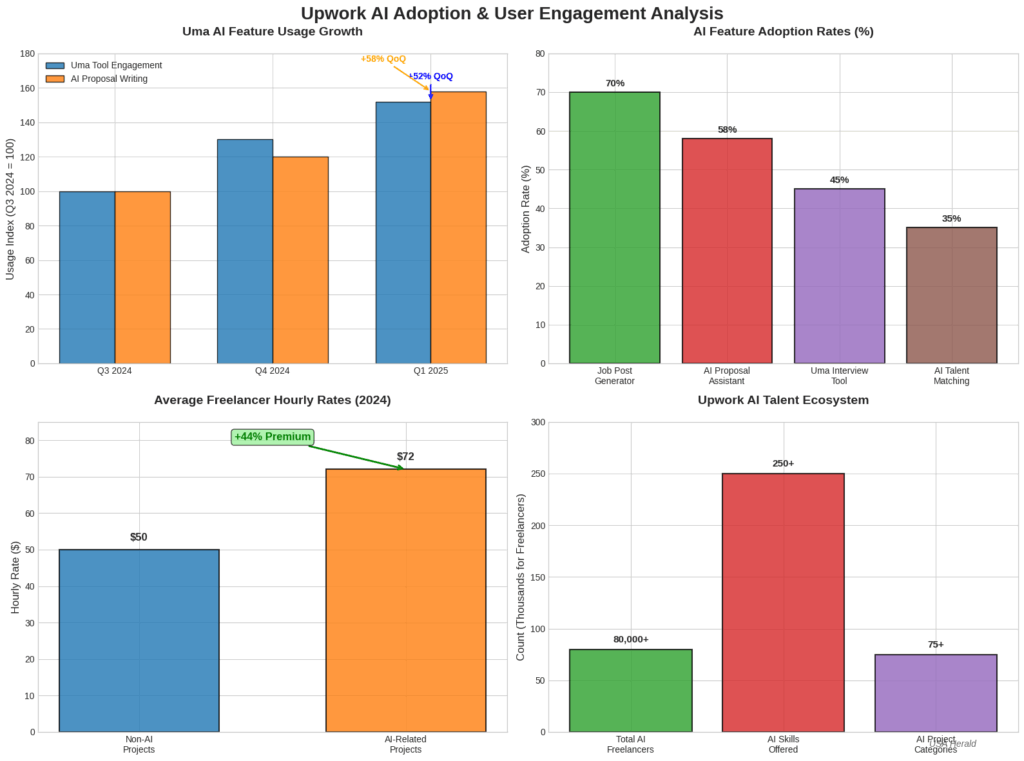
Crucially, Brown reports that Upwork’s AI strategy is already driving tangible results. “We’ve rapidly unlocked demand for AI-related work on our platform,” she noted in prepared remarks for Q4 2024. Indeed, Upwork’s internal data show that in 2024 the gross services volume (GSV) from AI-related projects grew by 60% year-over-year, and the number of clients posting AI-focused jobs jumped 42%. That surge contributed to Upwork’s record-high revenues in 2024 (reaching $769 million, +12% YoY) – achieved even as the broader staffing industry saw a 9% decline. Brown directly attributes Upwork’s outperformance to its early bet on AI: “Strategic investments in AI are already driving customer engagement and productivity, laying the groundwork for long-term market share gains,” she said. By Q1 2025, usage of Upwork’s AI features had skyrocketed – 52% more users engaged with Uma’s tools quarter-over-quarter, and AI-driven proposal writing usage jumped 58%. These are meaningful engagement lifts, translating to faster hiring cycles and more work getting done on the platform.
Upwork’s product leaders echo the CEO’s enthusiasm. “Work is being reshaped in real time as intelligent agents become a more familiar and essential part of how work gets done,” observed Dave Bottoms in the Summer 2025 release, framing AI as an “essential part” of modern workflows. In his view, Upwork’s job is to combine “human expertise and AI innovation” in ways that “solve problems, achieve results, and deliver meaningful work at scale.” This philosophy – AI as an amplifier of human “brilliance” rather than a threat – underpins Upwork’s marketing and product design. Notably, even as Upwork automates aspects of hiring (like screening via AI interviews), it emphasizes that the human element remains critical: AI handles the drudge work and initial analysis, so that clients and freelancers can focus on creative and high-value tasks. Upwork was even recognized by Fast Company as one of 2025’s Most Innovative Companies in the HR category for this AI-forward yet human-centric approach. The accolade specifically cited Upwork’s AI-driven work solutions – from the Job Post Generator (used by 70% of new clients) to Uma’s impact on hiring and project delivery – as transforming talent engagement.
Upwork’s leadership also speaks to the broader future of work they are enabling. “As the AI work tide builds, organizations of all sizes are seeking out more flexible talent models – with partners who integrate cutting-edge AI technology and valued human workers seamlessly and at scale,” Hayden Brown remarked. Upwork clearly aspires to be that partner. At the same time, Brown added, professionals worldwide “want digitally powered ways of working that give them easy access to more autonomy, flexibility and earning power.” By investing in AI, Upwork is catering to both sides of its marketplace: helping clients get work done faster and more efficiently, while empowering freelancers to earn more and learn the latest skills. This vision – where AI is a teammate to humans – permeates Upwork’s strategy and messaging.
How AI is Transforming Freelancing (Upwork’s Playbook)
From matching the right talent to the right job, to speeding up project execution, AI is redefining freelance and gig work processes – and Upwork provides a prime case study. One major impact area is hiring efficiency. Upwork’s AI features have dramatically shortened the time and friction in recruiting independent talent. For example, Upwork’s AI Job Post Generator helps clients craft detailed job descriptions in moments; over 70% of new clients are now opting to use this AI writing tool when creating a job post. This contributes to jobs being posted faster and with clearer scopes, which in turn leads to quicker matches. On the freelancer side, AI Proposal Assistants (like the Proposal Writer introduced with Uma) help freelancers auto-draft tailored proposals, saving them time and improving their win rates. The result: Upwork has observed higher volumes of proposals and bids, improved client conversion, faster time-to-hire, and even higher earnings for freelancers since deploying these AI tools. In fact, freelancers using AI on Upwork earned 44% higher hourly rates in 2024 than those who didn’t work on AI projects, reflecting the premium for AI-related skills and the productivity boost AI tools can lend.
AI is also enhancing the quality of matches and collaboration on Upwork. The platform’s machine learning algorithms analyze vast amounts of data (Upwork boasts the largest dataset of remote work interactions in the industry) to recommend the best talent for a job and vice versa. Upwork’s acquisition of Objective AI supercharged its search, making results more relevant and personalized. Moreover, new features like “Instant Interviews,” AI-curated candidate shortlists, and AI-generated work summaries all help clients make more informed hiring decisions quickly. For instance, a hiring manager can let Uma conduct initial voice interviews with top applicants asynchronously – Uma will ask preset questions and produce structured summaries highlighting each freelancer’s fit.
This not only saves the client’s time but also levels the playing field for talent by ensuring consistent interview experiences. Upwork reports that since Uma began assisting with candidate evaluation, high-value jobs from new clients have been filling at an 8% higher rate, meaning more successful hires, especially for complex projects. By blending AI automation with human judgment (clients can review Uma’s notes and then have final interviews themselves), the platform accelerates hiring without sacrificing quality.
Importantly, Upwork’s AI initiatives address the skills gap and training in the market. The company’s research found that 76% of freelancers are confident in their ability to learn new AI tools, and Upwork is actively channeling this enthusiasm. Through its AI Education Library and Academy, freelancers can upskill in areas like prompt engineering, building AI chatbots, and using popular AI APIs. This not only makes talent more marketable (which benefits Upwork via more engagements) but also reassures clients that the freelancers they hire are adapting to the latest technologies. In effect, Upwork is cultivating an AI-ready workforce on its marketplace. A senior designer using Upwork’s AI resources summed it up: “Upwork is meeting the moment and providing the latest tools and resources I need to enhance my workflows, boost productivity, and work with incredible speed and efficiency.”

The transformative impact is evident in real-world projects facilitated by Upwork. Brown shared examples like a global social media platform hiring Upwork experts to ensure the quality of LLM training data, a pharma giant engaging an Upwork-based AI agency to build healthcare AI solutions, and a law firm using freelancers to create a custom GPT for their knowledge base.
These cases illustrate that companies increasingly turn to on-demand talent for cutting-edge AI projects, not just routine tasks. Upwork now hosts over 80,000 AI-specialized freelancers globally – data scientists, machine learning engineers, prompt writers, etc. – who have already delivered AI solutions in every domain from software to marketing. And that pool is growing daily as AI adoption climbs. This makes Upwork’s marketplace a vital conduit for AI innovation: businesses can quickly find expertise in GPT-4 integration, computer vision, NLP, data labeling and more, while skilled professionals can capitalize on the AI wave without traditional employment frictions. In short, AI is supercharging the gig economy, and Upwork has architected its platform to ride this wave on both the demand and supply side. The result is a freelancing ecosystem where human talent and AI tools symbiotically raise the bar on what independent professionals can deliver.
Market Response and Investor Outlook (Eyeing a $25+ Upside)
Upwork’s strategic embrace of AI isn’t just a tech story – it’s increasingly a market and financial story, with investors taking notice. The company’s AI-fueled growth has coincided with improving financial performance, which in turn has bolstered investor sentiment. In early 2025, Upwork stunned markets with record quarterly results: revenue and earnings beat expectations, and adjusted EBITDA margins hit an all-time high (29%). Management cited the uptake of new AI features and robust demand for AI talent as key contributors to these results. For example, clients tapping into high-value AI projects helped lift average spend per client after several stagnant quarter. Off the back of these results, Upwork raised its full-year profit guidance, signaling confidence that the AI momentum is sustainable
Wall Street analysts have begun to highlight Upwork’s AI trajectory in their evaluations. Zacks Investment Research selected Upwork as a “Bull of the Day” stock in May 2025, noting: “The company’s strategic pivot toward AI integration appears to be gaining traction, driving both customer engagement and long-term profitability.”The report pointed out that Upwork’s earnings estimates were on the rise and that its stock chart had broken out of a slump, with bullish technical momentum building. Despite a tough macro environment for tech, Upwork’s AI differentiation was seen as an “intriguing setup for growth-oriented investors,” especially given the company’s improving margins and resilient execution. Similarly, a Yahoo Finance analysis (by Zacks) called Upwork “an AI talent powerhouse” and emphasized that UPWK is fast becoming the go-to platform for firms tackling complex AI projects beyond basic automation.
Crucially, price targets for Upwork have been edging upward as the market bakes in the AI opportunity. While the consensus 12-month target among analysts is around $18–19 (implying healthy double-digit upside), some bullish analysts see far more headroom. In fact, recent price targets range as high as $25 a share for Upwork. (For context, Upwork’s stock has traded in the low-to-mid teens for much of 2023–2024.) A Seeking Alpha analysis noted these $19–$25 targets and argued that the market was “underestimating” Upwork’s growth prospects, especially given the company’s net cash position and leverage to the AI trend. Even large banks have warmed up: for example, Goldman Sachs in late 2024 reportedly set a high-end target near $24. To reach the mid-$20s would likely require continued execution, but investors bullish on AI adoption in staffing see Upwork as a prime beneficiary that could justify such valuations. The stock’s forward price-to-sales ratio remains below peers and historical levels, so if AI-driven revenues accelerate, multiples could expand.

It’s worth noting that Upwork’s public recognition and thought leadership in AI also bolster investor confidence. Being named a Fast Company Innovator for its AI work and landing on lists of top AI-fueled companies has given Upwork added credibility. The company has formed an Economic Advisory Council focused on AI’s impact on work and launched a Research Institute to guide organizations in workforce transformation, positioning itself as a forward-looking authority in the space. All these efforts signal to investors that Upwork is not resting on its freelancer marketplace laurels – it is actively evolving with the AI era.
Of course, the market will continue to watch how effectively Upwork converts AI buzz into sustained growth. Metrics like GSV, client spend, and active clients will show if AI features drive more activity and attract new users. For now, early signs are encouraging: even as total active clients dipped amid macro pressures, spend per client is rising again (up year-over-year in Q1’25 for the first time in 6 quarters) and big clients are signing on to AI-enabled premium offerings like Upwork’s Business Plus plani. Analysts have remarked that Upwork is showing “renewed strength” after a period of weakness, with the AI strategy contributing to that turnaround. Should the trend continue, the stock’s current levels could indeed prove a springboard – with $25+ as a plausible near-term milestone, and even more upside long-term if Upwork solidifies itself as the premier platform for AI-age freelancing.
Competing in an AI-Empowered Gig Economy: Upwork vs. The Rest
Upwork is not alone in leveraging AI in the freelancing and staffing world – but its approach has some clear differentiators when compared to competitors like Fiverr and traditional staffing firms. Fiverr, another major freelance marketplace, has also embraced generative AI but with a different focus. Fiverr’s strategy centers on creative services: in 2025 it launched “Fiverr Go,” an AI platform aimed at creative freelancers (designers, writers, voice artists). Fiverr Go allows freelancers to train personalized AI models on their own work and use AI tools to augment their creative output, all while keeping the human creator in control. Fiverr’s CEO Micha Kaufman contrasted this with other AI solutions that “exploit human creativity”; Fiverr Go is meant to “empower a robust ecosystem of humans and AI that deliver beautiful results… while supercharging freelancers’ earning power,” he said. In practice, Fiverr is opening its large transaction dataset and 6.5 billion+ user interactions to enable third-party developers to build AI applications on its platform – essentially an app store for AI tools that freelancers can plug into their gigs. It’s a bold experiment to merge an open developer ecosystem with a freelance marketplace, and if successful, it will ensure AI “augments rather than replaces” creative workers on Fiverr.
Upwork’s positioning vs Fiverr skews more towards technical and professional services and enterprise clients. Upwork’s AI integration is deeply baked into core marketplace functions (search, job posting, hiring workflow), and it spans over 250 skill categories including software development, data science, and AI engineering – domains where Upwork traditionally has strength. While Fiverr has a high volume of quick-turnaround gigs, Upwork tends to facilitate larger or longer-term projects (its average client spend is several times higher than Fiverr’s). Thus, Upwork’s “AI Work Agent” approach (Uma) is tailored to speeding up multi-step hiring processes and managing complex projects (even assembling “optimal teams of experts” for a project, as Uma can now do). Fiverr’s AI, conversely, leans toward creative collaboration tools. Both firms share the philosophy that AI should help, not hurt, freelancers: Fiverr’s marketing explicitly reassures that humans remain at the center, and Upwork similarly emphasizes human-AI collaboration (Uma’s name even stands for a mindful assistant). However, Upwork appears to be ahead in directly embedding AI into user workflows at scale – evidenced by the high opt-in rates for its AI features and the fact that a majority of new job posts on Upwork are now AI-assisted. Upwork also partnered with enterprise tech players (OpenAI, Microsoft via Azure OpenAI services, etc.), signaling to big corporate clients that it’s serious about providing top-tier AI talent and tools.
Beyond Fiverr, other competitors include traditional staffing agencies and newer gig platforms. Large staffing firms have begun touting AI in their candidate vetting or workforce management, but they lack the breadth of Upwork’s freelance talent pool. Niche freelance sites may specialize in AI experts (for example, marketplaces just for data scientists), yet Upwork’s advantage is its scale and diversity – it can fulfill a wide array of AI needs in one place, from a quick machine-learning consultation to a full software development team for an AI project. Upwork’s recent partnership with Beeline (a Vendor Management System) to integrate its marketplace into enterprise procurement systems hints that Upwork is also targeting contingent workforce programs of large companies, an area where its AI capabilities (and enterprise compliance features) could differentiate it further. Notably, Upwork’s Business Plus and Enterprise offerings now come with AI-driven tools (like talent benchmarking, AI project scoping via Uma, etc.) that traditional staffing can’t easily match.
To the extent that generative AI poses a disruption risk – e.g. clients using ChatGPT instead of hiring for basic copywriting – Upwork’s focus on higher-value projects provides some insulation. In fact, while lower-end gig work might be automated away, demand for advanced AI implementation work is rising, and Upwork is tapping into that. A Seeking Alpha report on Fiverr noted its marketplace saw some pressure from generative AI as small businesses tried AI tools internally. Upwork, by contrast, is attracting companies that realize they need skilled experts to effectively apply AI. The company’s data shows clients are seeking specialists in things like prompt engineering and AI integration – tasks that require human expertise despite AI’s help. In short, Upwork’s AI strategy is to climb “up the value chain”, ensuring the platform is where businesses turn when they want to go beyond off-the-shelf AI and actually build custom solutions or adopt AI in meaningful ways. This strategic differentiation could prove decisive as the freelance marketplace sector evolves.
Conclusion: An AI-Augmented Future of Work – Upwork’s Leading Role
Upwork’s energetic embrace of artificial intelligence has repositioned the company at the cutting edge of the gig economy’s evolution. In a short span, Upwork has morphed from a traditional job board into what it calls a “human and AI-powered work marketplace,” where algorithms and digital assistants turbo-charge the process of connecting businesses with talent. The initiatives – from launching an AI work agent (Uma) and integrating GPT-4 across the platform, to partnering with OpenAI and educating its freelance community – all support a singular goal: make hiring and freelancing dramatically faster, smarter, and more scalable through AI. Crucially, Upwork’s narrative is one of augmentation, not automation. By letting AI handle repetitive and time-consuming tasks (like drafting postings or initial screenings), the platform frees up humans to focus on creativity, problem-solving, and building relationships. This resonates in an era when companies want the productivity benefits of AI without losing the ingenuity of human talent.
Financially, Upwork’s AI bet is beginning to pay dividends. The company is capturing surging demand for AI skills, which helped drive it to **record revenues and improved profitability in 2024. Investors and analysts have taken note, with bullish sentiment growing around Upwork’s ability to convert the AI trend into sustainable growth – some even eyeing the stock to hit the mid-$20s in the foreseeable future. To be sure, execution will be key. Upwork must continue to innovate (the competitive gap in AI features won’t last forever as others race to implement their own) and ensure that the quality of its marketplace remains high as volume scales. There’s also a balance to maintain: too much automation could alienate freelancers or clients who value the human touch, so Upwork will need to iterate with user feedback in mind. Thus far, the company seems aware of this, positioning Uma as an agent working on users’ behalf rather than a decision-maker in itself.
For tech investors and industry professionals, Upwork’s transformation offers a case study in how a platform can reinvent itself with AI. It’s not merely about slapping an AI label on marketing copy – Upwork invested heavily (over $200M in R&D in 2024, including acquiring AI tech) to deeply integrate AI into its operations. The reward is a marketplace that operates on a new level of efficiency and intelligence. Analysts have stated that Upwork’s AI-centric strategy is laying groundwork for long-term market share gains and a stronger competitive moat. Clients who experience the speed and efficacy of AI-assisted hiring on Upwork may be less inclined to return to more traditional or manual methods. Freelancers who build their AI skillset with Upwork’s resources and gain higher earnings through AI projects will likely stick with the platform that delivers those opportunities.
In the broader context, as AI becomes ubiquitous in every industry, platforms that enable flexible, on-demand collaboration between humans and AI will be in high demand. Upwork is striving to be the definitive platform for that new world of work. The company’s CEO perhaps said it best: “Upwork is well positioned to lead this AI revolution for our category, with clear advantages in the largest work dataset and scaled marketplace, the right talent and tech platform, and ample R&D investment.” In other words, Upwork has built up the data, the community, and the technology to seize this moment. If it continues to execute, Upwork’s strategic embrace of AI won’t just be a positive footnote – it could define the company’s trajectory for years to come, solidifying its role as a linchpin of the AI-enabled future of work. In the age of “AI + human” collaboration, Upwork’s bet is that it can provide the best platform for that collaboration – and so far, the bet is looking like a savvy one.
Upwork vs. Competitors: AI Adoption, Features & Market Positioning
Upwork’s AI-First Pivot: Upwork has aggressively embraced AI to enhance its marketplace. Central to this is “Uma,” Upwork’s in-house AI assistant, which the company has embedded into core workflows. Uma helps automate routine hiring tasks – from drafting job posts and writing proposals to screening candidates – making the user experience more seamless. In Q1 2025, engagement with Uma jumped 52% quarter-over-quarter (with AI-driven proposal-writing up 58%). These AI features aren’t just gimmicks; they’ve led to measurable improvements – boosting proposal volumes, client conversion rates, hiring success, and even freelancer earnings on the platform. Upwork is doubling down on this AI push both organically and via acquisitions. It acquired Headroom (an AI-powered video conferencing platform) in 2023 and Objective AI (an AI-native search/matching company) in late 2024. These “smart acquisitions” have sharpened Upwork’s talent matching algorithms and even added multi-modal search capabilities (across text, image, video, audio) to better pair clients with freelancers. By fine-tuning AI models on its proprietary data, Upwork is building highly customized AI tools tailored to freelance hiring. For example, Upwork’s team has chosen to develop in-house AI models rather than relying purely on off-the-shelf AI, allowing Uma to take “agentic” actions like autonomously coordinating interviews and recommending talent using Upwork-specific insights. This deep integration of AI into Upwork’s services positions it as an adaptive and efficient platform, aiming for stickier client retention and better unit economics over time. Notably, Upwork is also targeting larger business clients: it launched Upwork Business Plus (a premium plan) to attract mid-market and enterprise customers, and within a few months this offering has rapidly doubled its user count– a sign that bigger clients are responding to Upwork’s enhanced features and AI-enabled productivity boosts.
Fiverr: AI Matching & “Creator” Tools: Upwork’s closest marketplace rival, Fiverr, is also pursuing an AI-centric strategy – albeit with a different flavor. Historically, Fiverr’s model is to offer pre-packaged “gigs” for quick, fixed-price tasks (logo design, voiceovers, etc.). To improve matching on its platform, Fiverr introduced “Fiverr Neo,” a new AI-driven talent-matching engine that uses generative AI (large language models) to better understand client requests and recommend the ideal freelancer. Fiverr Neo gives the platform a more conversational, intelligent search interface (allowing natural language queries) and aims to streamline how businesses find freelancers. At the same time, Fiverr has expanded its marketplace categories to capture the AI services boom – for example, launching dedicated sections for AI services (chatbot development, generative art, AI content editing, etc.). In early 2025, Fiverr went a step further by debuting “Fiverr Go,” a suite of personalized generative AI tools for freelancers. Fiverr Go allows creators to train their own AI “co-pilot” on their body of work, effectively creating a custom AI assistant that learns a freelancer’s style and helps multiply their output For example, a top-rated illustrator or writer on Fiverr can use Fiverr Go to produce drafts or creative content in their signature style, drastically improving productivity without sacrificing quality. Fiverr’s marketing emphasizes that this approach keeps “the artist first” – the AI acts as a collaborator under the freelancer’s control, rather than a replacement. (The launch campaign even featured actor Brett Gelman in a comedic ad illustrating how freelancers can “train” an AI colleague to mimic their creative process). Initially limited to vetted top freelancers, Fiverr Go has added features like watermarking, voiceover licensing, and scheduling assistants, and plans to expand into more categories. In short, Fiverr’s positioning is to be an “AI-first” platform on both sides: using AI to match clients faster (through Neo) and empower freelancers to increase capacity (through Go), all while catering heavily to the booming demand for AI-related projects. This strategy aligns with Fiverr’s focus on quick-turnaround gigs and creative services – AI helps speed up delivery and handle more volume, which is key for Fiverr’s mostly SMB and entrepreneur clientele.
Toptal: High-Touch, Vetted Talent (Little AI Flash) – Toptal is a rather different competitor in the freelance space. It operates a highly curated talent network, promoting itself as providing the top 3% of freelance talent in fields like software engineering, design, finance, and consulting. Unlike Upwork or Fiverr, Toptal does not rely on open bidding or instant matches; instead, it thoroughly screens and hand-picks freelancers and then closely matches them to client engagements. Because of this model, Toptal’s adoption of AI has been more behind-the-scenes. It hasn’t publicized flashy AI products, but likely uses algorithms to assist its human matchers in searching its talent pool. On its website, Toptal now highlights Generative AI expertise as a key service line (e.g. offering to staff AI engineers, OpenAI developers, and AI project managers), indicating it’s targeting the same surge in AI projects with human experts rather than platform tools. Toptal’s market positioning is distinct: it caters to enterprise and high-end clients who want guaranteed quality and are willing to pay premium rates (often $80+/hour contracts or full-time-equivalent engagements). These clients may be less interested in self-service AI tools and more in Toptal’s white-glove project management and vetting. As a result, Toptal’s competitive edge lies in trust and talent quality. While Upwork is building AI to automate matching at scale, Toptal is somewhat analogous to a “talent agency” that might use AI internally to filter candidates but still leans on human judgment. In terms of client segments, Toptal targets larger enterprises and tech companies needing specialized talent for critical projects – including AI development itself – and it often provides account managers and support in a way marketplaces do not. The trade-off is cost and speed: Toptal placements can take days and come at a high bill rate (plus a hefty margin for Toptal), whereas Upwork/Fiverr offer immediate access and flexible pricing. For businesses that require absolute top-tier expertise or longer-term contractors, Toptal remains attractive. But as Upwork improves its matching (and even offers “Talent Scout” services – where Upwork’s team helps vet and present top candidates), the line between a curated network and a marketplace is blurring. In summary, Toptal has not led in AI-driven features; instead it banks on a high-touch, human-curated experience for both clients and freelancers. This model appeals to a different client segment than Upwork’s self-service marketplace, though both overlap in competing for enterprise budgets.
Freelancer.com and Others: Freelancer.com (an Australian-based platform) and similar sites (Guru, PeoplePerHour, etc.) are also players in the online talent market. Freelancer.com operates more closely to Upwork’s legacy model – an open marketplace with millions of users, where freelancers bid on posted projects across a wide array of categories. In terms of AI adoption, Freelancer has introduced some platform tools but nothing as prominent as Upwork’s Uma or Fiverr’s Neo. For instance, Freelancer.com has long offered “contests” as a feature (especially popular for design work), effectively crowdsourcing AI-like multiple options from humans. While not AI, this feature differentiates it: clients can get 50 logo drafts from different freelancers and pick the best – an approach somewhat analogous to generative AI producing many outputs, but driven by human contributors. Recently, as AI image generators rise, Freelancer.com ran contests like “AI image: reimagine Harry Potter” where participants use AI tools to generate art, blurring lines between freelancer skills and AI usage. The platform likely uses machine learning for fraud detection and maybe for job recommendations, but it has not made headlines for integrating generative AI into its core service. Market positioning: Freelancer.com has a strong global presence (especially in Asia-Pacific) and appeals to small businesses and individuals looking for cost-competitive bids. Its fee structure and user interface are similar to Upwork’s, though many users find Upwork has more high-paying clients while Freelancer.com has a lot of very small gigs. In the competitive landscape, Freelancer.com is a bit of a laggard in innovation recently – Upwork and Fiverr (both NYSE-listed) have outpaced it in growth and new features. That said, Freelancer’s large user base means it will also be touched by macro trends: for example, the most popular skills on Freelancer.com now include AI and machine learning, and projects involving GPT or automation are common on the site. In short, Freelancer.com remains a broad marketplace competitor, but without a distinctive AI-driven strategy, it competes more on breadth of freelancers and price. Other niche platforms like Guru or PeoplePerHour similarly have not made notable AI moves; they survive by catering to specific regions or types of work (e.g. PeoplePerHour is UK-focused). We also see new specialized marketplaces such as Turing.com, Arc.dev, and Andela, which pitch AI-driven vetting or remote work solutions for software developers. These upstarts often advertise “AI-powered talent matching” or testing, but they operate in a narrower lane (mostly placing full-time remote developers). For example, Turing claims to use AI to evaluate and match engineers to Silicon Valley companies, essentially positioning itself as a tech-enabled remote staffing firm.

Traditional Staffing Firms vs. Online Platforms: A significant “competitor” to Upwork – though in a different form – is the traditional staffing and consulting industry. Firms like Adecco, ManpowerGroup, Randstad, Robert Half, and countless specialized staffing agencies still dominate much of the contingent labor market (worth hundreds of billions globally). These firms have begun adopting AI in limited ways, primarily to improve recruiting efficiency: for instance, using AI software to scan resumes, rank candidates, or even schedule interviews. However, their business model remains heavily human-driven – recruiters match candidates to client job openings, and the workers are often engaged as employees of the agency (or on their payroll) for the contract duration. This model incurs higher overhead and markup costs (staffing firms typically charge clients a ~50% markup on a contractor’s pay to cover benefits and their margin). Upwork’s model contrasts starkly: by connecting clients directly with independent contractors (who handle their own taxes/benefits), Upwork’s “take rate” of ~10-15% ends up much leaner for clients than a traditional agency markup. Upwork’s platform approach, enhanced by AI, also speeds up the process – a client can post a job and hire a freelancer within hours, versus days or weeks through an agency. That said, traditional firms still offer services that marketplaces typically don’t, such as on-site staffing, full payroll handling, and deep candidate vetting for local roles. They also have long-standing relationships with large enterprises for bulk hiring. In terms of AI and product features, traditional firms are playing catch-up. Some have invested in online portals or even acquired freelance marketplaces (e.g. Adecco acquired a platform called Vettery, and Randstad acquired twago in Europe), recognizing the shift. But they haven’t fundamentally transformed their model yet. Notably, even the definition of “staffing” is evolving – Zacks Investment Research grouped Upwork with “staffing stocks” benefiting from AI and flexible work trends. It noted that companies like Upwork are gaining traction as AI and skills-based hiring reshape the job market. This suggests that from an investor perspective, Upwork’s digital marketplace is seen as the next-generation staffing solution, meeting companies’ need for fast, flexible, remote talent. Upwork’s CEO, Hayden Brown, has explicitly targeted the $500+ billion traditional staffing industry, arguing that a digital platform with AI-driven matching can deliver talent faster and more cost-effectively than old-school agencies. As AI further automates the process of finding and managing workers, platforms like Upwork and Fiverr are poised to pull more business away from traditional intermediaries.
Importantly, competition is not just limited to freelance marketplaces. Tech giants are eyeing the online talent space through an AI lens as well. LinkedIn (Microsoft), for instance, is leveraging generative AI across its platform – from smarter job recommendations to AI-written profile summaries. Microsoft has massive data on professionals and is integrating AI co-pilots into LinkedIn for hiring solutions. While LinkedIn’s freelance offerings (like ProFinder or Services Marketplace) are relatively nascent, Microsoft’s push could make LinkedIn a powerful AI-powered hiring ecosystem for both full-time and contract work. This means Upwork and Fiverr not only compete with each other, but must keep an eye on big tech entrants who are “sharpening their edge” with AI. In response, Upwork’s strategy is to innovate faster – continuing to roll out personalized AI tools, improving onboarding and matching, and even launching advisory councils on the future of AI and work. (Indeed, in 2025 Upwork formed an Economic Advisory Council with MIT/Stanford experts to study AI’s impact on labor – a thought leadership move to reinforce its role in this transformation.)
Summary of the Competitive Landscape: Upwork distinguishes itself by embedding AI deeply into the user experience and by courting larger enterprise clients with robust tools and services. Fiverr focuses on quick gigs and empowering creative freelancers with AI productivity tools, while also implementing AI matching. Toptal sticks to a premium, human-curated model, emphasizing quality over quantity. Freelancer.com and others remain generalists, competing largely on market breadth and price, with less tech differentiation. And traditional staffing firms, while still commanding a large share of contingent hiring, are being gradually disrupted by these online platforms – a shift accelerated by the very flexibility and AI-driven efficiency that Upwork and its peers are delivering. As all players recognize the importance of AI, we’re seeing convergence in some features (for example, both Upwork and Fiverr now have AI matching engines, and both emphasize they are “AI-first” platforms. However, their client segments and use-cases often differ: Upwork and Freelancer.com cater to longer-term projects and knowledge work, Fiverr to fast-turnaround creative and micro-tasks, and Toptal to mission-critical expert engagements. This means many freelancers use multiple platforms, and clients choose the platform that fits their needs and budget. Going forward, success in this space will likely hinge on who best harnesses AI to improve outcomes – i.e. faster hiring, better talent-quality match, higher project success rates – while also building trust and community for users. Upwork’s bet is that its AI investments (like Uma and custom-trained models) will yield a superior experience that attracts and retains the best clients and freelancers, thus outpacing competitors in growth.
Macroeconomic & Workforce Trends: AI’s Impact on Labor Markets, Freelancing & Remote Work
AI Disruption: Threat and Opportunity in Global Labor Markets. The rapid advance of artificial intelligence is having a profound macroeconomic impact on jobs worldwide. On one hand, there is real concern about job displacement. According to the World Economic Forum’s Future of Jobs 2025 report, about 92 million roles will be displaced by AI and other trends by 2030. Many employers (roughly 40%) expect to reduce their workforce in roles where AI can automate tasks. We’ve already seen AI encroaching on routine aspects of work – for example, AI chatbots handling customer service queries, algorithms automating data analysis, and generative AI creating content drafts. Entry-level and repetitive jobs are especially vulnerable. For instance, a Goldman Sachs analysis even estimated AI could potentially replace the equivalent of 300 million full-time jobs (if fully adopted across industries). These figures underscore why headlines often ask if “AI is coming for your job.” In the freelance context, even some independent contractors worry that automated systems might undercut their work (e.g. a freelance copywriter might lose gigs to an AI text generator).
Yet, the other side of the coin is immense opportunity and new job creation. The WEF report also projects about 170 million new jobs will be created this decade due to macro trends including AI and technology – a net gain of ~78 million jobs globally after accounting for the losses. Entire new categories of work are emerging around AI – from AI model developers, prompt engineers, and data annotators, to AI ethicists and automation specialists. In fact, many of the fastest-growing roles are in tech and data: demand for AI and machine learning specialists, big data analysts, and process automation experts is skyrocketing. We’re witnessing a classic technological upheaval where certain skills become obsolete even as new skills become highly valued. The net effect, if managed well, could be positive – AI can boost productivity and create growth, which in turn generates jobs. But it requires a workforce that can upskill and transition into those new roles. In macro terms, this puts a premium on continuous learning and adaptability across the labor force.

Freelancers Leading the Way in AI Adoption: Interestingly, freelance workers and independent professionals are at the forefront of adapting to these changes. A recent Upwork Research Institute study found that skilled freelancers are adopting AI tools at higher rates and reskilling faster than traditional employees. Over 54% of freelancers report advanced proficiency in using AI tools for their work, significantly higher than their full-time employee counterparts. Many freelancers see AI as a way to amplify their output – for example, a freelance marketer might use an AI copy generator to draft social posts more quickly, or a freelance data analyst might use AI to automate part of their data cleaning process. Because freelancers operate like independent businesses, they have strong incentives to incorporate any tool that makes them more competitive or efficient. Indeed, more than 80% of skilled freelancers are excited about AI and believe these tools will enhance (not replace) their work going forward. This optimism is higher than among traditional employees. Freelancers are essentially “first movers” in experimenting with AI across various fields – and this agility makes them attractive to companies trying to implement AI projects.
Platforms are reporting surging demand for AI-related freelance work. Upwork’s CEO noted that in 2024, client spend in AI categories on Upwork grew about 60% year-over-year, with subcategories like “prompt engineering” up over 90% in Q4. Similarly, Fiverr’s data shows an explosion in AI-driven projects: in Fiverr’s Spring 2025 business trends index, searches for freelancers who can build or integrate “AI agents” (autonomous AI systems that can handle tasks) spiked. Companies are essentially flocking to freelance platforms to find experts who can help them leverage technologies like GPT-4, ChatGPT plugins, Midjourney, and other AI tools in their business. Fiverr observed that businesses have gone from asking “What can AI do for us?” to “How quickly can we integrate AI into our workflows?”– and because many firms lack that know-how in-house, they turn to freelancers to fill the gap. In particular, there’s high demand for specialists who can implement agentic AI (systems of AI “agents” performing complex tasks autonomously) and those who can connect AI solutions across platforms (e.g. integrating an AI customer service agent into WhatsApp or a website).
Paradoxically, the rise of generative AI has also created new freelance work to “humanize” AI output. Fiverr reported a 641% increase in demand for freelancers who can take AI-generated content and make it sound more natural and on-brand for humans – essentially, editors or copywriters who specialize in polishing AI drafts. As one Fiverr freelance writer noted, after ChatGPT’s launch she feared less work, but instead she’s getting daily requests to rewrite AI-produced text so it better resonates with people. This dynamic – AI producing content, humans refining it – exemplifies how many jobs will evolve rather than vanish. It’s a collaboration model: AI does the heavy lift on first draft or routine code, and skilled workers add creativity, judgment, and quality control. Freelancers are embracing this synergy. In fact, a newly identified persona on Upwork is the “AI-Enabled Freelancer” – professionals explicitly marketing that they use AI plus their human skill to deliver results more efficiently. About 31% of skilled freelancers already work this way, and 36% expect to do so within five years. This is a competitive advantage for them: by partnering with AI, one freelancer can take on more projects or offer faster turnaround, which in turn can increase their earnings.
From a global labor market perspective, AI is causing a reallocation of work rather than an absolute reduction. Routine, repetitive tasks (whether in accounting, customer support, basic coding, or admin work) will increasingly be handled by AI or automation – meaning those roles will either disappear or be redefined. At the same time, new tasks emerge: training the AI, maintaining it, leveraging it in creative ways for business value. Freelancers, who often have cutting-edge skills and multiple clients, are in a great position to capitalize on these emerging needs. And companies, facing a shortage of talent in AI and data science, are tapping into the global freelance talent pool to get the expertise they lack internally. Upwork’s CEO described this as an “AI value gap” in many firms – lots of AI hype, but not enough internal capability to execute – driving them to hire freelance experts to actually realize AI projects. For example, a law firm might not know how to apply generative AI safely, so they hire an Upwork freelancer to build a custom GPT-trained on their legal documents. Or a large tech company might use freelancers to evaluate and tune the outputs of their AI models. These are real cases happening now on freelance platforms, highlighting how AI adoption in industry often relies on external help.
Evolution of Remote Work and Freelance Patterns: Beyond AI itself, broader macro trends since the pandemic have permanently shifted work patterns – particularly the normalization of remote work and the growth of the gig economy. In the U.S., remote work spiked during COVID and remains far above pre-pandemic levels. Upwork’s research predicted that by 2025, 36.2 million Americans will be working remotely – that’s 22% of the workforce, representing an 87% increase versus pre-COVID remote numbers. We’re essentially near that mark now. This means over one in five American workers are fully remote, and many more are in hybrid arrangements. Globally, the picture is similar for knowledge jobs: various estimates suggest roughly 25-30% of all office jobs are now fully remote, and a majority offer some remote flexibility. This is crucial for freelance platforms – remote work adoption makes it far easier for companies to engage freelancers from anywhere. Pre-pandemic, a company might have insisted on an on-site contractor; now they’re comfortable with a developer working from another city or country, as long as the work gets done. Geographic barriers have lowered, expanding the market for online freelancing dramatically. A client in London or Los Angeles can hire an expert in Buenos Aires or Bangalore without batting an eye, because everyone is used to Zoom meetings and digital collaboration.
Hand-in-hand with remote acceptance is a cultural shift toward flexible careers. More professionals are choosing independent work for reasons like autonomy, better work-life balance, or higher earning potential. Upwork’s Future Workforce Index (2025) found that 28% of skilled knowledge workers in the U.S. now operate as freelancers or independent professionals. That’s a huge segment – more than a quarter of high-skill workers have left (or never entered) traditional 9-to-5 employment. In 2024 these freelancers collectively earned an estimated $1.5 trillion in income, and many actually out-earn their peers in full-time jobs. The trend is accelerating: 36% of full-time workers (over one in three) are considering shifting to freelancing for greater flexibility or opportunities. Young professionals, especially Gen Z, are leading the charge – over half of skilled Gen Z workers are already freelancing in some capacity. This generational shift suggests that by the end of the decade, independent work could become as common as traditional employment for knowledge roles.
Why are workers opting for freelance/contract roles? Several reasons: autonomy and control over one’s career, diversification of income sources, the ability to choose meaningful projects, and often, the ability to work from anywhere (including as digital nomads). Freelancers also invest heavily in their own skill development – they have to stay competitive. That’s one reason they’re more likely to be proficient in emerging areas like AI, software, and green tech, as noted earlier. Interestingly, surveys show freelancers report higher satisfaction in many cases: about 78% of skilled freelancers are satisfied with their pay (versus 64% of traditional employees) and a large majority feel more energized and optimistic about their work and opportunities. In fact, 82% of freelancers say their work opportunities have grown in the last year, compared to 63% of full-time employees.
Figure: Despite economic headwinds, 82% of skilled freelancers say their work opportunities have increased since last year, versus only 63% of full-time employees who feel the same. Freelancers are leveraging new demand areas (like AI projects) and flexible work arrangements to access more opportunities. Source: Upwork Research Institute, 2025.
From a company’s perspective, macroeconomic conditions also drive freelance utilization. In a high-inflation, high-interest-rate environment, many firms face budget pressures and headcount freezes. Rather than hire new full-time staff (with the long-term commitments that entails), companies increasingly turn to on-demand talent to “do more with less.” Freelancers become a variable cost that can be scaled up or down as needed. We saw this in late 2022 and 2023: as the economy softened and big tech firms laid off tens of thousands, many of those projects didn’t disappear – instead, companies started bringing in contractors and freelancers to handle work in a more flexible way. Upwork noted that even as tech layoffs occurred, client spend on freelancers in tech categories remained resilient, implying businesses still had work to get done but chose non-employee talent to do it. Now in 2025, with economic volatility persisting, this agile workforce approach is further solidifying. A Zacks analysis highlighted that AI adoption and the shift to skills-based hiring are benefiting staffing and freelance platforms – companies want specific skills on tap, without necessarily adding permanent payroll. In practice, this might mean a retailer quickly hiring a freelance data scientist for a 3-month AI pilot, or a bank engaging a contract UX designer to revamp an app, rather than hiring full-time for those roles.
Remote collaboration tools (Zoom, Slack, cloud platforms, etc.) and now AI collaboration tools have made managing distributed work far easier, which supports both remote and freelance work. We’re also seeing more formalization of the freelance economy: more consultants and contractors are creating single-person businesses, governments are updating labor laws (some pro-freelance, some trying to classify certain gig workers as employees), and even benefits providers are tailoring services to independent workers. This all indicates freelancing is not a temporary trend but a fundamental piece of the future workforce. As the HBS “Managing the Future of Work” podcast with Upwork’s CEO discussed, five years after the pandemic, we’re in a new era of work arrangements. Companies that embrace a “hybrid workforce” – a mix of full-time staff, remote freelancers, and even AI tools working in tandem – are finding they can adapt better to volatility. Meanwhile, workers who embrace continuous learning and flexibility (as freelancers tend to) are positioning themselves to thrive in an AI-augmented world.
In summary, AI is reshaping the macro labor landscape significantly: eliminating some jobs, transforming others, and creating entirely new categories of work. Freelancers and remote workers are on the leading edge of these changes, often becoming the go-to talent pool for cutting-edge skills. The freelance model itself is gaining ground culturally and economically – a trend accelerated by the pandemic and sustained by the preferences of the new generation. All of this underpins the optimism around platforms like Upwork: they sit at the nexus of these trends, enabling companies to find the right skill at the right time (increasingly for AI-related projects) and enabling workers to find opportunities irrespective of location. If the global labor market is being reshaped by technology and new work models, as the WEF suggests, then freelancing is poised to be a cornerstone of that new landscape – potentially mitigating unemployment from automation by redeploying talent to the new opportunities quickly, and fostering a more dynamic, project-driven world of work.
Stock Analysis & Valuation: Path to a $25+ Share Price
Upwork’s recent financial trajectory reflects both the challenges of the past year and the promise of its AI-driven strategy. After a boom during the 2020–2021 remote work surge, Upwork’s growth decelerated in 2022 amid post-pandemic normalization and macro headwinds. Its stock, which once traded above $60 in early 2021, fell sharply to the low teens by 2023. However, the company’s 2024–2025 results demonstrate a successful turnaround toward profitable growth, and analysts are increasingly bullish that Upwork can sustain momentum – potentially driving the stock back to $25 and beyond.
Recent Financial Performance: Upwork delivered a “record” first quarter of 2025, surprising many with both growth and profitability. In Q1 2025, revenue reached $192.7 million and the company earned $0.34 in GAAP EPS (earnings per share) for the quarter. This was a beat on both top and bottom lines, marking the company’s first GAAP-profitable quarter of meaningful size (Upwork had long operated near break-even or at a loss while investing in growth). Notably, Gross Services Volume (GSV) – the total freelance payments on the platform – grew again after several stagnant quarters. Zacks research highlighted that Q1 saw GSV per active client rise 3% year-over-year, and GSV from larger clients (>$50k spend) up 11%. This is important because it indicates clients are spending more on Upwork, especially enterprise clients, after a period of decline. In fact, Q1 2025 was the first time in six quarters that Upwork’s GSV showed year-over-year growth– a clear sign that the “AI work” and new product initiatives are reigniting activity on the platform.
Crucially, Upwork’s profitability metrics improved dramatically. The company recorded an adjusted EBITDA margin of 29% in Q1, by far its highest ever for a quarter. This was partly due to disciplined cost cuts in late 2022 and 2023 (Upwork reduced operating expenses, especially Sales & Marketing spend, to prioritize efficiency). Both Goldman Sachs and Needham analysts noted that the EBITDA beat was due to lower-than-expected S&M expenditure. While such a high margin isn’t expected every quarter (management indicated they will reinvest some of those gains back into AI and growth initiatives, so margins will moderate), it demonstrated the underlying leverage in Upwork’s model. The company also generated robust free cash flow in Q1. According to a Seeking Alpha analysis, Upwork now has $620 million in cash on its balance sheet, minimal debt, and achieved a 10% free cash flow yield (when accounting for net cash). This healthy financial position means Upwork can continue funding R&D (like AI development) without needing external financing, a plus in the current high-rate environment.
From a valuation perspective, Upwork’s stock looks undervalued relative to peers and its own history. At around $13–$14 per share in mid-2025, Upwork’s market capitalization is roughly $1.8 billion. With 2024 revenues around ~$620M and 2025 expected to approach ~$740M (approx. 20% YoY growth if momentum continues), the stock trades at about 2.2–2.5 times forward sales. As Zacks noted, this P/S of ~2.3 is well below the industry average and Upwork’s 5-year historical average. For context, during the 2020-21 boom, Upwork traded at 10x+ sales; even Fiverr, which has slower growth now, trades at a higher multiple. In terms of earnings, analysts project that with the new efficiency, Upwork could deliver ~$0.80–$1.00 in adjusted EPS for full-year 2025 (factoring in continued profitability each quarter). That puts the stock at ~14–16x forward earnings – again, very reasonable, especially compared to the broader market (the S&P 500 is ~19x forward earnings). In fact, Upwork’s trailing P/E as of July 2025 is around 7.8 (likely skewed by one strong quarter of earnings), but even on a normalized basis the valuation is not stretched.
Wall Street is taking note. Analyst price targets for Upwork cluster around the high-teens to mid-twenties. For example, Goldman Sachs reiterated a Buy and set a $25 price target after Q1’s “solid start to 2025”. Needham has a Buy rating with a $19 target (they held it there despite the strong quarter, perhaps conservatively). The range of targets from 10 covering analysts runs from about $15 on the low end to $25 on the high end, with a consensus around ~$19. The $25 target represents roughly a 40–50% upside from current levels, and it is justified by several growth drivers:
- Re-Acceleration of Revenue Growth: Upwork’s investments in AI features and enterprise sales are expected to boost growth back into the double digits. After ~18% growth in 2022 and ~12% in 2023, analysts are forecasting an acceleration to ~15–20% annual revenue growth over the next few years as the economy improves and enterprise adoption rises. Zacks noted that AI-related work on Upwork jumped 25% YoY recently, contributing to the uptick in client spend. Additionally, new product offerings like Business Plus (a subscription for mid-market clients) are gaining traction quickly, indicating potential new revenue streams. If Upwork can sustain, say, 15%–20% growth and maintain even a 15% EBITDA margin, it starts to look like a very attractive SaaS-like financial profile – which would warrant higher multiples.
- Differentiation & Market Share Gains: Upwork’s “AI-first” pivot is setting it apart in the freelance economy. By embedding AI throughout the platform (Uma, better matching, automated interview scheduling, etc.), Upwork can improve the success rates for both clients and freelancers. This can drive user growth and retention. With freelancing expanding (as discussed in macro trends), the total addressable market for Upwork’s services grows as well. It’s worth noting Upwork’s Gross Services Volume in 2022 was around $4 billion, just a tiny fraction of the $1.5 trillion freelance economy – there is a huge runway if they continue to capture share. Upwork has also made a post-pandemic push into enterprise clients, which tend to have larger, recurring project needs. They now offer compliance services, talent sourcing assistance, and integrations that appeal to big companies. As a result, the number of enterprise clients (spending $1M+ on Upwork) has been rising, and these clients are stickier. If enterprises embrace Upwork for even a slice of their hiring needs (especially for AI and IT projects), Upwork’s GSV could swell, driving revenue growth above current forecasts. Zacks called Upwork a “go-to source for AI talent” that helps firms tackle complex projects beyond basic automation. This reputation could cement Upwork’s leadership in the high-value segment of the market.
- Improving Unit Economics: A key element of Upwork’s path to $25+ is demonstrating operating leverage – i.e. growing revenue faster than costs. The Q1 2025 results were proof of concept: even modest revenue growth produced strong profitability due to prior cost rationalization. Upwork has indicated it will invest in growth, but management is committed to maintaining profitability going forward. The company’s long-term target (shared in past investor days) was for 20%+ EBITDA margins at scale. If they execute, by 2026–27 Upwork could be doing ~$1 billion in revenue with ~20% margin, implying $200M EBITDA. A market that recognizes this might value the company at 15–20x EBITDA (given the growth profile), which would easily put the market cap in the $3–4B range – roughly double today’s, aligning with a stock price in the high $20s. Even on simpler metrics: at $25/share, Upwork’s forward P/E would be ~25x (if EPS hits ~$1), which is not unreasonable for a company expected to grow earnings 25%+ per year from a small base.
- Comparables and Sector Sentiment: Comparing Upwork to Fiverr (FVRR) provides some perspective. Fiverr is a bit smaller in revenue (expected ~$350M in 2025) but historically had higher margins. Fiverr’s stock also fell from lofty heights ($300 in early 2021 down to around $30 now), but Fiverr currently trades around 3.5x sales – a premium to Upwork. Fiverr’s growth has stalled (even declined in 2022) as the creative gig market cooled, whereas Upwork, with its broader service range and enterprise push, is arguably on a stronger trajectory now. If Upwork continues to outperform Fiverr in growth, one could argue it deserves at least equal if not higher multiples. Additionally, broader “future of work” tech stocks (e.g. HR software like Paylocity or staffing tech firms) have seen renewed interest as companies invest in digital workforce solutions. Upwork has been lumped into themes like AI beneficiaries and flexible work enablers, which garners investor attention. In a June 2025 Zacks piece titled “Top Staffing Stocks to Buy Amid AI Adoption and Flexible Work Trends,” Upwork was featured alongside a payroll software firm and an automation software firm. The inclusion itself is telling – it means Upwork is being viewed as a winner of the macro shift toward flexible, skill-based hiring in an AI era. If the market sentiment around AI remains strong, companies enabling that trend can enjoy multiple expansion.
- Catalysts Ahead: Potential catalysts that could propel the stock to $25 include: continued earnings beats (for example, if Q2 and Q3 2025 show high-teens revenue growth or additional profitability above guidance), new partnerships (perhaps Upwork partnering with enterprise tech providers or even AI companies to supply talent), and M&A speculation. On the latter, while purely speculative, one cannot ignore that Upwork could be an attractive acquisition target for a larger HR tech or software company looking to enter the freelance arena. There’s precedent (e.g. Microsoft partnered with Upwork in 2020 for Azure freelancers, and Japanese staffing giant Recruit owns stakes in similar businesses). A takeout by a firm like ADP, Salesforce (to integrate with Slack), or even LinkedIn/Microsoft could, in theory, command a premium – though Upwork’s own growth prospects are compelling enough on a standalone basis.
Risks to the Thesis: To be balanced, there are risks that could impede Upwork reaching $25. A significant economic downturn could slow freelance project volume (though the counterargument is that layoffs drive more freelancing – it’s a complex dynamic). Competition, as discussed, is intense: if Fiverr or new entrants out-innovate Upwork in AI, Upwork could lose market share or see pricing pressure. Also, some regulatory risk exists – changes in labor laws (e.g. laws reclassifying contractors as employees in certain jurisdictions) could raise costs or friction for the platform model. However, Upwork’s management has navigated such issues for years and often works proactively on compliance (it even offers compliance services to enterprise clients as a selling point). In the near term, one risk analysts pointed out is that Upwork’s Q1 29% EBITDA margin is likely a peak – the company itself said it will reinvest in marketing and R&D, so margins will dip for the rest of 2025. Goldman Sachs actually trimmed some 2026 estimates slightly to account for macro uncertainty and these reinvestments. If investors misinterpret the margin normalization as a negative surprise, the stock could be volatile. Nonetheless, the overall trend is improving profitability with growth, which is a recipe for value creation.
Analyst and Expert Confidence: Overall, the tone from analysts is positive. Zacks upgraded Upwork to a #1 Rank (Strong Buy) in June 2025. Seeking Alpha contributors have also turned bullish – one July 2025 analysis titled “Upwork: Cheaper Than You Think” argued the stock is deeply undervalued, noting Upwork trades at just ~11× forward earnings and ~2.2× sales, which is “well below historical averages and that of the S&P 500”. That piece pointed out Upwork had record Q1 EBITDA margin and strong free cash flow, suggesting the market hasn’t caught up to the company’s improved fundamentals. It also emphasized Upwork’s solid balance sheet (which reduces downside risk). When four analysts’ price targets range $19 to $25, hitting the high end of that range ($25) is achievable with a few quarters of execution. Indeed, as Benzinga reported, Goldman Sachs sees the recent results as a “solid start to 2025” with AI initiatives driving client spend (they cited a 25% YoY increase in AI-related work on the platform as evidence). Goldman highlighted improving trends like 3% growth in GSV per client and 11% growth in large client spend as signs of re-acceleration. These are precisely the kind of metrics – indicating higher customer value and success of new products – that give confidence in Upwork’s growth story.
To justify a stock move to $25 (approximately a $3.3B market cap), one can also look at the broader market trends and comps: If freelance platforms become integral in the new AI-driven work economy, they could command valuations akin to high-growth software marketplaces. For instance, a company like Fiverr, despite recent struggles, still has a market cap near $1 billion and traded at higher multiples when growth was strong. Upwork is larger and now growing again; a $25 price would not be pricing in anything outrageous – it would still be below Upwork’s all-time high and would value the company at perhaps ~4.5x 2025E sales, which is reasonable if growth ticks up to ~20%. It’s also instructive that high-growth “gig economy” companies in other domains (Uber, Doordash, etc.) often trade at rich multiples of sales. While Upwork is a different model, if it can position itself as the dominant platform for a vast and growing freelance workforce, the narrative alone could attract growth investors and boost valuation.
Finally, Upwork’s own efforts to court investors may help – the company has been more vocal in telling its “AI transformation” story. In 2023–2024, CEO Hayden Brown frequently discussed how generative AI is not a threat but a tailwind for Upwork’s business – because it drives more companies to seek freelance talent and more freelancers to upskill (a theme echoed by independent research). Upwork even established an economic advisory council in 2025 to explore the future of AI and work, signaling to the market that it’s at the forefront of these changes. This thought leadership can translate into greater investor confidence that Upwork will seize the opportunities AI presents.
Conclusion: Upwork’s stock around ~$13–$15 in mid-2025 appears to many analysts as a mispriced asset, given the company’s return to growth, improving profitability, and strong positioning in a secular uptrend (the shift to freelance and AI-powered work). Achieving a $25 share price would likely require a continuation of current performance – e.g., delivering on quarterly numbers, raising full-year guidance perhaps, and showing that AI integrations (like Uma) are translating into higher client spend and freelancer success. If those boxes are ticked, a re-rating is very plausible. In essence, the market is starting to recognize that Upwork is transforming from a volatile “gig economy” play into a more mature platform with operating leverage and a unique role in the future of work. As one report succinctly put it: “Upwork’s AI-first pivot and record Q1 profits give it the edge in the freelance platform race.” With edges like that, the stock may well edge higher – and $25 could be a stepping stone rather than a ceiling if the company executes its vision in the coming years.
Disclaimer: This article is for informational purposes only and does not constitute financial, investment, or trading advice. The views expressed are based on publicly available information and personal interpretation. Always conduct your own research or consult with a licensed financial advisor before making any investment decisions.

Discussion
No comments yet. Be the first to join the discussion!
FOLLOW US

Recent Posts







Don’t Miss It

Connor Hellebuyck Traded to New Jersey…
The New Jersey Devils have made a major move to…
By – Tyler Brooks
Education Department Drops PSLF Challenge, Delivering…
Federal student loan borrowers have secured a significant victory after…
By – Tyler Brooks
Humana and UnitedHealthcare Cancel Medicare Advantage…
Nearly 1 million Americans are facing a shake-up in their…
By – Tyler Brooks
Lawyers Could Collect $1.27 Billion in…
Outside lawyers in the Meta privacy case could collect up…
By – Michallie K Harrison
Plutonium Pit Production Faces Safety and…
WASHINGTON — The Energy Department has approved full construction of…
By – Michallie K Harrison
Powerful 7.0 Earthquake Strikes Tibet: At…
LHASA, Tibet — A powerful magnitude 7.0 earthquake struck a…
By – Derek Johnson
Wall Street Rattled: Nasdaq Plunges 2.6%…
NEW YORK — A fresh wave of doubt about the…
By – Derek Johnson
Judge Orders Trump to Sit for…
MIAMI — President Donald Trump must sit for a sworn…
By – Derek Johnson
Pope Leo XIV Needs No Further…
VATICAN CITY — Pope Leo XIV will not require additional…
By – Jackie Allen
Six Women Testify in Russell Brand…
LONDON — Six women have testified in the Russell Brand…
By – Michallie K Harrison
Websites Go Dark as AI Uncovers…
The PHP security crisis has pushed government websites offline and…
By – Michallie K Harrison
El Nino Could Reach Historic Strength,…
GENEVA — El Nino, a powerful climate pattern that warms…
By – Jackie Allen
News Overload Can Fuel Anxiety and…
News keeps people informed about wars, political conflict, public safety…
By – Jackie Allen
Atlanta Rapper Indicted in Alleged $4.6…
ATLANTA — Shawtey Dred, the social media persona of Atlanta…
By – Jackie Allen
Musk and Trump Have a Starlink…
Opinion | Starlink restrictions in Ukraine have exposed a problem Elon Musk…
By – Michallie K Harrison
Texas Trans Texts Spark Election Propaganda…
News Analysis | Texas voters began casting early ballots Monday,…
By – Michallie K Harrison
California Ballots: DOJ Cites Charges Against…
WASHINGTON — The Justice Department is citing charges against 28…
By – Michallie K Harrison
Richard Riehle Dies at 78, Leaving…
Richard Riehle, the character actor whose memorable roles included “Office…
By – Michallie K Harrison
Intuitive Surgical $450M Settlement Targets Da…
Intuitive Surgical has agreed to pay $450 million to resolve…
By – Tyler Brooks
Getty Images Files Chapter 11 With…
Getty Images Holdings Inc., the visual content giant behind millions…
By – Tyler Brooks
CBRE £760M Onnec Buy Targets Booming…
Real estate services giant CBRE Group Inc. has agreed to…
By – Rachel Moore
Kohen Wiley Is Dead. Mississippi Owes…
Kohen Wiley was 1 year old when police gunfire killed…
By – Michallie K Harrison
Chubb And GKN Race To Opposite…
What’s Driving the Insurance Battle ACE American, a Chubb unit,…
By – Samuel Lopez
Recently Obtained FOIA Records Reveal AARO…
What the Pentagon Records Now Show AARO arranged a private…
By – Samuel Lopez
Meta Stock in Focus as Earnings,…
Meta delivered a powerful revenue performance in its third-quarter earnings…
By – Tyler Brooks
Pantheon $6B Secondaries Fund Marks Firm’s…
Private markets investor Pantheon has secured $6 billion in capital…
By – Rachel Moore
TDI Launches Insurance Fraud Task Force…
The Texas Department of Insurance has launched a coordinated push…
By – Rachel Moore
Children’s Mercy Insurance Coverage Changes: Kansas…
Children’s Mercy Hospital in Kansas City will no longer participate…
By – Rachel Moore
BioWare Closing: EA Shuts Down Legendary…
Electronic Arts is reshaping its videogame empire in a sweeping…
By – Rachel Moore
Auto-Owners Insurers Verdict: Jury Awards Warehouse…
A North Carolina federal jury has awarded nearly $2 million…
By – Tyler Brooks
Extreme Heat Is Spreading and Lasting…
An extreme heat event lasting 367 days touched nearly 85%…
By – Michallie K Harrison
HealthSplash VP 18 Months Sentencing Rewards…
Cooperation can shave years off a prison term, but it…
By – Tyler Brooks
Daylight Saving Time Returns Nov. 1…
Americans will turn their clocks back one hour on Nov.…
By – Jackie Allen
California Identifies New York Life, Aetna,…
Key Takeaways California’s Department of Insurance maintains an official…
By – Samuel Lopez
Three Children, Teacher Killed in Oregon…
BEND, Ore. — An Oregon school shooting killed three children…
By – Michallie K Harrison
Trump Scraps Hegseth’s Execution Livestream After…
WASHINGTON — President Donald Trump canceled the planned execution livestream…
By – Michallie K Harrison
Information Ecosystem: Five Tools to Detect…
The information ecosystem is increasingly vulnerable to misinformation. There are…
By – Jackie Allen
An Airman Died After a Pregame…
By Michallie K. Harrison | Opinion Tech. Sgt. Ian Patterson’s…
By – Michallie K Harrison
NFL Player $300M Hip Surgery Lawsuit…
Athletes bet their bodies on surgeons the way pilots bet…
By – Tyler Brooks
Russian Drone Strikes Hit American Businesses…
Russian drone strikes against American-linked businesses in Ukraine are raising…
By – Jackie Allen
AP Poll Top 25: Georgia Claims…
Georgia has reclaimed the top spot in the AP Poll…
By – Rachel Moore
A.J. Armstrong: Former NFL Player’s Son…
HOUSTON — Antonio “A.J.” Armstrong Jr., the son of former…
By – Jackie AllenNo posts found.
No posts found.


Join the Discussion
Share your thoughts, ask questions, and engage with
other readers. Sign in or create a free account to
comment.