

By Samuel Lopez | USA Herald – It looks small in the sky, almost unremarkable at first glance. A compact point of light surrounded by a faint haze, suspended against the blackness of space. But the longer astronomers watch the interstellar object known as 3I ATLAS, the clearer it becomes that this visitor from another star system is doing something it is not supposed to do.
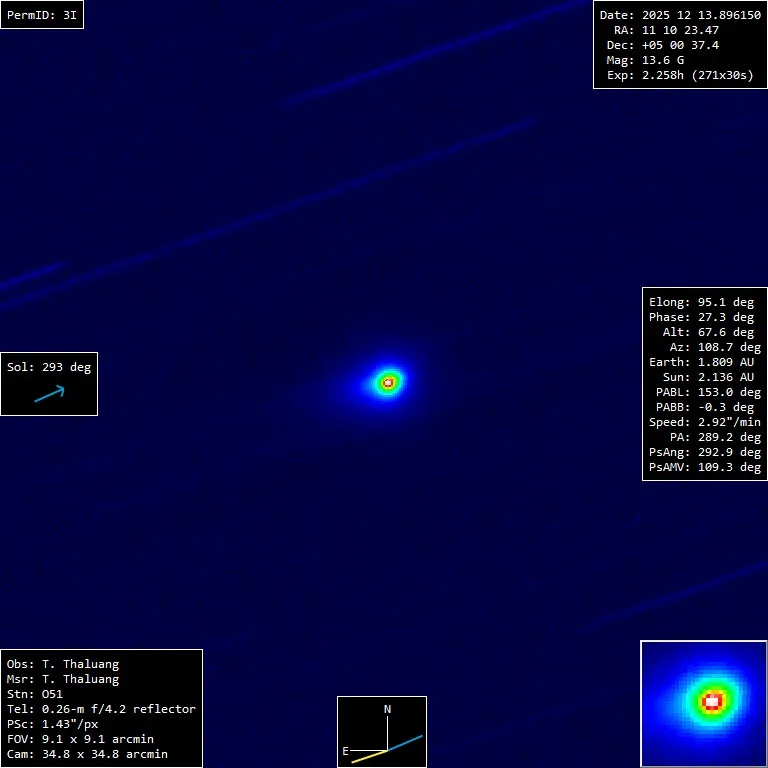
The latest image, captured on December 13, 2025, by astronomer Teerasak Thaluang using a 0.26-meter telescope in Rayong, Thailand, adds to a growing body of evidence that 3I ATLAS does not behave like an ordinary comet. The photograph is not a single snapshot, but a stacked image made from 271 individual exposures, totaling more than two hours of observation time. False color is used to represent brightness intensity, allowing scientists to see how light is distributed around the object rather than how it would appear to the naked eye.
At the center of the image is a striking feature that has remained consistent across months of observations: a compact, point-like nucleus. Even after extended exposure, the light from 3I/ATLAS remains tightly confined. It does not spread outward into a broad, fuzzy cloud the way most comets do as they heat up near the Sun.
To understand why this matters, it helps to think in everyday terms. A typical comet behaves like a block of ice tossed onto hot pavement. As it heats up, vapor and debris billow outward in all directions, creating a large, diffuse cloud. Over time, solar radiation pressure pushes that material away, forming the familiar tail that always points in the opposite direction of the Sun.
3I/ATLAS does not follow that script.
Instead of a wide, expanding coma, its brightness drops off sharply from the center, indicating that little dust is being released. The object appears more like a tightly focused beam of light than a glowing cloud. If most comets resemble a lantern casting light in all directions, 3I ATLAS looks closer to a laser pointer, remaining sharp and concentrated even across vast distances.
But the compact nucleus is only part of the puzzle.
Extending from 3I ATLAS is a persistent sunward feature often described as an “anti-tail.” The term itself is misleading. In ordinary comets, anti-tails are rare and temporary optical effects that occur when Earth passes through a comet’s orbital plane. Dust released earlier can briefly appear to point toward the Sun, but the illusion disappears as geometry changes.
That is not what is happening here.
The sunward feature of 3I/ATLAS has been observed repeatedly and consistently. It was present in the first Hubble Space Telescope image taken on July 21, 2025, when the object was approaching the Sun from nearly three astronomical units away. It was visible again in a second Hubble image on November 30, 2025, after the object had passed perihelion and was moving away. Thousands of ground-based images taken in between confirm that the feature does not vanish, rotate away, or behave like a trick of perspective.
In simple terms, this is not a glow caused by sunlight shining through a cloud. It is a real, directional emission feature.
That alone places 3I/ATLAS outside normal expectations. Solar radiation pressure and the solar wind act like a constant blast of outward force, pushing gas and fine dust away from the Sun. This is one of the most reliable principles in cometary physics. It is why comet tails always point away from the Sun and why sunward-facing jets are not expected to persist.
Yet 3I/ATLAS continues to show emission in exactly that forbidden direction.
Harvard astrophysicist Avi Loeb has addressed this anomaly directly in a series of peer-reviewed papers. One explanation proposes that extremely small ice fragments are being shed from the sun-facing side of the object. These particles could scatter sunlight efficiently but evaporate so quickly that radiation pressure never has time to push them backward, creating the appearance of a sunward flow without forming a conventional tail. Another explanation ties the feature to 3I/ATLAS’s measured non-gravitational acceleration away from the Sun, which could cause material released by the object to lag behind it, forming a luminous wake that remains aligned sunward.
Both explanations remain under active investigation. Neither requires speculative conclusions. Both, however, demand that 3I/ATLAS operate under physical conditions rarely observed in known comets.
As of December 14, 2025, 3I/ATLAS is approximately 270 million kilometers from Earth, meaning every image we receive shows the object as it appeared roughly 15 minutes earlier, the time it takes light to travel that distance. On December 19, it will reach its closest approach to Earth, passing at just under 270 million kilometers. Scientists are watching closely to see whether higher-resolution observations can distinguish between competing explanations for its behavior.
Notably, these anomalies were not addressed during NASA’s November 19 press conference on 3I ATLAS. That omission does not signal denial. Public briefings tend to focus on what is settled, not what remains unresolved. But unresolved does not mean insignificant.
In science, as in law, anomalies are not conclusions. They are evidence. And when the evidence repeatedly refuses to fit established models, the responsible response is not dismissal, but deeper scrutiny.
3I/ATLAS is not proving anything extraordinary. It is doing something more important. It is forcing scientists to ask why an object from another star system appears to be pointing material toward the Sun, when everything we know says it should not.



