

New Hubble Images Captured January 7th, 2026 Confirm That 3I/ATLAS Is Emitting A Powerful Jet Toward The Sun – A Phenomenon That Defies Everything We Know About Comets
America ı By Samuel Lopez
0 Comments
KEY OBSERVATIONS
- A comet’s tail is supposed to flee the Sun, driven outward by radiation and solar wind. That rule has held firm for generations of astronomers.
- But new images from the Hubble Space Telescope show 3I/ATLAS doing the opposite—launching a tightly focused jet directly toward the Sun, cutting against every known physical expectation.
- As more data arrives and anomalies accumulate, scientists are being forced to confront an uncomfortable possibility: this object does not behave like anything we confidently understand.
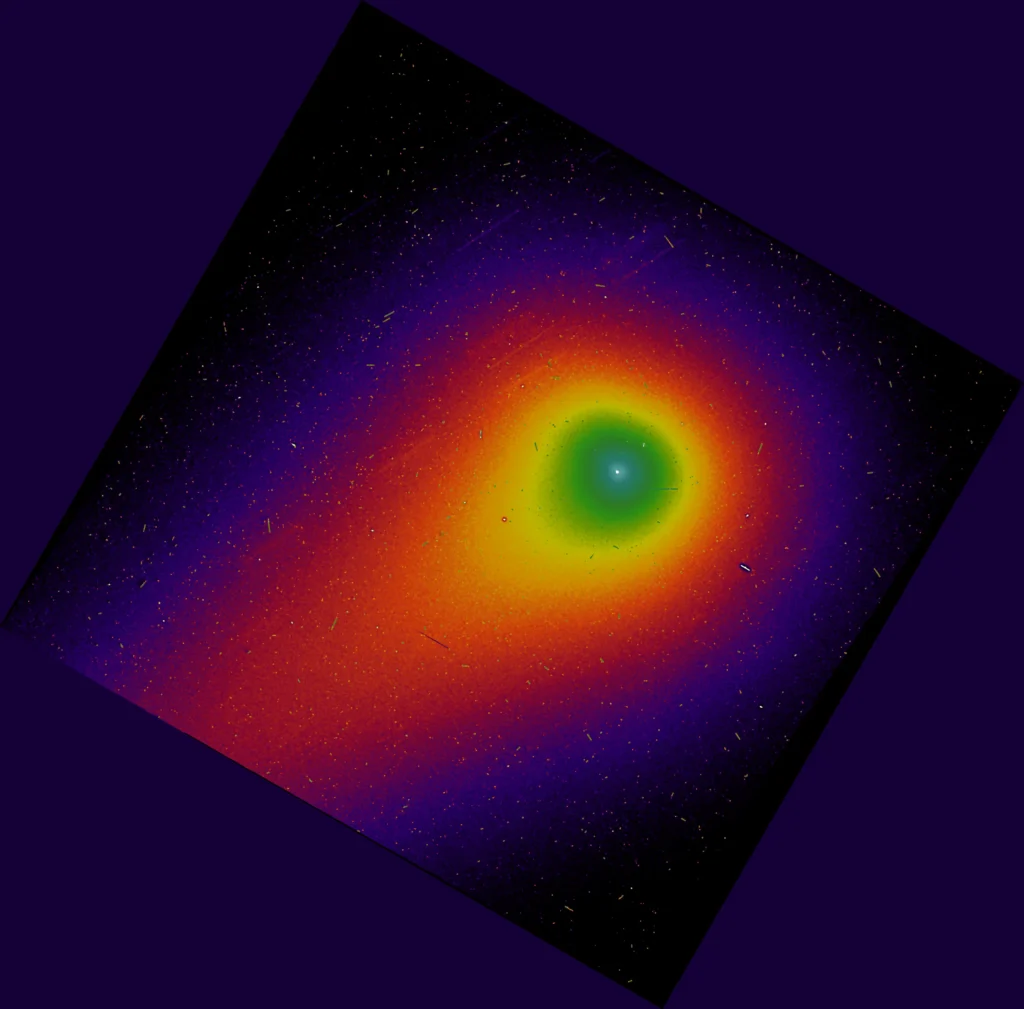
[USA HERALD] - On January 7, 2026, the Hubble Space Telescope captured its clearest view yet of interstellar object 3I/ATLAS, revealing a phenomenon that has now moved beyond curiosity and into the category of sustained scientific anomaly. The images, later processed using a Larson–Sekanina rotational gradient filter, expose a striking triple-jet structure emerging from the object’s nucleus—most notably a dominant, tightly collimated jet pointing directly toward the Sun.
According to data released by NASA, ESA, and the Space Telescope Science Institute, and processed by independent researcher Toni Scarmato, the sunward jet—commonly referred to as an “anti-tail”—extends to a scale comparable to the Earth–Moon distance. This alone places it far outside the realm of typical cometary behavior.
In conventional comet physics, tails form because solar radiation pressure and the solar wind push gas and dust away from the nucleus as volatile materials sublimate. The result is a tail that always points away from the Sun. Anti-tails do exist as optical illusions caused by viewing geometry, but those are projection effects—not physical structures. In the case of 3I/ATLAS, multiple observing angles over several months have ruled out such an explanation.
When Hubble first imaged 3I/ATLAS on July 21, 2025, astronomers noticed that the object’s coma—the glowing cloud surrounding its nucleus—was asymmetrically elongated toward the Sun. At the time, the observing angle was only about 10 degrees off the sunward direction, meaning the true structure was significantly longer than it appeared in projection. Simple trigonometry suggested the jet was nearly six times more elongated than observed, making it more than an order of magnitude longer than it was wide.
That early observation has now been reinforced by repeated detections. Images taken post-perihelion from different vantage points consistently show the same sunward jet, along with two additional jets spaced evenly in angle from the primary feature. None of these secondary jets align with the expected antisolar direction.
What makes this particularly difficult to reconcile is the jet’s persistence and collimation. The sunward direction is the harshest possible orientation for sustained outflow. Any gas or dust emitted in that direction must fight both solar radiation pressure and the solar wind—forces strong enough to disperse most cometary material almost immediately. Yet the anti-tail of 3I/ATLAS remains narrow, coherent, and dominant.
Published analyses have also documented a measurable wobble in the jet, indicating that it is tied to the object’s rotation. As 3I/ATLAS approached the Sun, the jet oscillated around a rotation axis that appears to be aligned with the Sun to within approximately seven degrees. This alignment alone is statistically unlikely. When combined with the object’s trajectory—closely aligned with the ecliptic plane—the probability of both occurring by chance drops below one in ten thousand.
NASA officials, during a November 19, 2025 press conference, characterized 3I/ATLAS as behaving like a “regular comet.” However, those statements did not address the geometric alignments or the physical implications of a sustained sunward jet. According to publicly available statements, the focus remained on compositional similarities rather than dynamical anomalies.
From a scientific standpoint, ignoring anomalies does not resolve them. It merely postpones the reckoning. Data released by NASA and ESA show that the anti-tail is not only real, but one of the most defining characteristics of 3I/ATLAS. Its presence forces researchers to consider mechanisms beyond standard sublimation-driven outgassing.
Alternative explanations have been proposed, including unusual volatile composition, asymmetric internal structure, or highly localized active regions. Yet none fully account for the jet’s strength, direction, and resistance to solar forces. At present, no published model explains all observed features simultaneously.
This is where the broader issue emerges. Scientific progress depends not on defending existing frameworks, but on interrogating their limits. Throughout history, the most consequential discoveries began as inconvenient data points—observations that did not fit comfortably within accepted theory.
Interstellar objects like 3I/ATLAS are, by definition, outsiders. They are shaped by environments beyond our solar system and arrive carrying physical histories we have never directly studied. Treating them as ordinary simply because that is more comfortable undermines the purpose of observation itself.
The anti-tail jet of 3I/ATLAS is not a footnote. It is a central feature, observed repeatedly, measured quantitatively, and documented by one of humanity’s most precise scientific instruments. Whether its explanation ultimately proves mundane or revolutionary remains unknown. What is certain is that dismissing it would be a failure of curiosity.
Science advances when we admit what we do not yet understand. The Universe has no obligation to conform to our expectations. Objects like 3I/ATLAS remind us that discovery begins where certainty ends.
3I/ATLAS will not linger in our cosmic neighborhood forever, but the questions it raises will. Whether its sunward jet ultimately rewrites comet science or exposes a rare edge case, its behavior demands attention rather than dismissal. The true loss would not be discovering something unexpected, but failing to look closely enough to notice it.
***
USA Herald continues to provide independent, in-depth reporting and analysis you won’t find anywhere else. Readers who want access to exclusive insights, developing investigations, and original reporting are encouraged to join our exclusive USA Herald newsletter. Signing up takes just a moment and helps support ethical, transparent journalism.

Discussion
No comments yet. Be the first to join the discussion!
FOLLOW US

Recent Posts





Don’t Miss It

Texas Trans Texts Spark Election Propaganda…
News Analysis | Texas voters began casting early ballots Monday,…
By – Michallie Harrison
Auto-Owners Insurers Verdict: Jury Awards Warehouse…
A North Carolina federal jury has awarded nearly $2 million…
By – Tyler Brooks
NJ $10M Car Insurance Fine: Geico…
New Jersey insurance regulators have accused Geico of overcharging motorists…
By – Tyler Brooks
Ara Partners $2.5B Energy Fund Reaches…
Ara Partners has secured $2.5 billion in capital commitments for…
By – Tyler Brooks
DXC Sell Insurance Software Division in…
DXC Technology is in advanced discussions to sell its insurance…
By – Tyler Brooks
Burger King Hello Kitty Meal Arrives…
Few pairings feel as inevitable as a kids’ meal and…
By – Rachel Moore
Kyle Kennedy Death at 42 Mourned…
Some people inherit a famous name. Fewer spend it on…
By – Rachel Moore
Christina Applegate Misdiagnosed: Five Years Treating…
Most people would celebrate hearing they don’t have a chronic…
By – Rachel Moore
Prudential’s $4B Brazil Mexico Sale Hands…
Big companies sometimes grow by letting go, the way a…
By – Rachel Moore
CBRE £760M Onnec Buy Targets Booming…
Real estate services giant CBRE Group Inc. has agreed to…
By – Rachel Moore
California Ballots: DOJ Cites Charges Against…
WASHINGTON — The Justice Department is citing charges against 28…
By – Michallie Harrison
Richard Riehle Dies at 78, Leaving…
Richard Riehle, the character actor whose memorable roles included “Office…
By – Michallie Harrison
Extreme Heat Is Spreading and Lasting…
An extreme heat event lasting 367 days touched nearly 85%…
By – Michallie Harrison
Information Ecosystem: Five Tools to Detect…
The information ecosystem is increasingly vulnerable to misinformation. There are…
By – Jackie Allen
Kohen Wiley Is Dead. Mississippi Owes…
Kohen Wiley was 1 year old when police gunfire killed…
By – Michallie Harrison
AP Fact Check Examines Online Claims…
AP Fact Check reviews disputed claims, examines evidence and helps…
By – Jackie Allen
Skywatchers: Meteor Season Brings Orionid and Taurid…
The Autumn Meteor Season is underway,. Skywatchers will have two…
By – Jackie Allen
Patriot Missiles Delayed Despite Payment, Zelenskyy…
WASHINGTON — The United States is delaying deliveries of Patriot…
By – Michallie Harrison
Chubb And GKN Race To Opposite…
What’s Driving the Insurance Battle ACE American, a Chubb unit,…
By – Samuel Lopez
Recently Obtained FOIA Records Reveal AARO…
What the Pentagon Records Now Show AARO arranged a private…
By – Samuel Lopez
Trump Fires Katie Zacharia After Five…
What You Need to Know Zacharia was dismissed after only…
By – Samuel Lopez
Katie Zacharia Says She Is A…
WASHINGTON – President Donald Trump’s new White House press secretary,…
By – Samuel Lopez
California’s New Mojave Steel Mill Brings…
What Matters in Mojave 1. Pacific Steel Group’s Mojave Micro Mill…
By – Samuel Lopez
Ilhan Omar MIA as Husband Flips…
What Readers Need to Know Federal agents seized Rep. Ilhan…
By – Samuel Lopez
Trump’s Russia Policy: Cornyn Shares Investigation…
WASHINGTON — Republican Sen. John Cornyn has amplified a call…
By – Michallie Harrison
Human Genome Project Legacy Advances Research…
The Human Genome Project transformed scientists’ understanding of human DNA.…
By – Jackie Allen
An Airman Died After a Pregame…
By Michallie K. Harrison | Opinion Tech. Sgt. Ian Patterson’s…
By – Michallie Harrison
Hunter’s Moon Illuminates October Skies
The Hunter’s Moon will light up the autumn sky in…
By – Jackie Allen
Alleged Chinese Agent Has Ties to…
A Federal investigation into California realtor Wanying “Heather” Zhang reveals…
By – Jackie Allen
Protests in Paris: Macron to Address…
PARIS, France — October 18, 2026 — Protests in Paris…
By – Jackie Allen
HealthSplash VP 18 Months Sentencing Rewards…
Cooperation can shave years off a prison term, but it…
By – Tyler Brooks
Daylight Saving Time Returns Nov. 1…
Americans will turn their clocks back one hour on Nov.…
By – Jackie Allen
California Identifies New York Life, Aetna,…
Key Takeaways California’s Department of Insurance maintains an official…
By – Samuel Lopez
Three Children, Teacher Killed in Oregon…
BEND, Ore. — An Oregon school shooting killed three children…
By – Michallie Harrison
Trump Scraps Hegseth’s Execution Livestream After…
WASHINGTON — President Donald Trump canceled the planned execution livestream…
By – Michallie Harrison
Pope Leo XIV’s Surgery Exposes Gap…
By Samuel López | USA Herald VATICAN CITY — As…
By – Samuel Lopez
NFL Player $300M Hip Surgery Lawsuit…
Athletes bet their bodies on surgeons the way pilots bet…
By – Tyler Brooks
Russian Drone Strikes Hit American Businesses…
Russian drone strikes against American-linked businesses in Ukraine are raising…
By – Jackie Allen
AP Poll Top 25: Georgia Claims…
Georgia has reclaimed the top spot in the AP Poll…
By – Rachel Moore
A.J. Armstrong: Former NFL Player’s Son…
HOUSTON — Antonio “A.J.” Armstrong Jr., the son of former…
By – Jackie Allen
NFL Pro Tyreek Hill Takes the…
What the Jury Is Hearing Lakeeta “Keeta” Vaccaro Hill testified…
By – Samuel Lopez
Terrell Owens Sued By Nolan Wells’…
What Readers Need to Know Three young men who were…
By – Samuel LopezNo posts found.
No posts found.


Join the Discussion
Share your thoughts, ask questions, and engage with
other readers. Sign in or create a free account to
comment.