


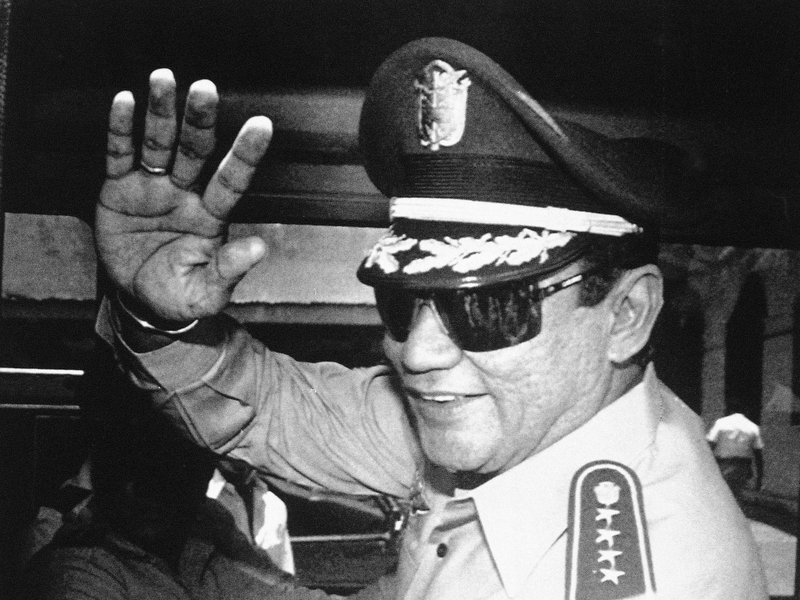
After his downfall, Noriega served a 17-year drug sentence in the United States, then was sent to face charges in France. He spent all but the last few months of his final years in a Panamanian prison for murder of political opponents during his 1983-89 regime.
He accused Washington of a conspiracy to keep him behind bars and tied his legal troubles to his refusal to cooperate with a U.S. plan aimed at toppling Nicaragua’s leftist Sandinista government in the 1980s.
In recent years Noriega suffered various ailments including high blood pressure and bronchitis.
In 2016, doctors detected the rapid growth of a benign brain tumor that had first been spotted four years earlier, and in January a court granted him house arrest to prepare for surgery on the tumor.
He is survived by his wife Felicidad and daughters Lorena, Thays and Sandra.
Following Noriega’s ouster Panama underwent huge changes, taking over the Panama Canal from U.S. control in 1999, vastly expanding the waterway and enjoying a boom in tourism and real estate.
Today the Central American nation has little in common with the bombed-out neighborhoods where Noriega hid during the 1989 invasion, before being famously smoked out of his refuge at the Vatican Embassy by incessant, loud rock music blared by U.S. troops.
Known mockingly as “Pineapple Face” for his pockmarked complexion, Manuel Antonio Noriega was born poor in Panama City on Feb. 11, 1934, and was raised by foster parents.
He joined Panama’s Defense Forces in 1962 and steadily rose through the ranks, mainly through loyalty to his mentor, Gen. Omar Torrijos, who became Panama’s de facto leader after a 1968 coup.
As Torrijos’ intelligence chief, Noriega monitored political opponents and developed close ties with U.S. intelligence agencies guarding against possible threats to the canal. Two years after Torrijos died in a mysterious plane crash in 1981, Noriega became the head of the armed forces and Panama’s de facto ruler.
Noriega was considered a valued CIA asset and was paid millions of dollars for assistance to the U.S. throughout Latin America, including acting as a liaison to Cuban leader Fidel Castro.



















 No comments yet. Be the first to comment!