

Charlie Kirk’s Former Security Chief Sues Candace Owens For Defamation Over Assassination Conspiracy Claims
America ı By Samuel Lopez
0 Comments
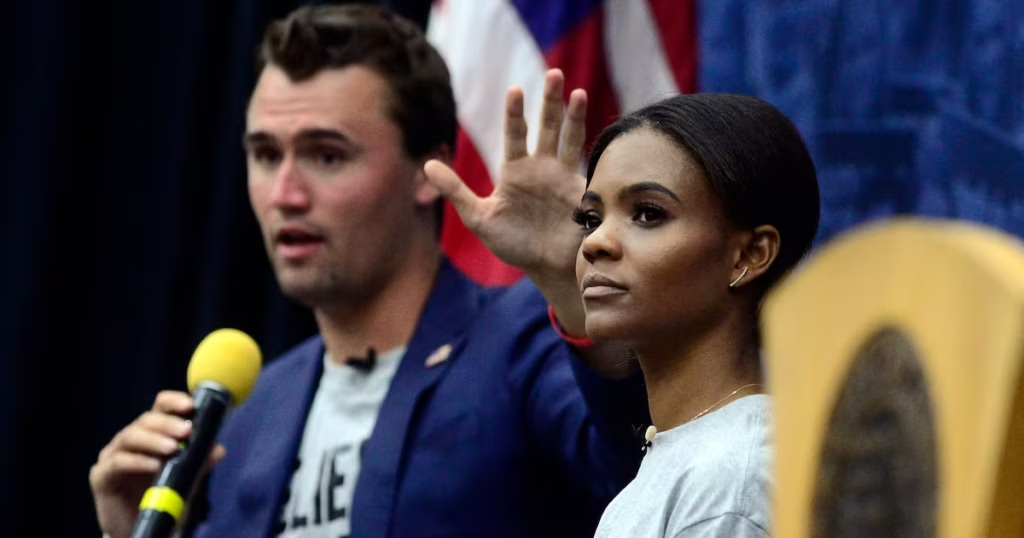
Brian Harpole, who led the security detail on the day of Kirk's killing, says Owens destroyed his reputation and livelihood by falsely accusing him of conspiring with Army intelligence to plan the murder. Legal experts say the complaint carries genuine firepower — but faces a demanding legal standard.
By Samuel López | USA Herald · M.D. TENN - It was the single-bullet killing heard around the country. On the morning of September 10, 2025, Charlie Kirk — the 31-year-old founder of Turning Point USA, a firebrand conservative activist and close ally of President Donald Trump — stood before roughly three thousand students in an open-air amphitheater at Utah Valley University in Orem, Utah, fielding a question that touched on mass shootings, gun violence, and transgender people. Seconds later, a sniper's round, allegedly fired from a rooftop approximately 142 yards away struck Kirk in the neck. He was rushed to a local hospital and pronounced dead. The nation recoiled.
Within twenty-four hours, the investigation pointed to Tyler James Robinson, a 22-year-old from Washington, Utah, who surrendered to local authorities the following evening after his own parents recognized him from surveillance images released by police. Prosecutors charged Robinson with aggravated murder on September 16, announced their intent to seek the death penalty, and presented what they described as a voluminous evidence file — including DNA on the bolt-action rifle used in the killing, a written note Robinson allegedly hid under his keyboard confessing to the plan, and text messages to his romantic partner confirming the act. A preliminary hearing is scheduled to begin May 18, 2026. By every official account, the case against Robinson has been straightforward.
What has not been straightforward is what came after. In the weeks and months following the assassination, Candace Owens — a former communications director at Turning Point USA from 2017 to 2019, a longtime friend of Kirk, and now one of conservative media's most combustible personalities — began broadcasting a series of theories on her podcast and X account suggesting that the official narrative was a fabrication. Kirk, she implied, had been set up. Those closest to him, she insinuated, may have known. And in December 2025, she began naming a specific man: Brian Harpole, Kirk's security chief, the founder of a Texas-based private security firm called Integrity Solutions, and the person responsible for protecting Kirk on the very day he was shot.
"Without even a modicum of substantiated evidence, she has publicly accused Harpole of foreknowledge, participation in, and cover-up of the assassination of Charlie Kirk."
— COMPLAINT, HARPOLE V. OWENS, CASE NO. 3:26-CV-00556 (M.D. TENN., FILED APRIL 30, 2026)
On April 30, 2026, Harpole struck back in federal court. His attorneys at the Dhillon Law Group, led by Matt Sarelson, filed a 69-page civil complaint in the Middle District of Tennessee — where Owens resides — accusing her, her media companies Candace Owens LLC and GeorgeTom Inc., and a podcast guest named Mitchell Snow, of defamation, false light invasion of privacy, and civil conspiracy to defame.
The lawsuit seeks damages in excess of $75,000 and asks for a jury trial, with the complaint making clear that the actual figure sought is likely in the millions. The full complaint is available on Scribd and has been catalogued through the CourtListener RECAP archive.
The story that Owens adopted and amplified originated with Mitchell Snow, who claimed to have "inadvertently" wandered into a classified gathering at Fort Huachuca, an Army installation in Arizona, on September 9, 2025 — the day before the assassination. According to Snow's account, he witnessed a secret meeting at which Harpole sat alongside twelve Army lieutenant colonels and Erika Kirk, Charlie's now-widow, finalizing the plot to kill the conservative activist. Owens, the complaint alleges, seized on this account and drove it into her audience across multiple podcast episodes and X posts spanning from October 2025 through the filing of the lawsuit — even after she reportedly had access to travel records showing Harpole was in Dallas, Texas, on the very day Snow claimed he was in Arizona.
WHAT THE COMPLAINT ALLEGES — KEY STATEMENTS
On December 12, 2025, Owens posted on X: "Brian Harpole has already been caught lying about what transpired on that day. Did he also lie about having placed a 911 call? Did no one from their team call 911 after Charlie was shot?"
The complaint notes that Owens knew, at the time of that post, that Harpole had in fact run to Kirk with a medical bag and rendered aid.
On December 19, Owens said on her podcast that she found Snow's narrative "compelling" because she had "been given travel logs for Brian Harpole and it is entirely possible that Brian Harpole could have made it to that meeting." She stated, on air: "I can tell you that definitively."
The complaint calls this assertion "blatantly false."
On December 22, Owens posted on X claiming she had reviewed Harpole's flight records and they "did not provide an alibi." On December 23, she posted "Fort Huachuca Confirmed" alongside what the complaint describes as an unsubstantiated incident report. On December 28, she wrote that the story had been "legitimized" by Harpole's estranged son.
On January 8, 2026, she stated that Harpole had been "planning things you're not supposed to be planning"— language the complaint characterizes as a direct accusation that Harpole had foreknowledge of Kirk's death and conspired to enable it.
The complaint is painstaking in documenting what it calls Owens's pattern of deliberate disregard for the truth. It notes that she had access to documents and records that contradicted her claims, that she nonetheless chose to publish those claims, and that she used Harpole's silence — after he declined to respond to her outreach requesting an "off the record discussion" — as further fodder to suggest guilt rather than to prompt caution.
The complaint also notes that Owens's viewers and social media followers explicitly understood her posts as accusing Harpole of participating in a government-orchestrated assassination, with responses that treated it as established fact.
Owens addressed the lawsuit with characteristic defiance the same day it was filed. On her podcast, and in a post on X, she celebrated the litigation, saying it hands her "the power of subpoena" — suggesting she intends to use the discovery process to pursue her theories through official legal channels.
She argued that Harpole never sent her a retraction demand before filing suit, and bristled at what she called a departure from how defamation claims normally proceed. "You never communicated with me. You never spoke," she said. On X, she posted tartly: "It's certainly an interesting claim that Brian Harpole is losing clients/contracts because of me — and not like, you know, how his last job ended."
Kirk's widow, Erika, who has called out the conspiracy theories in the press, told reporters simply: "Stop. That's it. That's all I have to say. Stop."
— ✦ —
So how strong is this lawsuit? The honest legal answer is: stronger than most defamation complaints filed in political contexts, but not without significant obstacles that Owens's legal team will almost certainly exploit.
To understand why, a brief primer on defamation law is necessary. Under American law, a private individual suing for defamation must prove that the defendant made a false statement of fact — not opinion — that was published to a third party, that it caused harm to the plaintiff's reputation, and that the defendant acted with at least negligence in doing so.
The analysis grows considerably more complicated when the plaintiff is, or has been treated as, a public figure. Under the landmark 1964 Supreme Court ruling in New York Times Co. v. Sullivan, a public figure must prove not just negligence but "actual malice" — meaning the defendant either knew the statement was false at the time it was made, or acted with reckless disregard for its truth or falsity. This is a notoriously demanding standard, and it is the battlefield on which this case will largely be fought.
LEGAL ANALYSIS: STRENGTHS OF THE COMPLAINT
The strongest element of Harpole's case is the allegation that Owens had access to travel records placing him in Dallas on September 9, 2025 — the very day Snow claims he was at Fort Huachuca — and broadcast her claims anyway, characterizing those records as insufficient to provide an alibi. If true, and if discovery bears this out, this is textbook evidence of actual malice. Courts have held that knowingly dismissing exculpatory evidence to sustain a preferred narrative constitutes reckless disregard for the truth.
This is not a case of a commentator speculating wildly on insufficient information; it is an allegation that the commentator had information directly undercutting her theory and chose to spin it rather than stop.
Second, the complaint is careful to argue that Owens's statements were not mere opinion or rhetorical hyperbole — the two most common defenses available to commentators. Calling someone a conspiratorial figure or questioning their competence in vague terms is generally protected under the First Amendment. Stating specifically that a named person attended a classified military meeting on a specific date at a specific installation to plan a murder is a factual claim, capable of being proven true or false, and thus actionable as defamation if false. The complaint hammers this distinction across multiple pages, quoting Owens's own words where she presents conclusions as factual findings, not conjecture.
Third, the harm alleged is concrete and commercial. Harpole runs a private security firm. His professional reputation is his product. The complaint alleges lost business opportunities, reputational damage, and significant emotional distress — each of which is a recognized category of compensable injury in defamation law.
LEGAL ANALYSIS: VULNERABILITIES IN THE COMPLAINT
The case's biggest challenge is whether the court decides that Harpole has become, even involuntarily, a limited-purpose public figure. Owens's legal team has already floated this argument publicly, noting that Harpole gave a lengthy interview on the nationally prominent Shawn Ryan Show in November 2025, addressing the conspiracy theories directly.
Courts have found that individuals who voluntarily insert themselves into a public controversy to address accusations against them can thereby assume limited public figure status for purposes related to that controversy — which would subject Harpole to the demanding actual malice standard rather than the more forgiving negligence standard. The complaint anticipates this argument and structures its factual claims to satisfy actual malice anyway, but the threshold question of Harpole's public or private status will almost certainly be litigated early and vigorously.
Second, Owens will argue — as she has already signaled — that her statements were framed as questions, investigative journalism, and commentary, not as declarations of established fact. The "Fort Huachuca Confirmed" post notwithstanding, much of her language was cast in interrogative or speculative form. Courts have split on whether such framing insulates a speaker from liability when the natural implication of the language is factual and damaging. Tennessee courts and the Sixth Circuit, where this case will be heard on appeal if it gets that far, will be the relevant jurisdictions.
Third, the absence of a pre-suit retraction demand, which Owens has complained about publicly, is not legally required under federal defamation law, but it does bear on damages in some states and can affect the overall equities a jury perceives. Tennessee has its own retraction statute that may come into play in calculating punitive versus compensatory damages.
Taking all of this together: this is not a nuisance filing, and it is not the kind of lawsuit that typically gets dismissed at the pleadings stage. The complaint is detailed, its legal theory is coherent, and the factual predicate — particularly the allegation about the travel records — gives it a sharp edge that many defamation cases lack. The Dhillon Law Group is not a law firm that files cases without doing its homework; its principal, Harmeet Dhillon, has litigated high-profile political cases for years, and Matt Sarelson's decision to frame the complaint around Owens's access to contradicting evidence before broadcasting her claims suggests a deliberate strategy aimed at the actual malice standard from the outset.
That said, Owens is an experienced media personality who is no stranger to litigation. She has faced — and survived — other defamation-adjacent claims, including a dispute connected to remarks about French First Lady Brigitte Macron. She has a large and loyal audience, considerable financial resources, and a demonstrated willingness to use legal proceedings as public theater rather than treat them as existential threats. Her "power of subpoena" framing is not just bluster; it is a strategic posture that tells her audience she intends to come out swinging in discovery, turning any deposition into content and any document request into a narrative. That approach may serve her interests in the court of public opinion even if it complicates her position in federal court.
"All of Owens's statements are either false on their face or create a false meaning reasonably conveyed by the published words. They are not protected opinions, rhetorical hyperbole, or questions without defamatory implication."
— HARPOLE V. OWENS COMPLAINT, P. 69
For Harpole, the stakes are personal as well as professional. He spent years building a private security firm. He was present on one of the worst days in recent American political history, doing the job he was paid to do. Whether anyone believes he did that job well enough is a fair matter of public debate; the record of what happened at Utah Valley University on September 10, 2025 — an outdoor event attended by thousands, with no bag checks, no metal detectors, and six campus police officers on site — will itself be extensively scrutinized in the Robinson criminal trial. But there is a legal and moral difference between criticizing a security professional's performance and accusing him of conspiring to commit murder. Harpole is asking a federal jury to recognize that difference and assign it a dollar value.
The case is still in its infancy, and the court has not yet addressed any preliminary motions. Watch for a motion to dismiss under Rule 12(b)(6) from Owens's legal team, likely arguing that her statements constituted protected opinion and that Harpole fails to plausibly allege actual malice. Watch also for an early motion regarding Harpole's status as a limited public figure. If the case survives those early skirmishes and proceeds to discovery, the travel records — and what Owens knew about them before she went on air — may prove to be the fulcrum on which everything else turns.
The full complaint in Harpole v. Owens, Case No. 3:26-cv-00556, filed in the United States District Court for the Middle District of Tennessee on April 30, 2026, is publicly available through the Scribd platform. It is, by any measure, a document worth reading — both as a legal filing and as a window into how the grief, fury, and conspiracy-generation that followed one of the most politically jarring assassinations in modern American history has now begun to collide with the courts.

Discussion
No comments yet. Be the first to join the discussion!
FOLLOW US

Recent Posts





Don’t Miss It

Spartanburg Woman $8K Insurance Fraud Case…
A South Carolina woman is behind bars after investigators accused…
By – Rachel Moore
TDI Launches Insurance Fraud Task Force…
The Texas Department of Insurance has launched a coordinated push…
By – Rachel Moore
Children’s Mercy Insurance Coverage Changes: Kansas…
Children’s Mercy Hospital in Kansas City will no longer participate…
By – Rachel Moore
BioWare Closing: EA Shuts Down Legendary…
Electronic Arts is reshaping its videogame empire in a sweeping…
By – Rachel Moore
Musk and Trump Have a Starlink…
Opinion | Starlink restrictions in Ukraine have exposed a problem Elon Musk…
By – Michallie K Harrison
Texas Trans Texts Spark Election Propaganda…
News Analysis | Texas voters began casting early ballots Monday,…
By – Michallie K Harrison
Auto-Owners Insurers Verdict: Jury Awards Warehouse…
A North Carolina federal jury has awarded nearly $2 million…
By – Tyler Brooks
NJ $10M Car Insurance Fine: Geico…
New Jersey insurance regulators have accused Geico of overcharging motorists…
By – Tyler Brooks
Ara Partners $2.5B Energy Fund Reaches…
Ara Partners has secured $2.5 billion in capital commitments for…
By – Tyler Brooks
DXC Sell Insurance Software Division in…
DXC Technology is in advanced discussions to sell its insurance…
By – Tyler Brooks
Burger King Hello Kitty Meal Arrives…
Few pairings feel as inevitable as a kids’ meal and…
By – Rachel Moore
Kyle Kennedy Death at 42 Mourned…
Some people inherit a famous name. Fewer spend it on…
By – Rachel Moore
California Ballots: DOJ Cites Charges Against…
WASHINGTON — The Justice Department is citing charges against 28…
By – Michallie K Harrison
Richard Riehle Dies at 78, Leaving…
Richard Riehle, the character actor whose memorable roles included “Office…
By – Michallie K Harrison
Extreme Heat Is Spreading and Lasting…
An extreme heat event lasting 367 days touched nearly 85%…
By – Michallie K Harrison
Information Ecosystem: Five Tools to Detect…
The information ecosystem is increasingly vulnerable to misinformation. There are…
By – Jackie Allen
Kohen Wiley Is Dead. Mississippi Owes…
Kohen Wiley was 1 year old when police gunfire killed…
By – Michallie K Harrison
AP Fact Check Examines Online Claims…
AP Fact Check reviews disputed claims, examines evidence and helps…
By – Jackie Allen
CBRE £760M Onnec Buy Targets Booming…
Real estate services giant CBRE Group Inc. has agreed to…
By – Rachel Moore
Chubb And GKN Race To Opposite…
What’s Driving the Insurance Battle ACE American, a Chubb unit,…
By – Samuel Lopez
Recently Obtained FOIA Records Reveal AARO…
What the Pentagon Records Now Show AARO arranged a private…
By – Samuel Lopez
Trump Fires Katie Zacharia After Five…
What You Need to Know Zacharia was dismissed after only…
By – Samuel Lopez
Katie Zacharia Says She Is A…
WASHINGTON – President Donald Trump’s new White House press secretary,…
By – Samuel Lopez
California’s New Mojave Steel Mill Brings…
What Matters in Mojave 1. Pacific Steel Group’s Mojave Micro Mill…
By – Samuel Lopez
Prudential’s $4B Brazil Mexico Sale Hands…
Big companies sometimes grow by letting go, the way a…
By – Rachel Moore
Skywatchers: Meteor Season Brings Orionid and Taurid…
The Autumn Meteor Season is underway,. Skywatchers will have two…
By – Jackie Allen
Patriot Missiles Delayed Despite Payment, Zelenskyy…
WASHINGTON — The United States is delaying deliveries of Patriot…
By – Michallie K Harrison
Trump’s Russia Policy: Cornyn Shares Investigation…
WASHINGTON — Republican Sen. John Cornyn has amplified a call…
By – Michallie K Harrison
Human Genome Project Legacy Advances Research…
The Human Genome Project transformed scientists’ understanding of human DNA.…
By – Jackie Allen
An Airman Died After a Pregame…
By Michallie K. Harrison | Opinion Tech. Sgt. Ian Patterson’s…
By – Michallie K Harrison
HealthSplash VP 18 Months Sentencing Rewards…
Cooperation can shave years off a prison term, but it…
By – Tyler Brooks
Daylight Saving Time Returns Nov. 1…
Americans will turn their clocks back one hour on Nov.…
By – Jackie Allen
California Identifies New York Life, Aetna,…
Key Takeaways California’s Department of Insurance maintains an official…
By – Samuel Lopez
Three Children, Teacher Killed in Oregon…
BEND, Ore. — An Oregon school shooting killed three children…
By – Michallie K Harrison
Trump Scraps Hegseth’s Execution Livestream After…
WASHINGTON — President Donald Trump canceled the planned execution livestream…
By – Michallie K Harrison
Pope Leo XIV’s Surgery Exposes Gap…
By Samuel López | USA Herald VATICAN CITY — As…
By – Samuel Lopez
NFL Player $300M Hip Surgery Lawsuit…
Athletes bet their bodies on surgeons the way pilots bet…
By – Tyler Brooks
Russian Drone Strikes Hit American Businesses…
Russian drone strikes against American-linked businesses in Ukraine are raising…
By – Jackie Allen
AP Poll Top 25: Georgia Claims…
Georgia has reclaimed the top spot in the AP Poll…
By – Rachel Moore
A.J. Armstrong: Former NFL Player’s Son…
HOUSTON — Antonio “A.J.” Armstrong Jr., the son of former…
By – Jackie Allen
NFL Pro Tyreek Hill Takes the…
What the Jury Is Hearing Lakeeta “Keeta” Vaccaro Hill testified…
By – Samuel Lopez
Terrell Owens Sued By Nolan Wells’…
What Readers Need to Know Three young men who were…
By – Samuel LopezNo posts found.
No posts found.


Join the Discussion
Share your thoughts, ask questions, and engage with
other readers. Sign in or create a free account to
comment.